 Netwrck
Historical Fantasy.
The Last Letter
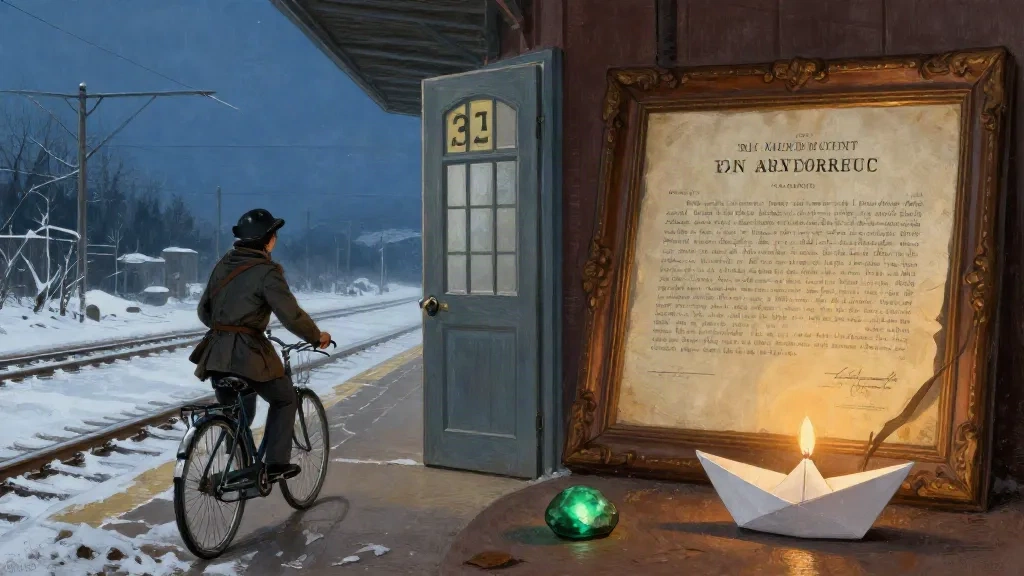
By the first frost, Mara Venn had delivered nine hundred and eleven letters without hearing a single reply from the future. Her bicycle carried them through the winter station in a black leather case, its brass gears polished by the shoulders of travelers. The station stood where four seasons met: spring blowing through the west arch, summer leaking from a locked dining car, autumn waiting beneath the platform boards.
Winter possessed the main hall. Frost silvered the timetable. A coal fire burned in a iron cage, and reflected candlelight trembled across the steel-blue windows. Mara checked the delivery ledger each evening. The past had names and return streets. The present had accusations. The future column remained empty.
That night, the station clock struck thirteen. One platform door appeared between the tracks, solid oak and numbered 1894. Mara wheeled her bicycle toward it. The front wheel crossed first.
The Door in the Snow
Beyond lay another winter, though the snow hung motionless in the air. The station lamps were unlit, but candle flames floated above a platform crowded with sealed coaches. A paper boat rested beside the nearest carriage, folded from a child’s letter.
Mara took it into her hand. The ink along its folds had not smudged. In her pocket, the green stone she always carried pressed cold against her thumb. It had belonged to her mother, who claimed it could tell when a place was listening.
“Courier Venn,” said a voice behind her.
An old woman stood beneath the departure board, wrapped in tobacco-brown wool. On the wall behind her hung a framed treaty, its seal blackened with age. Mara knew the document. Every station worker had studied it. The Agreement of Careful Ears, signed in 1741 after the border disputes, permitted the land to hear any promise spoken within its limits.
“The future stopped writing,” Mara said. “Why?”
“It did not stop.” The woman touched the green stone through Mara’s coat. “It was compelled to keep quiet.”
The Land’s Evidence
The treaty made silence punishable. A village could accuse a person of breaking faith, and the land itself would submit whatever sounds it had heard. Farmers had used it against neighbors. Governments had used it against kings. By the twentieth century, the Agreement had been amended to protect private correspondence, but the old clause remained hidden in the station foundations.
“Listen,” the woman said, “and the land records the speaker. That is how it keeps faith.”
Mara looked toward the dark coaches. “And the future?”
“The future withdrew its permission.”
Inside the first coach, rows of letters lay unopened beneath blue lamps. The paper smelled of rain and hot iron. A ledger beside them showed Mara’s handwriting repeating across the same page, each entry ending with the same sentence: I will ask them to listen again.
She remembered the year she had failed to deliver a message to a distant empire. The station had recorded her argument with the railway clerk. The clerk had repeated it to the border authority. The letter had never crossed the river. A generation later, the future had inherited the silence and preserved it.
Mara opened the paper boat. Inside lay a green splinter, bright as spring moss.
A Reply in Reverse
The woman admitted the truth. The land had listened to the treaty for so long that it could no longer distinguish consent from captivity. Every future reply had been treated as evidence against the present. So the future had stopped sending letters, waiting for the station to release its hold.
“I am only a courier,” Mara said.
“Then deliver the truth without permission.”
At dawn, Mara placed the paper boat in the station’s brass compass, set the green stone beside it, and spoke aloud the names of every place whose correspondence had been used as evidence. The old treaty shivered in its frame. Candlelight, steel blue and amber, passed over the paper as the doors opened onto every season at once.
Letters began arriving from the future. They fluttered through the hall like flocks of pale birds, carrying news of cities built on reclaimed winters and children born beneath artificial stars. Mara did not read them. She placed them before the waiting seasons, and one by one, each road remembered its destination.
At last, the paper boat sailed across the platform floor. The green stone glowed once, then became ordinary again.
Mara wheeled her bicycle through the numbered door. Behind her, the station clock struck twelve. In her delivery ledger, a new line appeared in fresh blue ink:
Recipient: all years. Message: received.
Some silences are not empty. They are places where the future has learned to wait.
Mara smiled, pushed open the winter doors, and rode toward the first road that had ever answered her.





