 Netwrck
Weird Fiction.
The Empty Carriage
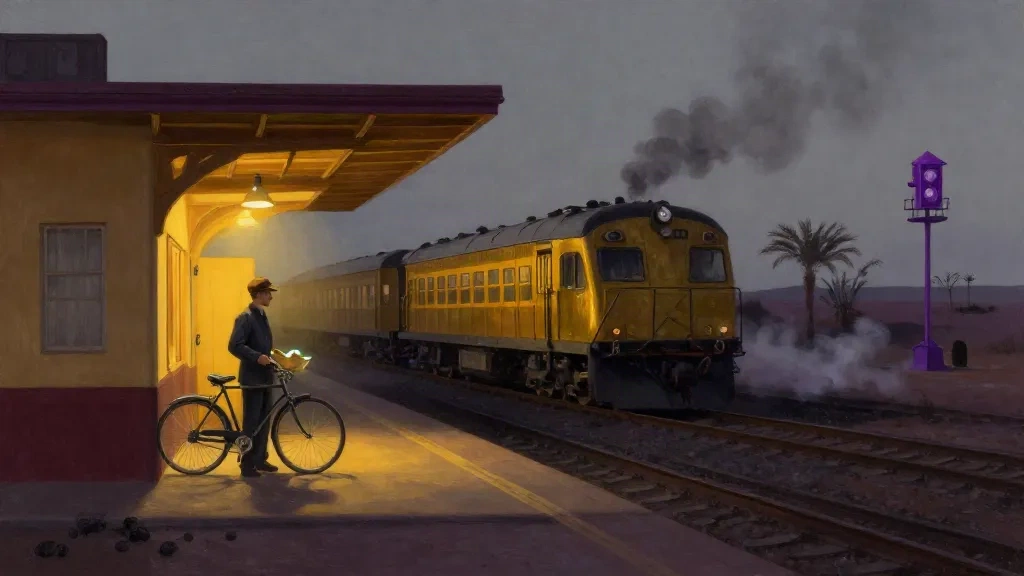
At four in the afternoon, when the saffron light lay flat across Platform Three, Mara Venn found a train arriving from a century that had not happened yet.
It had no whistle. Its windows were smoked mirrors, and its brass number read 2046, though the station board insisted it was local service. The conductor opened the door without looking at her.
“No mail,” he said.
Mara lifted her leather satchel. She was a courier, one of the last people still crossing the desert by bicycle. Her bicycle leaned against the ticket window, its front wheel half inside a locked storeroom. Closed doors were no obstacle to it. Neither were locked cupboards, sealed cupboards, or the doors of houses that had been empty since the first survey.
She had delivered letters between vanished hamlets, carried sealed votes through sandstorms, and once delivered a marriage certificate to a woman waiting inside a mountain. But never had she seen a future send nothing at all.
The conductor pointed down the empty aisle. “The station keeps the account,” he said. “Find out why the account closed.”
Then the train departed backward, its wheels flashing through the rails.
The Treaty of Listening
In the archive beneath Platform One, Mara found a treaty printed on vellum the colour of smoke-grey air. Its first clause granted the railway station the right to listen to every conversation held within its borders.
The second clause granted the desert the right to listen in return.
Her courier’s licence had been stamped with the same seal: a green stone split by a white vein. The stone was warm in her palm, though she had found it cold in the sand outside the station.
Mara’s father had left her that stone with one instruction: deliver it to the station if the trains began arriving empty.
She unfolded the paper boat she had carried since childhood. It had survived drought, flood, and a sandstorm that peeled the paint from the station sign. Inside its folds, someone had written a list of names. The final name was hers.
“Mara Venn, courier, born without a destination,” the vellum whispered.
She looked at the walls. Behind them, she could hear thousands of voices speaking in careful turns. Most were old. Some were young. One repeated the same sentence over and over:
We are still waiting for the letter that says we are allowed to leave.
The Road Through the Door
Mara climbed onto her bicycle and pedalled toward the archive wall. The front wheel struck the stone, passed through it, and entered a narrow passage filled with date palms.
Beyond the wall, the desert had been painted plum-dark by a storm that never ended. The railway ran through it without tracks, dividing the dunes in a straight line toward a low violet sun.
At the horizon stood a signal tower. A single light burned there, amber as a coal.
“That is where the future goes,” said a voice from the bicycle’s bell.
“I need the letters, not the route,” Mara said.
The bicycle rang once. “The letters are inside the tower.”
She pedalled harder. Doors appeared along the passage: a child’s bedroom door, a customs gate, a door made entirely of frozen water. Her bicycle passed through each one, and Mara followed, carrying the treaty and the paper boat.
At the tower, she found a desk beneath the signal lamp. A clerk sat there, filing clouds into pigeonholes. He looked up when she entered.
“You are late,” he said.
“The trains have stopped writing.”
“No,” he said. “The trains are writing to us. We simply stopped answering.”
The Name in the Sand
On the desk lay a letter addressed to the station. Its seal was the green stone. Mara broke it and found only one sentence:
Do not deliver us to the century that sends us.
The clerk confessed that the railway had been built by the first people to cross the desert, before the country had a name. They had asked the land to listen so their descendants could travel safely through time. The treaty answered both sides: every message received must be sent onward.
But the future had begun sending letters backward, each one describing a world where the desert remained undeveloped. Those letters could not be delivered, because acknowledging them would erase the station’s agreement—and with it every road, house, and closed door that protected the people living beside them.
So the station stopped passing them on. The trains kept arriving, carrying empty carriages, while the desert waited for permission to speak.
Mara placed the paper boat in the clerk’s inkwell. It floated. The green stone split open along its white vein.
“Then the land can listen,” she said, “and I can answer.”
She wrote a single letter on the back of the last receipt, addressed to no century, and placed it beneath the station lamp.
By morning, the platform was crowded. Doors stood open in the walls. Beyond them, bicycles pedalled through rooms that had been sealed for years, carrying letters, names, and the green stone toward people who had stopped being forgotten.
The next train arrived full of light.





