 Netwrck
Gothic Fantasy.
The Train from 1911
Dr. Sera Venn arrived at Kilometer Nine with a black medical bag, a brass music box, and one clean shirt. The railway station crouched beneath a white coral sky, its whitewashed walls flaking above an ink-black platform. A red thread ran from the station bell to the rail, from the rail to her boot, and from her boot to the second button of her coat.
She did not remember tying it. She had tied it around her wrist the night her daughter left, because people claimed that homesickness could be guided home like a splinter.
The timetable listed no destination.
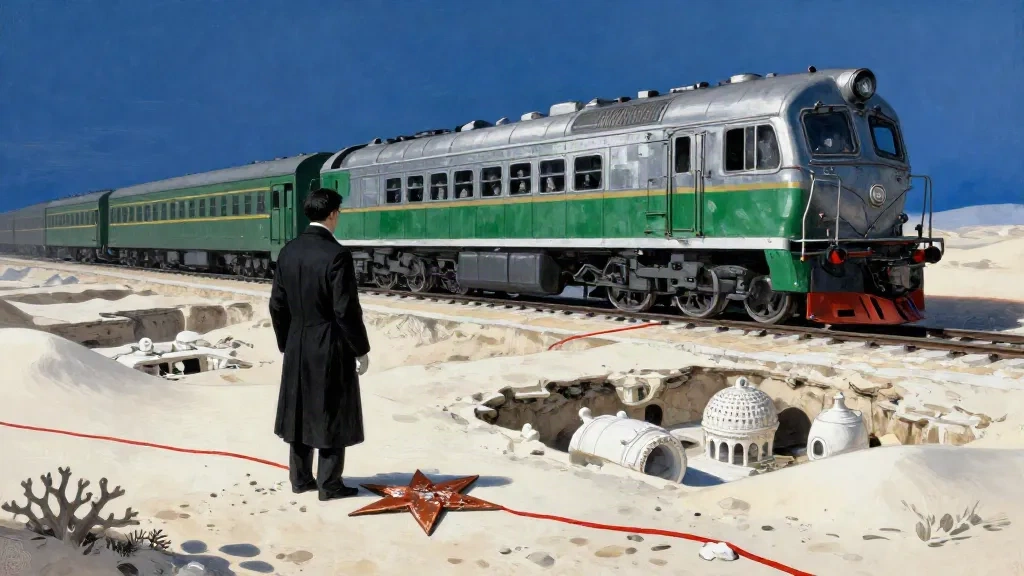
At 19:11, the train arrived before 19:10. Its locomotive had the shape of a mourning bird, polished silver along the boiler and green with age elsewhere. Faces appeared in every window. Some were asleep. Some pressed their palms to the glass.
One face was her daughter’s.
Sera ran down the platform. The train did not stop. The red thread tightened, then slipped beneath a crack between the boards.
When she looked up, the station clock had begun counting backward.
Homes Without Inhabitants
The passengers came with their symptoms. A merchant from a drowned province carried a jar of seawater and would not sleep unless it touched his skin. A railway clerk from 2031 held a ticket printed in a language that burned his tongue. Two children had forgotten how to enter rooms.
Sera treated them under the station awning. She wrapped the merchant’s jar in cloth, wrote the clerk’s impossible words on a prescription, and asked the children to describe their house from its smallest sound.
“The kettle,” one said.
“My mother’s chair,” said the other.
By dawn they could cross a threshold.
Then the copper star hanging above the ticket window began to turn.
It had been bolted there for decades, one point chipped. Now its points moved independently, scraping into the wall with every revolution. In its center appeared a window: a row of red-lit houses beneath a sea of white coral.
The clerk looked up and smiled. “That is where they are taking us.”
Sera recognized the houses. They were the missing districts of every city she had treated. A civic project, called the Homeward Settlement, had once been designed to house those who could not endure the century they lived in. Its plans were buried beneath the station before construction began.
“The train is a beautiful prison,” she said.
The music box in her bag began to play without being opened. Its tune was the one her daughter had hummed while packing. With each note, the station walls moved outward, revealing another platform, another century, another crowd waiting to depart.
The Flood’s White Door
Rain arrived as a single red drop on the station sign, then a wall of water.
The flood tore the timetable from its frame and lifted the false floor beneath the waiting room. Below it lay white ceramic pipes, copper stars threaded together like a constellation, and the civic project’s sealed archive. Water poured through the old chambers, filling them with reflected streets.
Sera waded into the archive. Pages lifted around her like white wings. Every entry recorded a person’s address in one century, then a room in another.
She found her daughter’s name.
Next to it was a destination: Kilometer Nine, 1911.
Sera climbed the pipe ladder and cut the train’s red signal thread. The locomotive screamed. Windows went dark. The beautiful houses vanished, leaving only the desert and the station leaning against the storm.
The passengers demanded passage. They had come from places erased by progress, floods, borders, and ordinary forgetting. Without the train, they would become symptoms again: grief with nowhere to sit, longing with no address.
Sera opened her bag and took out the music box.
She removed the spring.
The tune died halfway through its last measure. The copper star stopped turning. The buried pipes began to crack.
“A station is not a home,” she told them, “but it can remember one.”
The Address of a Place
They worked until dusk. The clerk taught the children the names of lost rooms. The merchant mapped the drowned province beneath the rails. Sera examined the buried project and discovered its final chamber: a circular room with no doors, designed as a waiting hall for people who could not decide whether to return.
She gave it a name. Mara’s House.
When she spoke it, the chamber opened.
Inside, a girl sat beside a small window. Red thread ran from her wrist to a copper star on the sill. She did not rise.
“I waited for you,” Mara said.
Sera sat opposite her. She did not pull the thread. She placed the silent music box between them.
Behind her, the station clock reached midnight. The train from 1911 waited at the empty platform, doors open, silver boiler bright beneath the white coral stars. A hundred passengers stood beneath its windows.
They had nowhere else to go.
Sera looked at her daughter and at the dead spring in her hand. The machine could carry everyone home, or it could keep them forever inside a beautiful room. The choice was not whether the train was a prison. It was who would have the courage to open its doors.
She took Mara’s hand.
“Come home,” she said.
The copper star went dark. The red thread reached the horizon. And, for the first time in a hundred years, the station did not send a single passenger away.





