 Netwrck
Historical Fantasy.
The Door in the Bicycle
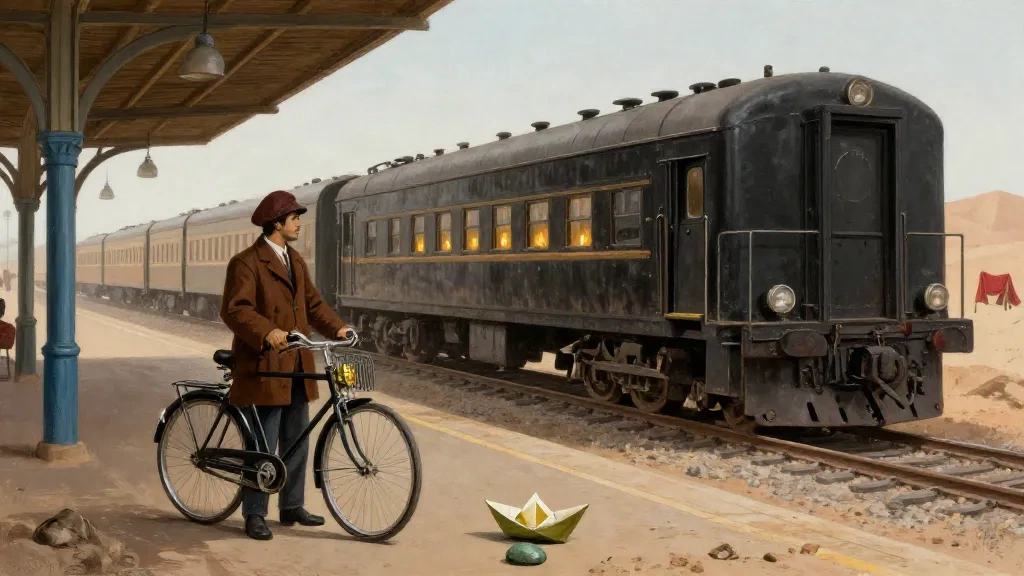
At four minutes past midnight, the train arrived without a sound. Its wheels clicked over the rails, yet the desert swallowed the noise as if it had never crossed sand. The station clock showed 1887, though the timetable beside it promised service from 1962. Nara Vey, a courier in a tobacco-brown coat, stood beneath the steel-blue lamps and waited for a letter that had not existed three days ago.
Her bicycle leaned against the ticket window. It was an ordinary black bicycle, except that its rear mudguard had a brass handle shaped like a closed door. Nara had used it to cross the Kharir desert for eleven years. In that time, it had opened barn locks, shed bolts, and once a sealed gate at a customs post nobody remembered building.
She was not here for the train. She was here for the silence.
For six weeks, no letters had come from the future. Not delayed letters, not letters returned to sender, but nothing at all. The railway office had received the last one three days before the line went quiet: a blue envelope with no stamp, addressed to the station itself. Nara still carried it inside her coat.
The Land's Permission
The stationmaster, an old man with a face like folded leather, met her beside the platform. “You have brought the bicycle,” he said.
“It is not mine to bring.”
He nodded as though that made sense. “Then the land has heard you.”
He led her to a low building behind the platform. Its walls were built from sun-baked brick, and a strip of red cloth hung across the doorway. The treaty had been placed there in 1791, when the kingdom feared the desert would take more than water. The land had agreed to listen, in exchange for a promise never to build a roof without a chimney.
The land had listened for more than a century. Every whisper carried into the brick and remained there. Nara understood, then, that the treaty was not a metaphor. The desert had legal permission to hear.
Inside the building, shelves held jars of dry air, sealed letters, and fragments of conversations from roads that no longer existed. The stationmaster took a green stone from a locked cabinet. It was smooth, dark as pond water, and warm in his palm.
“The last future passenger gave it to me,” he said. “They said you would understand what it meant.”
Nara turned the stone. In its surface, reflected candlelight revealed a tiny room where a child was writing by lamplight. The child looked up, though Nara knew no such child had been born in the year to come.
Across the Closed Century
The train waited in the dark. Its windows showed no reflection, only a pale corridor filled with people who had removed their shoes. Nara climbed aboard with the green stone, the blue envelope, and the bicycle. The stationmaster followed, though the train had no room for him.
“The treaty permits listening,” he said. “It does not permit taking.”
Then the doors closed.
Inside, the carriage stretched farther than the horizon. Every seat carried a different year. Nara moved through 1912, 1937, 1954, 1978, and 2001, searching for the missing letters. In each year, the same paper boat floated beneath the seats, its folds bright with reflected candlelight. The first boat was empty. The second carried a copy of the treaty. The third carried a green stone like the one in Nara's hand.
At the front of the train, she found the letter writer.
He was an old woman dressed in a railway clerk's black coat. Her desk was covered with unopened envelopes. “We stopped writing,” she said.
“Why?”
“Because the future heard us.”
Nara set the blue envelope on the desk. “Heard us?”
The woman looked toward the bicycle. “Every letter was answered. Every answer was answered. Soon there were more voices than people. The century became a room with no walls.”
Nara understood. The future had not abandoned her. It had hidden itself from the weight of its own replies.
The Last Crossing
She opened the blue envelope. Inside was no letter, only a paper boat folded from the treaty. Nara placed the green stone beside it. Both began to glow, steel blue through the folds, while the train shuddered around them.
“If I send one letter,” Nara said, “the listening stops.”
“If it stops, someone may never hear us.”
“Then the land keeps the treaty. It can listen without collecting.”
The woman nodded. Nara folded the paper boat around the green stone and set it on the floor. It drifted through the closed doors of the carriage, passing years without touching them. The green stone dimmed. The station clock struck one.
Nara woke beneath the steel-blue lamps, her bicycle beside her and the blue envelope empty. Beyond the platform, the desert was silent. Then a small boat emerged from the darkness, drifting toward the station. Inside it lay a single sheet of paper, folded neatly around a green stone.
It was not addressed to her.
It was addressed to the station.
Nara mounted the bicycle. The mudguard door clicked open, and she rode into the night, carrying the future's first silence back toward everyone who had mistaken it for absence.





