 Netwrck
Surrealism.
The Last Departure Board
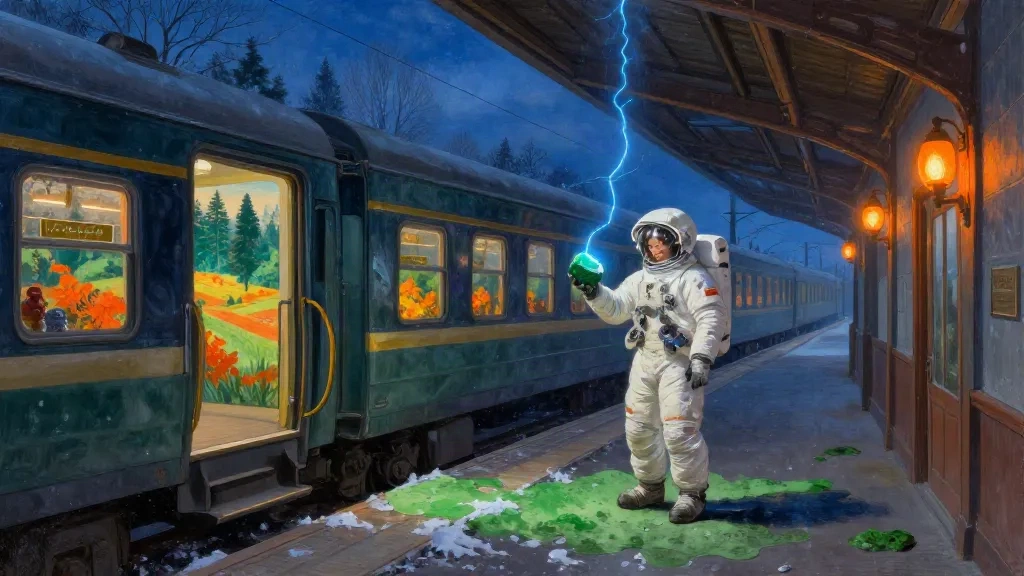
Mara arrived at Vinter Station wearing her old pressure suit beneath a wool coat. The suit had not been pressurised for eleven years, but she kept its sealed helmet under one arm, a green stone in the other hand. The stone had been warm when she found it in the drawer marked FLIGHT RECORDS, though the drawer had no power.
Across the platforms, the winter evening had been divided into seasons. A brass sign pointed toward SUMMER, where people boarded beneath artificial leaves. Another pointed to THAW, and another to LATE AUTUMN. The departure board blinked in three colours: burnt orange, lichen green, and the blue light of a storm that had not yet arrived.
Mara did not want to go home. Home was a rumour people repeated in kitchens and theatres, a blue marble mentioned by children who had never seen rain. She had left orbit because the engines failed, but in her memory she had never landed. Her voice was there, somewhere beneath the station, trapped in the static behind every announcement.
Attention, passengers. History is being cleared for departure.
The Voice Under the Static
She had discovered the voice in a damaged transmission, a fragment of herself recorded during the final orbit. It said no important thing. It said, “The green stone is not a stone,” and then broke into wind. History had used that sentence as background noise: beneath news, beneath the announcements, beneath the names of the dead.
At platform nine, a ticket clerk with a frost-white moustache studied the green stone in her palm. “That is not a stone,” he said.
“I know.”
“Then you have brought the wrong object.”
Mara placed the stone on the counter. It vibrated. Behind the wall, something answered with her own voice.
She took a blue thread from her coat pocket. It had been wound around the stone since the night she left orbit. At the time, she had wanted a mark to remember her direction by. Now the thread pulled taut toward the ceiling.
On the train, passengers exchanged tickets for memories. A woman surrendered her childhood and received a small, well-kept summer. A boy traded his shadow for a ticket to Spring. Mara kept her seat beside a blank window. In the glass, the station changed before the train did. Doors appeared in the walls, opened inward, and revealed rooms full of snow.
A Storm in the Walls
The storm arrived without weather. Blue light entered the carriages and moved the doors between them. A man stepped halfway through a doorway to Autumn, then vanished when the door became a door to Summer. The train bucked. Mara saw the conductor thrown into a wall that was suddenly a mirror.
She followed the thread. It led beneath the seats, through a panel marked STAFF MEMORIES, and into a corridor that existed only when the carriage tilted. On both sides, doors were rearranging themselves. Behind one, she heard her mother laughing. Behind another, a crowd counted backwards from zero.
Then she heard herself.
“The green stone is not a stone,” said the voice behind the blue-lit door.
Mara seized the handle. The storm rewrote the number above it, changing 9 to 0, then to no number at all. The door opened onto the station’s abandoned control room, where every microphone was connected to every platform. The blue thread snapped and curled around the green stone.
For a moment, Mara could only listen. The voice was not speaking to her. It was speaking through her, from a future where she had become a warning: Do not trust the direction of the doors.
Orbit Without Landing
She stepped through. The control room filled with the smell of wet earth. Above her, the ceiling became a map of stars, though the stars were arranged like windows. Outside, a winter train waited in orbit, its carriages full of people leaving the seasons behind.
Mara placed the green stone on the console and held out the blue thread. The system took both. Light entered the microphones. Her voice returned—not as background, not as echo, but as the first sound in the room.
She said, “I was here.”
Then she said, “I am here.”
The doors stopped moving. In every carriage, passengers turned toward the windows. The station doors opened onto their proper seasons, and the blue storm-light broke into ordinary morning.
Mara remained on the train. The conductor offered her a destination.
“Earth?” she asked.
He shook his head. “That line was discontinued.”
So she took the blue thread and followed it upward. Behind her, the station announced her departure. The green stone glowed in the dark, no larger than a remembered world.





