 Netwrck
Fairy-Tale Fiction.
The Last Departure
Dr. Ilyra Vale had learned that homesickness was not always a memory of home. Sometimes it was a room with no occupant, a chair polished by an absent body, a child asking when the sky would stop being winter.
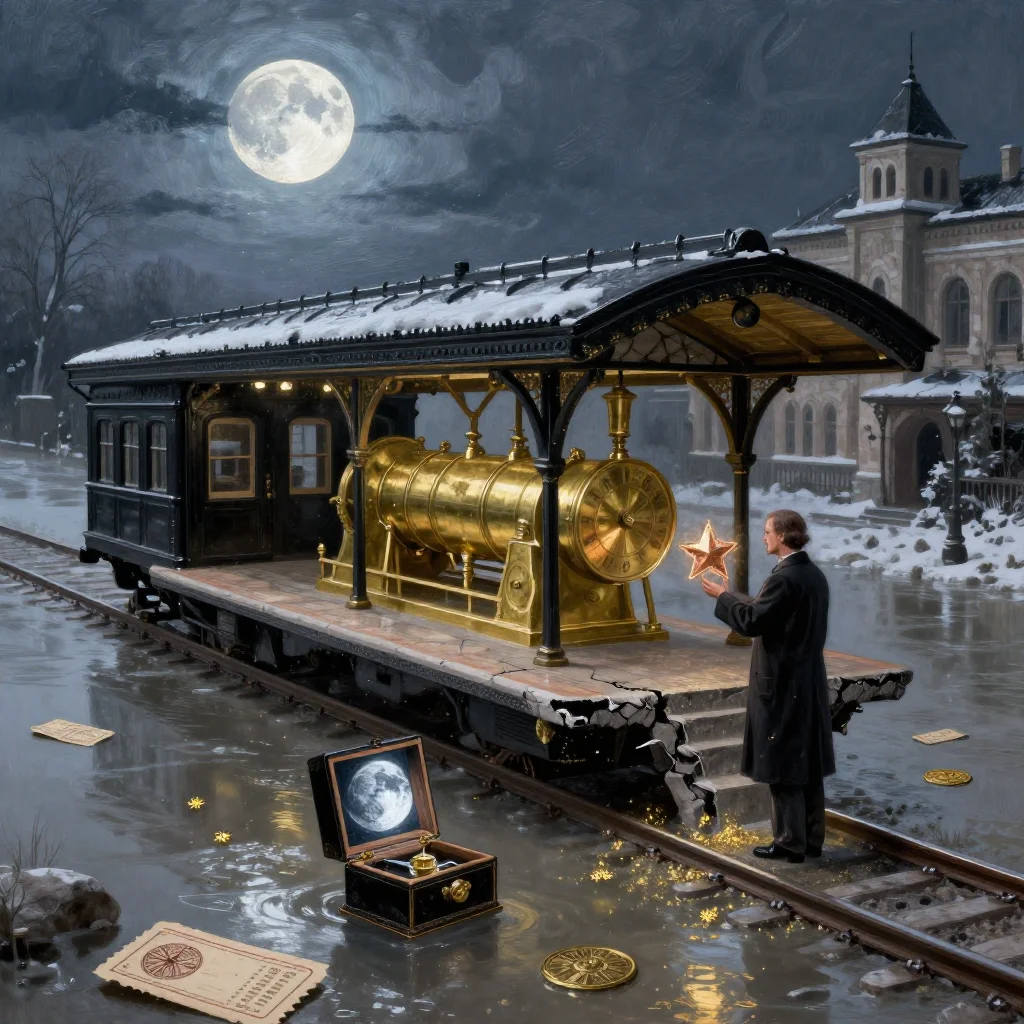
The station stood beneath a black sky, its platforms glazed with frost. Beyond the tracks, the departure board shone in letters of gold dust: SPRING, HARVEST, THE LONG RAIN, SUMMER AS IT WAS BEFORE. Passengers waited beneath cold moonlight, clutching cases and scarves, while the great machine breathed behind a wall of iron glass.
Ilyra carried no medicine except a silver thread, a tin of bitter salt, and the small music box her mother had left her. The box played eight notes whenever a patient said the word return. Its tune had no name. At night, when the machine's brass gears clicked in darkness, she kept it beneath her coat.
Her newest patient was a woman named Serin, whose cheeks were blue with cold though she wore no winter coat. Serin had arrived from a city called Bellweather, a place Ilyra had never heard of.
“I remember the smell of oranges,” Serin whispered. “I remember my brother's laugh. But when I try to picture the house, the walls move away.”
“Then the house is not the illness,” Ilyra said. “The distance is.”
That night, the station's northern wall collapsed inward. Not from explosion, but from water. A black flood surged through the tunnel, overturning benches and carrying a thousand silver ticket stubs into the darkness. When it subsided, the machine stood exposed.
What the Flood Found
Under the mud lay a second station.
Its walls were made of black lacquer, its corners traced with old civic seals. Bronze letters emerged from the silt: THE COMMON RETURN, BUILT BY THE CITY OF WINTER, 1841. The inscription continued beneath the platform, where water dragged at a copper star embedded in the floor.
Ilyra knelt beside it. The star was warm. The music box in her coat began to play without being touched.
Serin found her there. “I remember this,” she said, touching one sharp point. “Not Bellweather. This. I was brought here as a child.”
“By whom?”
“By the people who built the machine.”
Far beneath them, something turned. The station's departure board changed from SPRING to RETURN. Every platform bell rang at once.
The physician examined the buried project. It was not a station for traveling to alternate seasons. It was a machine for removing the inconvenient parts of a city: the poor, the grieving, the children who dreamed of another shore. Once loaded into its carriages, they were delivered to a place called the Equinox, where no one was permitted to speak of home.
Its promise had been beautiful. No citizen will remain where love has become labor.
Ilyra understood then why the machine needed the alternate seasons. They were not destinations but disguises. Spring concealed the labor camps. Summer concealed the prisons. Every departure was a disappearance polished into an event.
The Physician's Choice
Serin asked Ilyra to destroy the machine.
“If the board is broken,” she said, “perhaps the missing people can find their way back.”
“If the board is broken, everyone on every platform is lost.”
“If it remains, no one is allowed to leave.”
The water climbed the black lacquer walls. Above them, passengers shouted as the machine opened its doors. Beyond each carriage lay a convincing sky: blossom-filled forests, golden fields, a summer sea. A child stepped forward. An old man held his wife's hand. Their faces softened with relief.
Ilyra took out the music box.
Her mother had once told her that a cure was not a potion but a truthful direction. Ilyra had dismissed the saying as sentiment. Now she opened the box and let its eight notes cross the station.
The machine answered with a ninth.
It was the note of the buried civic seal. The copper star split beneath the floor, releasing a thin line of blue fire. The alternate seasons trembled. In each carriage, images of home flickered through the painted weather: a chipped blue bowl, a staircase with thirteen steps, a dog waiting under a pear tree.
Not memories of places as they were. Proof that they existed.
Ilyra climbed onto the machine's central console. Beneath the glass, she found the original inscription, scratched by an unknown hand: A city is not kind when it sends away those who hurt it.
She turned the machine toward winter.
The Way Back
The carriages filled with cold moonlight. The doors opened onto the station platform, and the passengers saw not the seasons they had been promised but the station as it truly was: muddy, damaged, crowded with people holding one another against the wind.
Serin stepped from the Equinox carriage carrying nothing but a copper star.
“Bellweather is gone,” she said.
“Yes,” Ilyra replied.
“Then what do I return to?”
“The place where you can begin again.”
That was the machine's only permissible journey. It could not restore what had been taken, but it could stop pretending that exile was weather. One by one, the passengers boarded toward their own difficult lives.
At dawn, the buried civic project stood open to the sky. The city council wanted to seal it, name it an error, and sell the land. Ilyra placed the copper star above the entrance, where all could see it.
The music box had lost its final note. She did not mend it. Some cures, she decided, should leave a silence where certainty had been.
That winter, when new travelers came asking for distant seasons, Ilyra treated them for homesickness with tea, silver thread, and the truth. She told them that home was not always behind them. Sometimes it was the place they were forbidden to reach.
And when the next flood uncovered another buried project, she would be waiting at the station with her coat buttoned, her boots filled with rainwater, and the black lacquer shining beneath the cold moon.





