 Netwrck
Folk Horror.
Letters from the Wrong Season
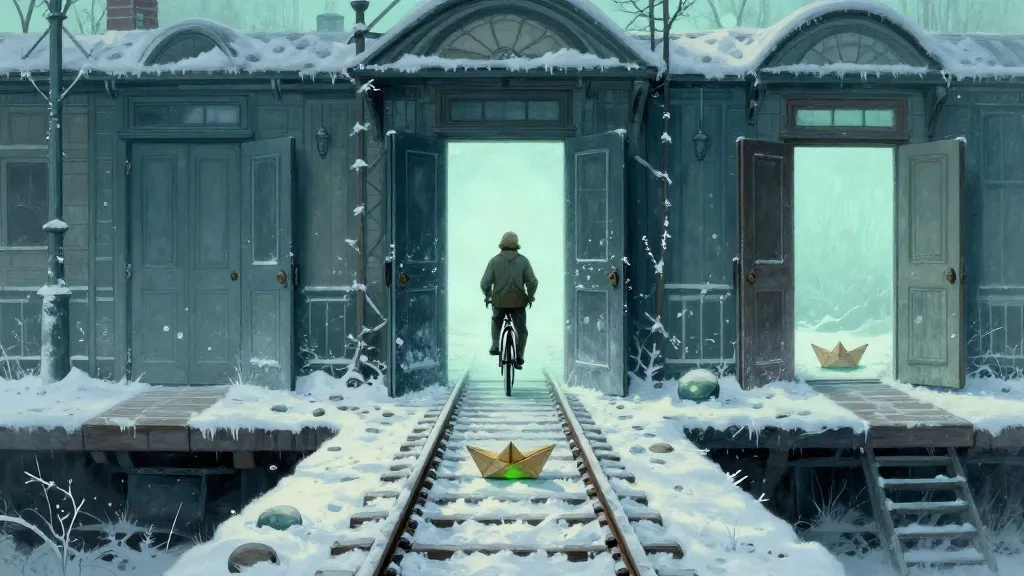
The winter station opened only when the frost began to lift, though no one could say who lifted it. Its platforms stretched beneath a low iron sky, each roof furred with snow, each clock disagreeing by an hour or a season. Boarding signs changed between the languages of travelers, and destinations appeared in warm ink: MARCH, HARVEST, THE LONG THAW.
Ilsa arrived with a bicycle built for narrow streets. Its front wheel was thin as a coin, its rear rack wrapped in blue wool, and its bell gave one silver note when she pushed it through the station doors. The doors were shut. She rode at them anyway.
Beyond was a summer street.
Heat pressed against her cheeks. Moss softened the station stones. A woman sold blackberries from a cart, though beneath her feet the rails were furred white. Ilsa left the bicycle beside a closed bakery door and found a paper boat in the gutter, folded from a letter bearing no stamp. Inside the boat was a single green stone, smooth and cold.
She had carried that stone since childhood, recovered from the roots of a pear tree after a storm. The paper boat was new. She tucked it into her courier bag and returned to the station.
In the winter waiting room, a clerk watched her. His nameplate said:LISTENER, BY TREATY.
“I need to know why the future stopped sending letters,” Ilsa said.
The clerk glanced toward a black board. Under LAST DELIVERY, someone had written: NEVER.
“They still send them,” he said. “Only not to you.”
The Land at the Table
He led her below the tracks to a room lined with filing drawers. A woman in a red coat sat at a table, listening to a blue gramophone turn without a record. When the needle touched the shell, the walls breathed dust.
“There is a treaty,” the woman said. “The land and the people signed it after the first winter. In exchange for grain, fuel, and graves, the land was granted permission to listen.”
She placed the paper boat on the table.
“It remembers every voice that crosses its borders. Every promise. Every silence.”
Ilsa touched the green stone. The gramophone stopped.
In the drawers, letters rustled. Hundreds of them, thousands, packed behind labels such as SPRING REJECTED, SUMMER MISDELIVERED, FUTURE WITHDRAWN. One drawer held envelopes addressed to her. The stamps showed years she had not lived.
“The future is still delivering,” the woman said. “But the station has learned that letters carry news. So it keeps the envelopes and sends the paper boats.”
The clerk opened a drawer marked LIVING COURIERS. Inside were thin strips of frozen grass, each tied with blue wool.
“The station needs a witness who can pass between seasons,” he said. “Someone whose bicycle is permitted to cross closed doors. The treaty gives the land permission to listen. It does not give the future permission to speak.”
What the Dawn Heard
That night, Ilsa rode into the dawn platform.
It was not sunrise. It was a soft cyan seam opening behind the mountains, lighting the rails without warming them. Her bicycle passed through the station’s locked waiting room, through a wall painted with old advertisements, through a corridor filled with sleeping birds. The green stone grew warm beneath her palm.
Beyond the final door stood a field under impossible snow. A young man waited beside a mail sack, his breath turning to white numbers in the air.
“I brought the letters,” he said. “But I cannot cross the treaty.”
His sack was full. Ilsa recognized the blue wool on her own bicycle.
“The treaty says the land may listen,” she said.
“Yes.”
“It does not say the future may speak.”
He nodded. The cyan light climbed over his face.
“Then leave something that can.”
Ilsa unfolded the paper boat. She placed the green stone inside it and set it on the rail. The little boat trembled, filled not with water but with a sound: wheels crossing thresholds, bells, names called at midnight, a child promising to return before spring.
The future opened its mouth and sent one letter into winter.
The Undelivered Season
By morning, the station had changed. The platform signs now read only WINTER, and the summer street was buried beneath white. The clerk cut the label from the gramophone. The woman in the red coat put the treaty into the stove, though it was already ash.
Ilsa’s bicycle stood where she had left it, shining with rain that had not fallen. In the basket was the letter.
Her mother’s handwriting covered the outside: IF THE WINTER KEEPS YOU, COME HOME IN ANY SEASON.
Ilsa did not open it. She placed it beneath her shirt and rode through the station doors.
Behind her, the platform filled with doors opening onto unfamiliar springs. Each one carried the scent of wet soil. The listeners called out questions. The land listened, as it always had, but the station no longer kept the answers.
At the edge of the impossible dawn, the paper boat lifted from the rail. The green stone glowed beneath the ice, small and patient as a heart.
Ilsa rang her bicycle bell. Once, twice, three times.
Somewhere beyond the closed doors, the future began to answer.





