 Netwrck
Historical Fantasy.
The departure board
By January, Frostmere Station had acquired eleven departures a day and no reliable map of them. Each brass door opened on another season: a brown harvest under white lightning, a thaw crowded with soldiers, a summer afternoon bright enough to sting.
Severin Vale stood beneath the board, keeping his hands in the pockets of his old flight coat. The coat had belonged to the year his country still entered particulars in a public register. Launch time. Capsule number. Crew surnames. Earth reduced to ink beside a blue line.
He had not left orbit for thirty-one years. Not because the station offered him weightlessness, though it did, but because the descent tapes continued to call Earth a rumour. Other travellers boarded the seasonal doors. Severin refused. If the ground beneath him existed, why had no reliable witness crossed the sky to confirm it?
He had come for a voice instead.
In the observatory aboard the orbital relay, a woman named Ilyana Sorn had spoken every human transmission for nine years. She had repeated the first arguments over Antarctica, the names of forgotten weather stations, the last speeches before radio became law. The archives called her background noise. Severin had called her the only continuous witness.
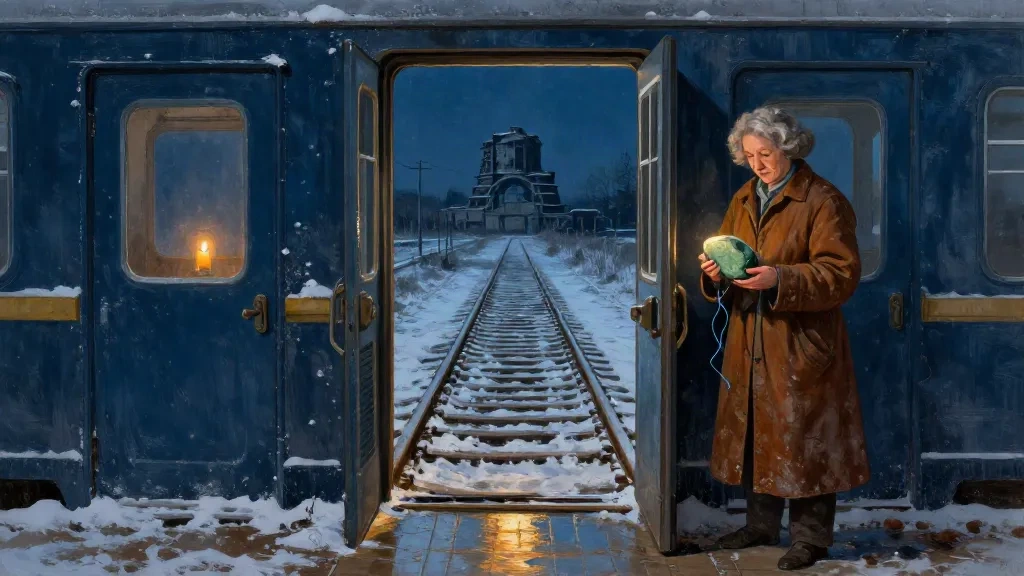
On the winter platform she waited beneath a dead clock, wearing a brown coat damp with snowmelt. In her palm lay a green stone polished smooth, its interior clouded like weather.
“They are closing Platform Nine for repairs,” she said.
Severin looked at the board. The final departure read: EARTH, UNVERIFIED.
Doors out of order
They entered Platform Nine together. Inside stood a narrow corridor with five doors and no windows. Each number had been painted over except one: 221.
Sorn drew a blue thread from her sleeve and tied it to Severin’s wrist. “That is the last thing I retained from the observatory,” she said. “The recordings decayed. The thread did not.”
He had carried the green stone ever since the relay lost power. He did not know why he had kept it. It had arrived in his survival pack with no inventory mark, warm as a sleeping animal.
The storm arrived without wind. Snow stopped in the open platform behind them. A deep pressure moved through the floor, and the numbered door changed places with the emergency exit.
Severin pulled the thread. In the wrong door they found a railway carriage full of frost. Each window showed a different century. In another, a wheat field beneath a red military sky. When Severin looked back, the corridor had stretched.
They entered the door marked 221. It opened into a room of candlelight reflected from polished steel. Sorn stood at a brass microphone, younger than she had been, saying names.
Severin stopped.
“Seventeen,” the voice said. “Severin Vale. Record the testimony before the eastern tower falls.”
He reached for her, but the room folded. The floor became a wall, the ceiling became a bridge, and Sorn was drawn through a door that had opened beneath the microphone.
The unrecorded winter
He followed without the thread. It remained tied to his wrist, taut across impossible distances.
Beyond the door lay winter as a living thing. Snow climbed the walls in slow blue waves. Doors drifted through the dark, each carrying one room from another history. Severin caught glimpses: the tower falling; a child hearing his own name; a government clerk rubbing out a sentence. The green stone warmed in his fist.
Sorn’s voice traveled through the thread.
“History has no room for witnesses,” she said. “Only for the documents it keeps.”
“Keep my testimony,” he called. “Keep hers.”
“The station will not remember the winter unless someone returns through it.”
Then the thread snapped.
Severin tore open the nearest door. A blast of tobacco-brown air struck him. Inside, a ruined observatory leaned over a frozen sea. Sorn’s younger self sat at a microphone, transmitting toward a sky full of departing ships. Behind her stood Severin, wearing the flight coat, younger and certain, with a green stone in his hand.
He remembered. Not launch, not orbit, not the descent he had refused. He remembered choosing the relay because the first reports from Earth had arrived in a dead man’s voice. Sorn had preserved every uncertain word.
The storm shoved the room apart. Candlelight ran along the steel walls like liquid fire.
What the sky returned
Severin crossed to the microphone. Sorn’s younger self looked up, waiting for the next transmission.
He spoke into it.
“Earth is not a rumour,” he said. “Neither are the people who stood beneath it. Preserve the evidence. Do not confuse silence with absence.”
The microphone carried his voice across the ruined observatory, through the frozen station, and into the century that had tried to erase its origin. Every rearranging door stopped. For one held breath, the winter lay still.
When the walls returned, Sorn stood beside him as she had at the platform, older, snow in her hair, blue thread looped twice around her fingers. The green stone had split cleanly down the middle. One half lay in Severin’s palm. The other had become a bright seam in the platform.
“Was it enough?” he asked.
She looked toward the board. New letters appeared beneath the old ones, steel blue against tobacco brown.
EARTH, CONFIRMED. DEPARTURE: NOW.
Severin took her hand. The doors opened, and beyond them the station smelled of rain, coal smoke, and distant fields. He stepped down with her into the remembered world. Behind them, the microphone continued speaking long after their train had gone.





