 Netwrck
Adventure.
The Copper Wind
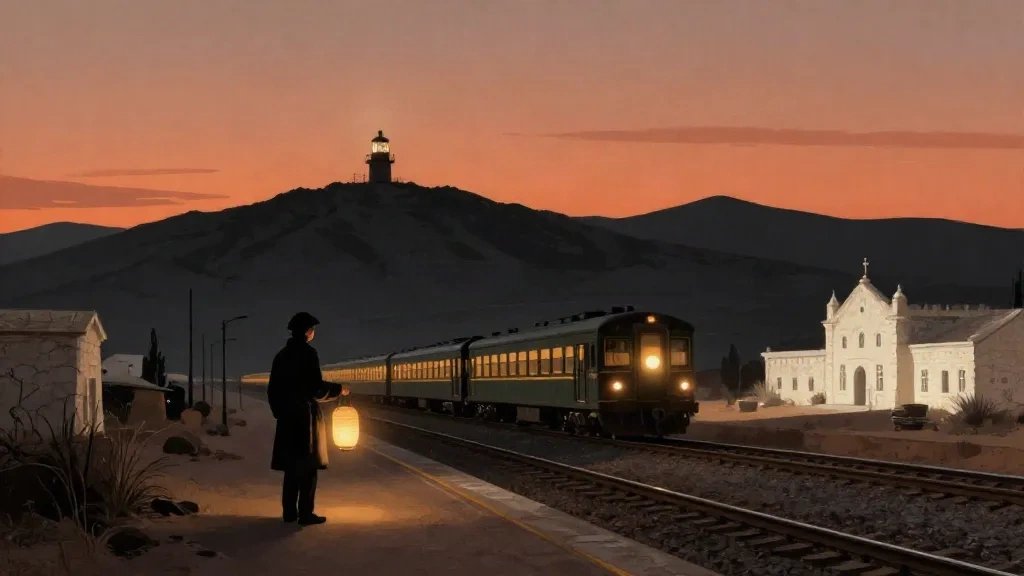
Mara Venn kept the lighthouse at Bellwether Station, though the tower stood a hundred miles from any sea. Its lamp pointed upward, into a sky where weather moved between worlds like trains through tunnels. Rain from a drowned green planet drifted past the glass. Blue snow collected on the desert. Some mornings the wind carried the smell of salt, cinnamon, and hot iron.
She entered each arrival in the Ledger of Other Skies. Pressure. Temperature. Smell. The name of the wind, if it had one. The station lay beneath a copper horizon, its rails running from a black-cherry mountain toward a pale stone town that appeared only when the sun was low.
That evening the lamp turned without her touching it. Beyond the windows, the rails began to sing.
A train arrived from no year Mara could name. Its carriages were dark, its windows bright with frozen faces. The conductor stepped down carrying a lantern made of folded paper. He set it on the platform, and the little flame leaned toward the tracks as if greeting an old friend.
The Illegal Sky
The conductor presented a ticket punched with a symbol like a small moon.
“Passenger,” he said. “One. No luggage.”
Mara looked through the carriage windows. At the far end sat a girl wrapped in a pale coat, clutching a black-cherry umbrella. The girl raised one hand. Her mouth formed a word without sound.
Then the lantern flame went out.
Mara ran for the office telephone. The municipal inspector answered before she spoke.
“Station regulations,” he said, “declare impossible weather, impossible transport, and impossible persons subject to immediate removal.”
“She came from another century.”
“Then she is an unauthorized temporal arrival.”
“She’s a child.”
“Age does not amend regulation nine.”
The conductor unfolded a notice and nailed it to the platform. Mara read the fine print beneath the headline: all departures must be recorded. Nothing arriving from outside the approved calendar could remain in the district’s memory. At dawn, the station would become the only place where the girl had never been.
Mara seized the lantern. Its paper walls were warm. Inside the flame, she saw a miniature moon hanging over a black-cherry mountain.
A Name Against Erasure
She returned to the train and offered the girl the lantern.
“Keep this,” she said. “When the world begins forgetting you, say your name into the light.”
“It will not hear me.”
“It has heard stranger things.”
The girl touched the lantern. Its flame rose. Outside, the wind shifted. Copper light ran along the rails, and Mara felt the desert crowd the station with voices. Merchants remembering debts. Children remembering songs. A woman on a distant train remembering a lover’s face. Every memory pressed against the same small flame.
The inspector shouted that the arrangement was forbidden.
Mara opened the Ledger. On the page for the girl’s arrival she wrote: “Wind from a century that has not happened. Rain that falls upward. One small moon, paper lantern, pale stone, black cherry.”
Then she wrote the girl’s name.
It was Lio.
The ink resisted. The page tried to turn blank. Mara pressed harder, using the brass weight of the lamp as a seal. Lio leaned over the book and whispered her name. The lantern blazed.
Across the platform, the conductor’s face became clear for the first time. He was young, frightened, and far from home.
“If she is remembered,” he said, “the train must be remembered too.”
The Last Departure
Dawn reached the station as a white line. The inspector arrived with a clipboard and began reciting regulation nine.
Mara lifted the lantern. Its paper shell glowed pale as stone. Inside it, the small moon shone without being reflected. Every impossible thing the train had carried gathered there: the upward rain, the salt wind, the blue snow, the faces behind the glass.
“By municipal order, all unauthorized impossibilities will be forgotten.”
“Then forget the rule,” Mara said.
He struck the first clause from the notice. The train bell rang once, sharply.
“By order of the station keeper, all passengers are allowed to arrive.”
The black-cherry horizon brightened. Lio stepped onto the platform, the lantern in her hands. The conductor bowed. Behind him, the carriages filled with light, and the station clock began ticking backward.
Mara recorded the final entry. She did not write that the impossible had been made legal. She wrote that a child had come home, that a lantern had remembered her, and that the desert had chosen, for once, not to look away.
When the train departed, the rails kept glowing after midnight. Mara stood beneath the pale stone tower, listening to weather arrive from worlds beyond the stars.
In her ledger, beneath the copper horizon, one new line remained wet:
Lio, present.





