 Netwrck
Fantasy.
The Low-Tide Platform
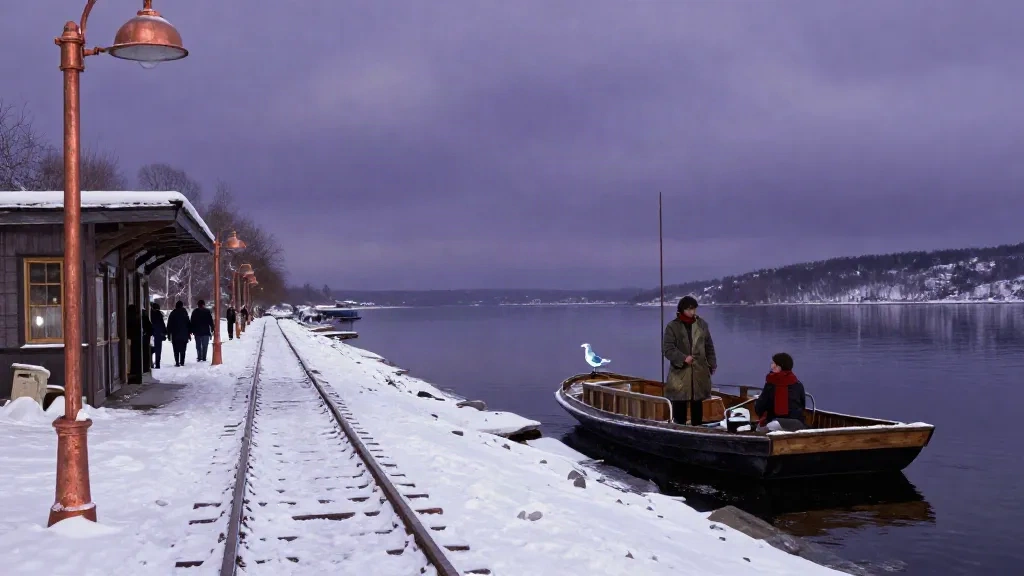
By the violet hour, frost had sketched the windows of Winter Station in ferns of cloud-white. Beyond the tracks, the lake waited below the embankment, its dark water lower than the land. It appeared only at low tide, and only for those who knew the ferryman.
He waited beside the brass clock with one hand on the red scarf around his neck. The scarf had belonged to a woman who had vanished from the timetable forty years ago. Every winter, she returned to the station in a different coat, carrying the same glass bird beneath one arm.
“You are late,” she said.
“The tide is late.”
She turned the bird in her palm. Its wing caught the violet dusk and burned copper at the edges.
“Then it is waiting for you.”
At the end of Platform Three, the station doors opened without a train arriving. Passengers stepped through carrying summer leaves, autumn apples, and handfuls of rain. The porter checked their tickets, but never asked where they had come from. He only marked the season beside each destination.
The ferryman unfolded the map.
It was painted on vellum, its routes wandering between the station, the lake, and a mountain that had no name. The first time he had used it, it showed a straight road. The second time, the road had become a cliff. The third time, he had found himself walking backward toward a house that vanished when he touched the gate.
The map changed whenever someone tried to use it honestly.
He traced the route to the lake. The ink lifted from the page and became a black fish swimming beneath his finger.
“Do not tell me what you want,” the woman said.
He looked toward the departures board. One line had been added in fresh red:
THE FIRST WORLD — PLATFORM ZERO
“I want the person who remembers the original version,” he said.
The map folded shut with a crack like breaking ice.
Passengers for Other Seasons
He boarded the night ferry when the lake finally appeared. The boat was flat-bottomed and smelled of wet rope, salt, and engine smoke. Across the water, Winter Station rose on a hill, its windows glowing blue.
“The lake has no other side,” the woman said. “Only different distances.”
She sat beneath the glass bird, which now hung from a thin chain around her neck. He had asked her once why the bird mattered. She had said, “Because it remembers being alive.”
The ferry crossed a field of violet reeds. Somewhere beneath them, a church bell rang for spring. A flock of white birds burst from the water, and for an instant the sky opened onto autumn.
At the far shore stood Platform Zero, where no winter had ever touched the stones.
Passengers waited there: a child in a snowstorm, an old man holding a summer peach, a bride whose veil was made of rain. Each carried a memory that did not belong to the season around them.
The ferryman searched their faces.
Then the map opened in his hands.
It showed a path straight through the station wall, across the tracks, and into a field of cloud-white snow. At the end stood the woman in the red scarf.
He followed the map.
Every step made it change.
The wall became a forest. The forest became a staircase. The staircase led back to the same platform, where the winter clock struck thirteen.
“You cannot use it honestly,” said a passenger. “That is how it protects the world.”
The ferryman looked at the glass bird.
Inside it, something moved.
The Map’s Honest Face
He placed the bird on the map. The ink froze. The red scarf began to glow through the snow.
“The first world was not a better one,” the woman said. “It was only the first.”
“Then why hide it?”
“Because memory is a door. Doors open both ways.”
He understood then. The map had not been changing to mislead him. It was changing because he wanted one person, one answer, one moment that could prove the world had once been otherwise. The map gave him a different world whenever he asked for certainty.
So he stopped following it.
He placed his palm over the lines and said, “I do not know where she is.”
The vellum went still.
“I know what I have lost,” he continued. “I know I have crossed this lake in every season. I know the scarf is warm because I keep it close.”
The map opened to a blank center. A small line appeared, leading not toward the lake or the station, but toward the old waiting room beneath the clock.
There, the woman sat beside a coal stove. No red scarf. No glass bird. Only a cup of tea cooling between her hands.
She looked at him as if recognizing a song she had forgotten.
“You came back before the water changed,” she said.
“Do you remember the first world?”
“I remember the station before it had seasons.”
She touched the empty air where the scarf had been.
“And I remember you, before you learned to call waiting a duty.”
A Season Without a Return
The glass bird appeared in his hands, whole and trembling. He understood that it had not been hers. It had been a promise made between them, carried through every possible departure until one of them could return without changing the other.
He set the bird on the windowsill. The station filled with the violet light of a winter sunset, then copper, then cloud-white.
The woman tied the red scarf around her neck.
“The lake will rise soon,” she said.
“Then come with me.”
“I remember the first world because I stayed in it long enough to let it end.”
She smiled. “You must decide whether remembering is a place, or a promise.”
The ferryman opened the door. Beyond it, the low-tide lake shone like dark glass. The ferry waited, patient and unchanged.
He did not ask the map where to go. He stepped onto the boat, and the woman followed.
At the shore, the winter station opened its doors. Passengers hurried toward summer, autumn, and the dry clarity of spring. None of them saw the two figures crossing the water.
The map lay forgotten beneath the ferryman’s hand, its routes finally still.
Behind them, the red scarf streamed in the wind. Ahead, the glass bird caught the first pale light of a season that had never existed before.
He rowed on, no longer searching for the world that had been lost.
He was taking the memory with him.





