 Netwrck
Fairy-Tale Fiction.
The Train with No Platform
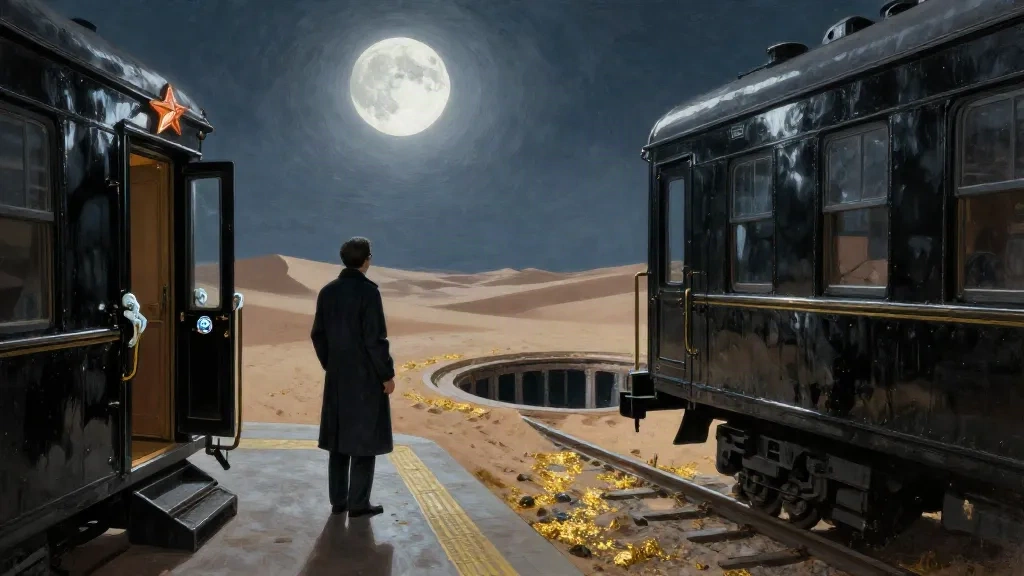
At midnight, the desert station received a train that had no track beneath it. Its carriages were black lacquer polished to the color of a beetle's wing. Gold dust drifted along the seams, and cold moonlight poured through windows shaped like narrow, patient eyes.
Dr. Ilyra Senn met it alone. She had come to the station to treat homesickness, the peculiar disease that settled in travelers whose bodies had crossed oceans but whose hearts remained trapped in kitchens, schoolrooms, old gardens, and sleeping rooms.
She carried no medicine but a black case of listening instruments: silver spoons for detecting lies, glass beads for locating forgotten songs, and a small brass key given to her by a stationmaster who had died before she was born.
The conductor bowed without showing his face. His hat was a polished black dome, powdered at the brim with gold. Behind him, in the first carriage, sat a beautiful machine.
It had a body of lacquered wood, twelve porcelain hands, and a copper star turning above its head. The star cast a pale point of light across the floor. When the machine turned, the carriage filled with the scent of rain on hot stone.
“It comes from another century,” the conductor said. “It can take you home.”
Ilyra looked at the machine. “And keep you there?”
He did not answer. Instead, he offered her the first seat.
What the Flood Revealed
Two nights later, rain came to the desert. It began as a silver line beyond the dunes and became a wall. Water rushed beneath the station, lifting the floorboards and pouring blackly through the sleeping quarters.
Ilyra's patients fled toward the platform. Some carried dolls, jars, or folded letters. Others stood still, smiling at the storm as if it had called them by a childhood name.
The flood uncovered a buried staircase behind the ticket office. Its steps descended into the earth, each marked with a gold symbol Ilyra recognized from old civic seals: a doorway with a roof shaped like an open hand.
At the bottom stood a vast circular chamber. Its walls were covered in names—thousands of names, arranged in neat lines. Beside them ran channels of clear water, carrying the names toward the railway's unseen rails.
On a stone table lay a music box. Its lid was black lacquer, its winding key shaped like a small keyhole in a child's mouth. The copper star rested beside it, no longer turning.
When Ilyra lifted the lid, one note escaped. The chamber answered with thousands of voices, each saying the name of a place no longer found on any map.
The Price of Arrival
She understood then. The railway had not built a line through the desert. It had built a refuge beneath it.
Every city, village, and roadside shelter had sent its displaced memories here. The century train collected them from their last remaining thresholds, preserving their doors, songs, and familiar rooms. But preservation was not freedom. The beautiful machine kept every home in perfect condition, and every traveler inside it.
Ilyra's hands trembled over the music box. Its melody was the same one her mother had hummed before the fever took her voice. If she shut the box, the refuge might close forever. If she let it finish, every lost place would remain complete, beautiful, and impossible to leave.
Behind her, the conductor said, “Your patients are already aboard.”
She looked up the staircase. The travelers were descending willingly. The little girl clutching a doll stepped into a golden square of moonlight and became part of a ballroom no one had built.
Ilyra took the copper star and fitted it into the music box's lid. The note stopped.
“A home is not a room,” she said. “It is the door someone has not yet opened.”
The Door That Stayed Open
She turned the key backward. The chamber shuddered. Walls split into doorframes. The channels of memory-water rushed through them, carrying names back into the world.
They did not return as people. Names became birds, bread crusts, bells, pencil marks, and songs. The woman searching for her mother's kitchen heard a recipe spoken in a child's voice. The soldier who missed the smell of pine found pine in the wind. The homesick did not go backward. They were released into the unfinished present.
The machine's porcelain hands cracked. Gold dust rose from its seams and settled on the black floor. Its beautiful, imprisoned chambers opened one by one.
At dawn, the desert station stood above an empty hole. No train returned. The machine remained buried beneath the sand, its copper star fixed in the music box, which no longer sang unless someone opened it by hand.
Ilyra kept the black case of listening tools. She no longer traveled to distant stations. Travelers came to her, carrying impossible complaints, and she listened until each could name one door they wished to leave open.
Some nights, the station was quiet except for the wind. Then came a faint note from under the floor, delicate as a star striking a distant rail.
Ilyra never mistook it for an arrival. She opened the door.





