 Netwrck
Hopeful Science Fiction.
The Green Light
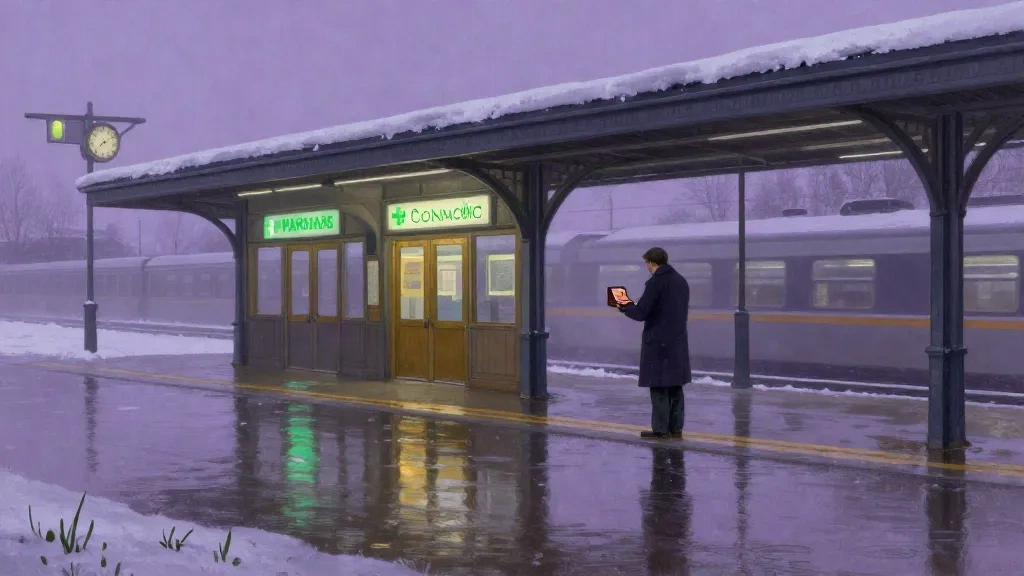
On the worst nights, frost silvered the platform and the departure board listed destinations in seasons rather than places: THAW, LATE HARVEST, FIRST SNOW, GREEN AFTER FIRE. Dr. Iona Vale stood beneath the station clock, listening to its single clear chime and the patient scrape of boots across wet asphalt.
She treated homesickness. Her dispensary was a narrow room beside Platform Three, stocked with peppermint, dried orange peel, and medicines stronger than either: a brown bottle for remembering doors, blue tablets for returning at the wrong hour, and a sugar pill that quieted the urge to board.
“You are not ill,” she told the first patient of the evening, a man whose coat still carried pine resin. “You are homesick.”
He placed a small music box on the counter. Its lid bore a winter star in tarnished silver. The melody rose in three notes, stopped, then began again.
“My daughter keeps it,” he said. “She left for spring. I followed. I am tired of being almost home.”
Iona did not give him the sugar pill. Instead, she opened the station ledger and found his travel history. Every platform, every borrowed season: he had followed his daughter through a hundred mild mornings, but always arrived after she had gone.
At midnight, the lights failed.
Not the ordinary failure of a winter storm. Water burst through the station's foundations.
What the Flood Remembered
It rose around the platform, black and patient, carrying buckets, ticket stubs, and a box of copper stars melted from old railings. Iona waded toward the emergency stairs. The music box went silent in her hand.
The flood did not destroy the station. It peeled one thing away.
Along Platform Four, where the wall had seemed solid, a row of doors appeared beneath the water. Brass numbers hung from every handle. Beyond them were small rooms furnished like kitchens, parlors, and porches. Lamps burned inside. Someone was home in each one.
A child laughed behind a fogged pane. An old man sang two notes, the same melody as the music box. A woman pressed her palm to the glass and mouthed, “Wait.”
Iona found Iona's own name above the nearest door.
The room behind it was warm. On its table sat her mother, younger than Iona remembered, sewing a copper star by lamplight.
“You came,” her mother said.
Iona looked back at the water. Her patients were scattered among the doors. Each had found a version of home. Each would remain there if the station allowed it.
The station had been built to ease homesickness. Its engineers had discovered that people did not need a cure if they could enter a season where their lost loved ones still lived. Beautiful machine: the winter platform, the lavender dusk, the impossible departures. Beautiful prison: no ticket home, no return to winter, no grief permitted to become change.
“I cannot open all of you,” Iona said. Her voice carried through the flooded corridor. “But I can open a way through.”
The Copper Star
She ran to the control room, where the old civic maps still hung beneath glass. Floodwater had lifted them from the wall. The buried project lay underneath: a public refuge built before the station's first winter, intended for citizens who had nowhere else to go. It had rooms, kitchens, beds, and a charter signed by every government office in the city. No season. No belonging purchased by disappearance.
The engineers had buried it when they installed the machine.
Iona found the original charter beneath a fallen copper star. The metal was stamped with the station's founding mark, but the hand was human: a city is not a machine for reaching elsewhere. It is a promise to remain reachable.
She carried the charter to the platform controls and inserted it into the reader. A warning flashed: THIS SYSTEM WAS BUILT TO MAKE DEPARTURES IRREVERSIBLE.
“Then make them reversible,” she said.
She turned the machine from seasons to stations. The departure board flickered. THAW became HOME. LATE HARVEST became HOME. Even WINTER became HOME.
Doors opened everywhere.
Passengers stumbled into the corridors, carrying the music box, the copper star, the names of the living. The man who had followed his daughter found a telephone instead of another season. The child laughed behind the glass found a mother waiting at the clinic. Iona's mother set down her sewing.
“Can you remain?” Iona asked.
Her mother touched the copper star in her palm. “Yes,” she said. “But not inside a memory.”
Arrival
Dawn found the station changed. The flood had withdrawn into the tunnels, leaving lavender stains on the platform and green pharmacy light reflected in the puddles. The machine still stood, polished beneath its brass dome, but its doors now opened only to ordinary winter streets.
Travelers boarded slowly. Some went home. Some went to the hospital, the market, the rooms beneath the restored refuge. Iona kept her dispensary, but removed the sugar pills from the shelf. A person could be tired, frightened, lost, or lonely without being trapped by the wish for a perfect elsewhere.
The man returned the music box to Iona. Inside, instead of the three-note winter melody, a fourth note had appeared: clear, patient, unfinished.
She wound it once. The box opened a small copper star.
Beyond the station glass, the first green shoots broke through the snow. Not a season summoned by a machine. A season beginning because the city had decided to make room for it.
“Welcome back,” Iona said to no one in particular.
The clock struck six. Every clock in the station answered.





