 Netwrck
Speculative Fiction.
The physician of lost hours
At the monastery of Saint Vey, clocks hung from every rafter and filled every window, each making a different argument about what a minute was. Some ticked. Some chimed. One coughed quietly into its brass lungs whenever snow approached the valley.
Dr. Ilyra Sen came there because the villagers of Orison could no longer agree on a season. Their orchards flowered beneath a charcoal sky while frost sealed the river. Children born in summer argued that winter was older. The tax collector had begun charging for hours he claimed to have stored in his cellar.
The monastery had promised to regulate time. For three weeks it had, beautifully.
Ilyra listened to the bells and watched the copper star turning in the central tower. Her patient was the mountain itself. It suffered from homesickness.
“We do not treat places,” the abbess told her, meeting beneath a ceiling crowded with pendulums. “We treat the people who cannot leave them.”
“The people here are leaving. One at a time, with different versions of the same day.”
The abbess looked through the pale winter light toward the star. “Then find them a home.”
The machine in the tower
The clock was beautiful, though beauty was not the part that frightened Ilyra.
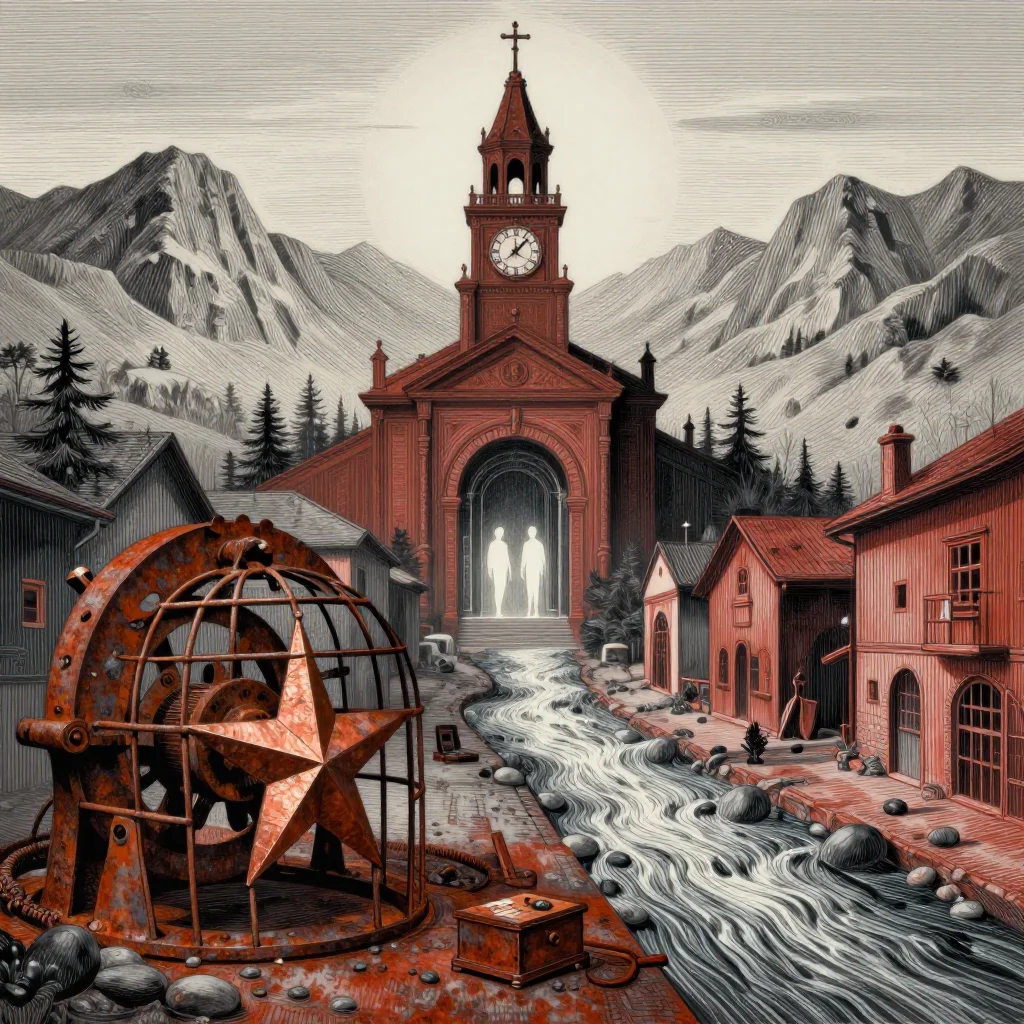
Its gears were cut from moon-colored brass. Two hundred weights descended into the mountain on braided chains. At the center, the copper star turned without touching the mechanism that moved it, a small five-pointed sun suspended in a cage of black iron. Below it, a music box played six notes whenever the river changed course.
The monks had built the clock to prevent a flood.
That was what they told Ilyra. Eighty years ago, the river had cut through a valley wall and swallowed the old civic quarter, along with its records, courts, schools, and waterworks. The flood had been blamed on a broken dam. The dam had never broken. It had been opened.
“We were sent to correct the damage,” Brother Oren said. “We slowed the water by lending it the hours before the flood.”
“Lending time?”
He tapped the star with one knuckle. It rang like a sealed bell.
“Time is not a line here. It is a weight. Hold enough of it, and nothing can move.”
Ilyra understood then that the monastery’s clock was not keeping the valley from drowning. It was holding the drowned city beneath it.
Every rotation suspended another hour of water against the hillside. Every hour preserved was also a prison. Somewhere below, thousands of citizens continued inside the instant the flood arrived, unable to drown, unable to escape, unable to believe the water had won.
What the water uncovered
On the ninth day, the river found a crack beneath the eastern wall.
It came through the monastery as a low silver roar. Monks carried clocks from the dormitory while Ilyra climbed toward the tower. The music box began playing by itself. Its six notes were not a melody. They were directions.
The flood peeled away the hillside and uncovered a paved avenue, its stones still bright beneath a skin of rust red silt. Shop signs lay where they had fallen: a locksmith, a public bath, a registrar of births. Beyond them stood the intact façade of the civic archive.
Water streamed through its doors, and the lights came on.
People stepped from the building.
They were transparent as smoke, dressed in the fashions of several decades, all carrying the same brass seal. The woman at the front held it up to Ilyra. It read: EMERGENCY MEASURE 6. TEMPORAL CUSTODY OF THE BOROUGH.
“You are the physician?” the woman asked.
“I am.”
“Then tell them to release us.”
Behind her, the rest of the dead city continued pressing toward the archive doors. They had not been caught by the flood. They had been housed in it.
Oren seized the copper star. “If the clock stops, they fall.”
“If it does not stop, they are forgotten.”
Ilyra looked at the prisoners passing through the archive, at the thousands of days they had been forced to repeat. The machine was not preserving the past. It was refusing to let anyone reach the present.
The hour of release
She climbed into the mechanism with the abbess’s knife and cut the music box’s governor.
The six-note chime stopped. The copper star lurched free of its invisible orbit and struck the iron cage once, hard enough to split it.
Water entered the tower.
The monks shouted, but Ilyra understood what the machine had done. A clock built as a prison could not be opened without breaking the hour. She turned the star counterclockwise. The weights rose through the mountain, hauling up the years the monastery had stolen.
First came the citizens, spilling from the archive like smoke through a broken window. Then came the rain, which fell upward into a sky of pale winter light. Then came the old river, carrying stones, doors, names, and children’s shoes.
Oren clung to the star as the machinery tore itself apart. “You have killed them!”
“No,” Ilyra said. “I have let them die.”
The bell that had survived the flood rang once.
By morning, the valley had changed. The river ran freely through the new channel. The civic quarter lay broken but visible, and its people had found their own graves. In the monastery, only the clocks still ran, each showing a different hour.
Ilyra left the copper star on the sill above the central courtyard. The abbess asked whether the country had a timekeeper now.
“No,” Ilyra said. “Only witnesses.”
Below them, the water clicked softly over the stones, keeping no time at all.





