 Netwrck
Science Fiction.
The Patient Who Missed Her Century
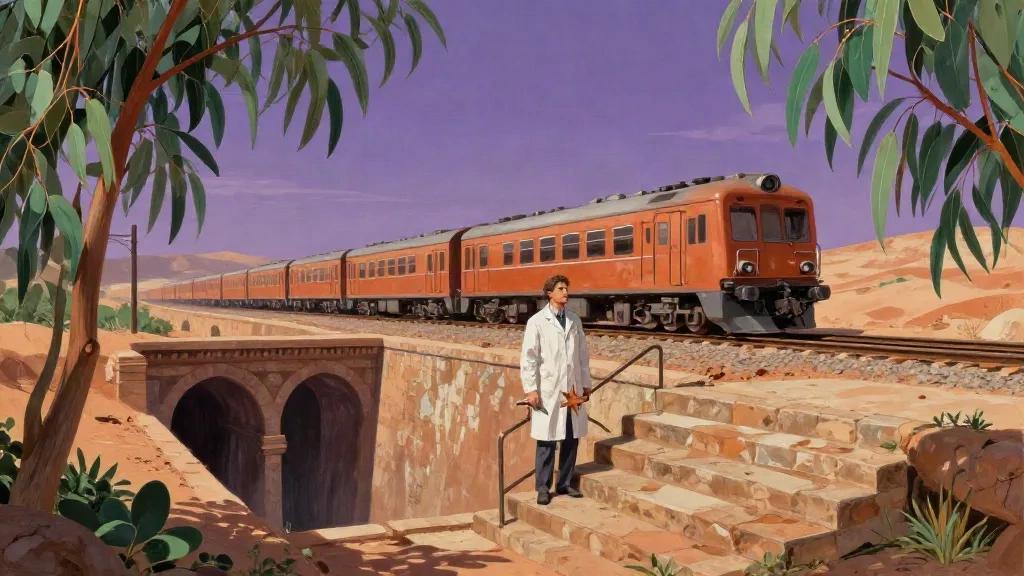
Dr. Ilyan Vale kept his office in the abandoned signal box at Kestrel Halt, where the heat entered through the roof tiles and the eucalyptus trees cast thin blue shadows over the rails. He treated homesickness as if it were a disease: dizziness at the scent of soap, nightmares filled with kitchens, a sudden inability to recognize one’s own reflection.
His remedies were practical. He asked patients to name the room they missed, then described its exact dimensions. He prescribed dust from the place of departure, mixed with tea and a little salt. When that failed, he gave them a story about a person who still remembered them.
On the evening the train came, Ilyan was treating a woman who could not stop weeping for a childhood house.
“It is not the house,” he told her. “It is being expected there.”
Nothing leaves a person more homesick than the certainty that the world has gone on without their return.
At midnight, the rails began to sing. The sound rose from beneath the ballast, through the eucalyptus roots, into the brittle air. The station clock stopped at 11:58.
The Buried Waterline
The train arrived without smoke. Its carriages were painted the red of terracotta roofs, and their windows shone with the pale interior light of a summer decades gone. The conductor wore a silver watch that ran backward.
“Return passage,” he said, showing Ilyan a punched ticket. “One passenger. Destination: before the flood.”
Ilyan looked inside. The seats were upholstered in green velvet. On every armrest rested a small music box, all playing different tunes. A copper star hung from the ceiling, turning gently although there was no wind.
Behind the train, water surged through the dry wadi. A wall had split open beneath Platform Nine, exposing a stone stairway and rows of brass nameplates. The buried project had been a civic reservoir, built before the desert became permanent. Its foundation held the names of every family the government had promised to house after the next flood.
The physician understood then. The train had arrived not from another century, but from the moment when the reservoir was completed and the promised neighborhoods still existed. It had been waiting beneath the station, carrying those displaced people toward a home that had never been built.
A Machine for Remembering
The woman from his office pressed her hand to the glass. Her lost house stood on the other side of the completed reservoir, its kitchen bright, its door unlatched.
The conductor opened the carriage. Inside, every seat was occupied by people Ilyan had treated. They looked through him.
“I can restore one route,” the conductor said. “A platform, a neighborhood, a century. But the route must remain open. If it closes, everyone aboard loses the place they are traveling toward.”
Ilyan wanted to board. He wanted a train carrying the vanished villages, their courtyards, their unfinished gardens, their ordinary rooms where someone had left a bowl on the table. He could build a place for the homesick if only he could keep the machine fed with departures.
But the copper star above him had begun to turn toward the buried names.
He climbed the brass stairs. At the top, he found levers marked with present, proposed, and surrendered. A fourth lever was blank.
The Doctor’s Blank Instruction
The music boxes stopped one by one. In the silence, the water struck the reservoir wall.
Ilyan took the blank lever. The conductor frowned. “That destroys the route.”
“No,” Ilyan said. “It returns the choice to the passengers.”
He pulled it down.
Every window became a door. The train released the people into the station, not into another century, but into the dry morning where they could build with the materials they had carried: bricks from demolished homes, seeds, letters, spoons, blue tiles, a child’s wooden horse.
The woman was the last to leave. She stepped down carrying a music box with no tune.
“I still miss the house,” she said.
“Then remember the person who lived there,” Ilyan replied.
The train began to dissolve, its carriages becoming heat above the sand. The copper star fell from the ceiling and struck the reservoir stair. Inside it, the stolen decades burned away. What remained was a plain fragment of metal, useless and reassuring.
By sunrise, the flood had retreated. The brass nameplates lay exposed in the wadi, and townspeople gathered to read them. No one knew who had been meant to live in the neighborhoods named there. Ilyan proposed a different civic project: a public garden, with rooms made from recovered bricks and no fixed assignments.
Years later, travelers still came to Kestrel Halt. Some waited for the train. Some heard music beneath the sand.
Ilyan left the office door open and placed the copper star on his desk. Above it, the eucalyptus trees shook in the morning wind. The station clock remained at 11:58.
It was not stopped, Iylan decided. It was keeping the moment before departure, when every lost place was still possible.





