 Netwrck
Folk Horror.
The House With Two Shadows
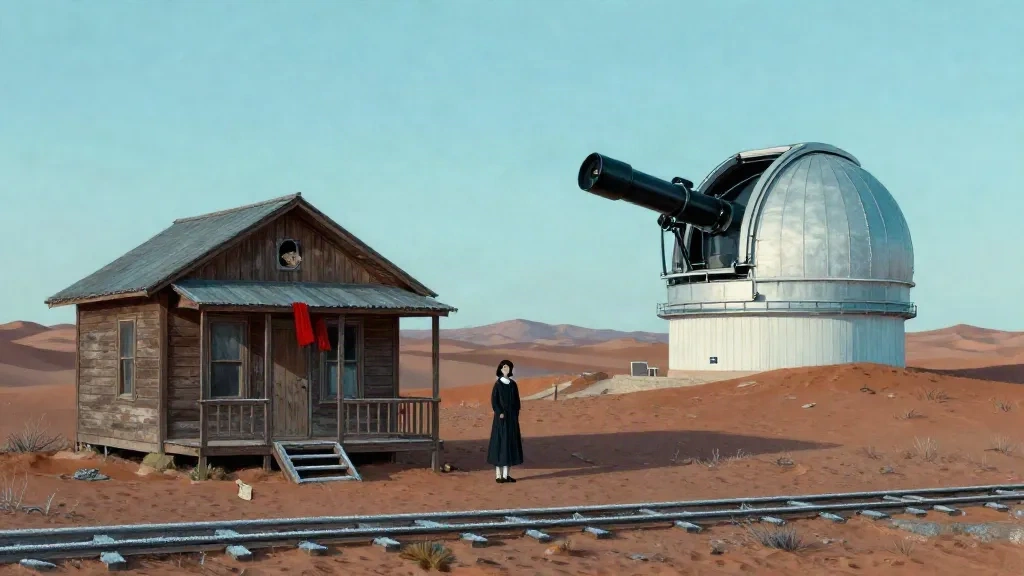
By the time Mara Venn reached the house outside Veyra Station, the well had frozen from the inside out. Frost silvered the pump handle. Beyond it, the desert shone beneath a dawn that had no sun, a soft cyan light rising from the horizon and turning the dunes into the backs of sleeping animals.
The house belonged to an old woman named Salla, who sat beside the stove with one hand pressed to her chest. A red scarf lay across her knees. It was the same scarf Mara had once tied around her own neck, years ago, when she left the village without saying goodbye to her brother.
“It has been speaking,” Salla said.
Mara listened. The walls gave a low breath. Behind the plaster, pipes knocked in a patient rhythm. From the floorboards came the faint scrape of a train ticket being pulled across wood.
“Not the house,” Mara said. “The people in it.”
Salla’s mouth tightened. Her son, Iven, worked at the observatory and was leaving for the northern relay station before the next impossible dawn. They had not spoken in eleven days.
Mara unpacked her medicines: iron filings for headaches, salt for names that had grown too heavy, and a small silver bell to call the living back from wherever grief had taken them. She had treated homesick houses since childhood. Their owners brought her complaints of cold floors, doors opening onto wrong years, and bedrooms that kept repeating the last words spoken in them.
She placed the bell on the table. The house immediately went quiet.
Every Ending Is a Mistake
The stationmaster arrived before midnight. His name was Oren Vale, and he wore a coat white with frost though the desert was warm beneath the cyan dawn. He carried a ledger of departures, each page crowded with names, destinations, and times.
“There has been a mistake,” he said. “The northern train leaves at dusk, but it should have left yesterday. Iven is scheduled to arrive before his own departure.”
“That cannot be true.”
“Everything is true if the timetable permits it.”
He opened the ledger. Beside Iven’s name, the ink had bled upward into a sentence: SPEAKER WILL ARRIVE AFTER SILENCE.
Below the house, the observatory answered. Its dome rose from the dunes like a black pearl, its telescope pointing not at the stars but at the pale strip of dawn. Messages arrived there in bundles of light. Every night, the stationmaster sorted them. Every morning, he carried the words into town.
Mara climbed the observatory stairs with him. Inside, the night was thick with moths. They clustered around the lens, wings brushing one another in a sound like whispered names. On the desk lay a red scarf, damp with frost.
She recognized the weave. It was the scarf she had left on the train with her brother.
“Iven found this,” she whispered.
“Iven finds things that have been abandoned,” Oren said. “That is his gift. He can hear the last sentence of every journey.”
The lens flared. A message appeared in the glass, written in letters that were also frost:
DO NOT LET HER LEAVE BEFORE HE ASKS HER TO STAY.
Oren smiled without warmth. “Every ending is a scheduling error. I have corrected them for thirty years.”
The Ticket Under the Tongue
Mara found Iven in the signal room, beneath the great telescope. He was holding a train ticket between his teeth, as if he had been trying to say something he could not bear to release.
“You came,” he said.
“I came because your mother’s house is ill.”
“You came because you heard my message.”
“I came because the observatory is sending messages.”
He looked away. The cyan light caught the hollows beneath his eyes.
“I am not going north.”
“The stationmaster says you are.”
“Oren rearranges departures. He has spent years making certain no one says the last word. If I leave, I will forget why I came back.”
He gave her the ticket. The destination was not a place but a time: 04:17, THE MORNING AFTER.
“I needed to repair this before I left,” he said. “Not the house. Us.”
Then he told her the truth. Their mother had not died. She had boarded the northern train years ago, carrying a red scarf and a promise to return. The house had been calling every traveler who passed through, hoping to hear her footsteps. Iven had stayed to listen.
Mara felt the old shame rise, sharp as swallowed iron. She had left her own family without giving them a chance to answer. Now she was doing the same thing she hated most.
She took out the red scarf. The frost along its fibers melted into a dark, living red.
The Dawn That Could Not Arrive
Oren appeared at the doorway with the ledger dripping water. Behind him, the stars were falling into the desert, one by one, each making a small iron sound when it struck the ground.
“The timetable is closing,” he said.
“No,” Mara said. “You are.”
She took Oren’s pen and crossed out the final departure. The ink fought her. Then Iven placed his hand over hers, and the paper tore cleanly.
The observatory bell rang.
In the signal room, the great lens turned toward the west. A new message burned across the glass, not frost but gold:
STAY UNTIL THE HOUSE FORGETS YOU.
Iven laughed. It was the first sound Mara had heard from him that did not sound borrowed.
“That is not an ending,” he said.
“No,” she replied. “It is a beginning.”
At sunrise, the impossible cyan dawn softened to pearl. The red scarf hung beside the stove, dry and warm. On Salla’s table, the train ticket had become blank paper.
Mara and Iven sat together while the house breathed around them. Outside, the desert began to lose its stars. Oren walked toward the station, carrying his ledger open to the final page.
There was no name on it. For once, he did not write one.





