 Netwrck
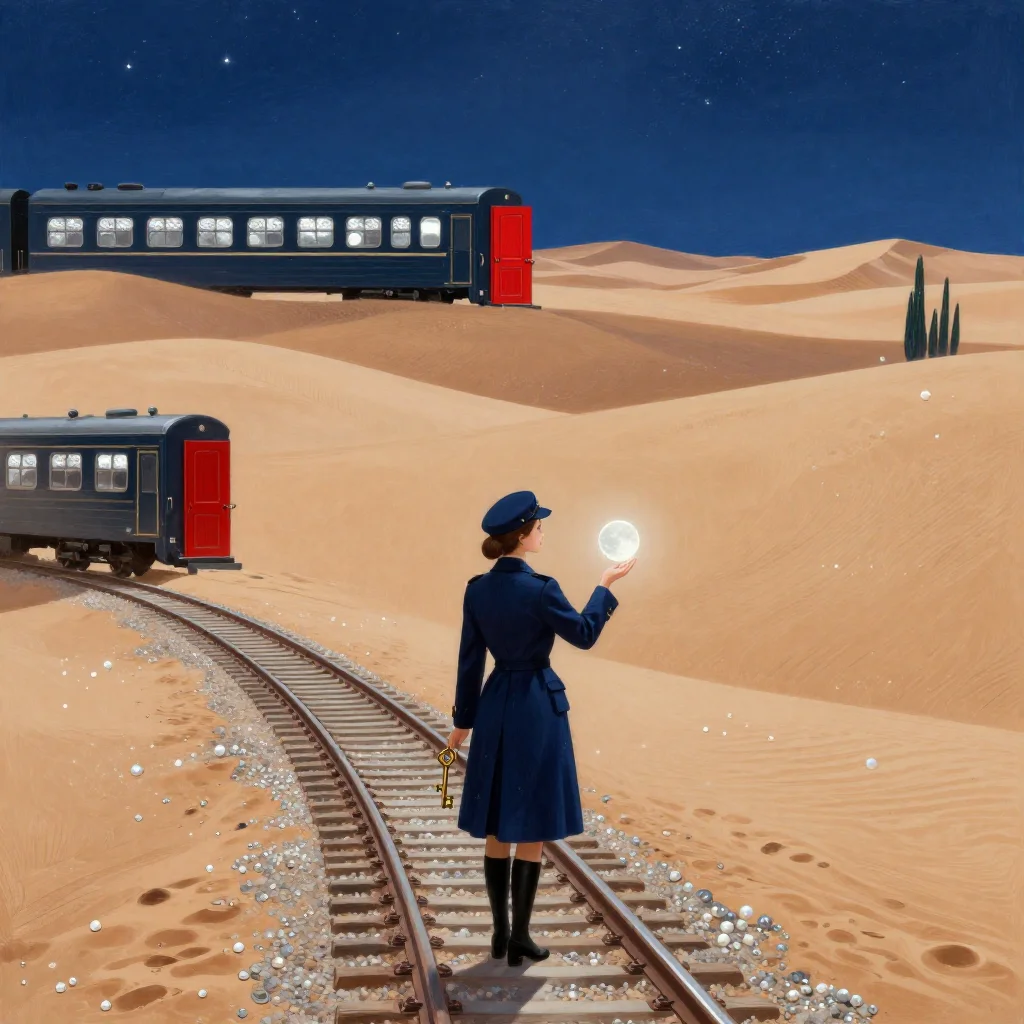
Magical Realism.
The Forest That Had Been Missing
On the night the forest disappeared from time, Mara Vale was standing beneath its oldest cedar with a jar of lamp oil and a list of forbidden fires.
The cedar had not withered. It had simply ceased to belong to the year. Leaves hung in the air without casting shadows. Owls called from a sky that was no longer above them, their voices traveling backward through the branches. At the forest edge, the ranger station showed three years of repairs in a single night, all the nails bright and the paint still wet.
Mara received the order before dawn. The forest had been evacuated from time and assigned to her protection. A red door had appeared at its northern boundary, locked with a brass key too large for any ordinary lock.
Her predecessor, Tomas Arendt, had vanished while carrying the key. He had left behind a timetable, a pair of gloves, and these words: Finish the journey. Do not let the small moon go out.
No one knew where he had gone. The railway station at Vesper, where the forest met the desert, offered one answer each evening. At 2:13, a train arrived from another century.
The Train With Pearl Windows
The station had been built for a railway that no longer existed. Its platform stretched beneath a pearl-colored sky, though night had already fallen over the dunes. Brass lanterns burned without fuel. The rails hummed beneath the sand.
Mara reached the station with the key inside her coat. The stationmaster was a small, courteous creature with a face like a folded timetable. He watched her from the ticket window.
“You are late,” he said.
“The forest was in the wrong century.”
“That is not lateness. That is geography.”
He placed a blue ticket on the counter. Its destination read: Where the Journey Began.
“Tomas purchased that,” Mara said.
“Tomas purchased a seat.” The creature tapped the ticket with one precise finger. “The journey is not the same thing.”
At 2:13, the train arrived without sound. Its windows were pearl shells set in midnight-blue steel. Inside sat passengers reading newspapers dated 1788, 1841, and 2096. One child waved from a compartment marked RETURNING.
The conductor stepped down wearing a silver mask. “You have the key,” he said. “You do not have the hour.”
Mara showed him the brass key. He nodded and fastened a blue thread around her wrist.
“Tomas must return before the moon sets,” he said.
“He has been gone for three years.”
“Then he has three minutes left.”
The Curfew of the Sand
The creature at the station was not hostile. It stood beyond the platform with a long, pale body and eyes like polished stones. It raised one hand, and the dunes began to arrange themselves into narrow streets.
“Curfew,” it said.
Mara looked at Tomas’s note. He had written a final line beneath the instructions: The curfew is not punishment. The night must be counted correctly.
The creature pointed toward the sky. A small moon hung above the desert, no larger than a coin, though it cast a silver circle around the train.
“Before moonrise,” the creature said, “you may cross the open sand. After moonrise, you may cross only what has been named.”
Mara ran.
She passed dunes marked with names of vanished wells, a canyon where wind wore the shape of a doorway, and a field of blue grass that sang in voices she recognized. At every turn, the creature appeared farther ahead, never hurrying, always precise. It closed one street before she entered it. It opened another when she named the traveler who had used it.
The small moon sank behind the ridge.
The curfew began.
Sand flowed across the path. The creature stood before a narrow arch of black stone.
“Name the road,” it said.
Mara understood.
She held up the brass key. “The road Tomas Arendt began.”
The creature studied her. “That road has no destination.”
“It has a passenger.”
For the first time, something moved across its stone eyes: recognition, or grief, or the memory of either.
It opened the arch.
The Door Inside the Carriage
Beyond it stood the last carriage of the train. Its door was the only red thing in the desert.
Tomas sat inside, younger than Mara remembered, holding a small moon in both hands. His coat was covered in frost. When he saw the key, he smiled.
“You found it,” he said.
“You left it for me.”
“I left the journey.”
He explained that the forest had not been destroyed. It had been removed from its century to protect it from a fire that burned through dates rather than trees. Tomas had carried the forest’s seed into the train and intended to deliver it to a winter that had not happened yet.
But the train had mistaken him for a passenger without a destination. The brass key was not for the red door. It was for the forest’s final boundary, and the boundary could be opened only by someone carrying both the key and the journey’s unfinished promise.
Mara held out her hand. “Give me the moon.”
Tomas placed the small moon in her palm. Cold light spread through her fingers.
“The train leaves in one minute,” he said. “The forest will return, but the station will be gone.”
“And you?”
“I began this journey.”
“Then finish it with me.”
He shook his head. “No. You were sent to protect what remained.”
Mara looked at the red door. Behind it, she heard leaves moving in a century that had almost vanished.
She turned the brass key.
The door opened onto the cedar forest. Midnight-blue wind poured through the carriage. Tomas stepped across the threshold, carrying the small moon above his palm.
“The journey starts here,” he said.
They crossed together before the final carriage vanished.
The Line That Held
At dawn, Mara stood on the desert platform with Tomas beside her. The forest had returned, older and quieter, its borders marked by blue grass. The station remained, but the rails now ended at a single red door.
The stationmaster approached with a ticket book. “One journey completed,” he said.
Mara looked at Tomas. He shook his head.
She placed the brass key on the counter. “One journey finished,” she said. “Another begins when the next forest is lost.”
The small moon had become a pale bead in the western sky, visible above the dunes. Tomas lifted his hand toward it, and for one moment the desert glittered like a shell.
Then the train arrived. This time it carried no passengers, only a forest growing silently in every window.
Mara took the key from the counter and stepped aboard.
Behind her, the stationmaster opened the red door. Beyond it, the cedar forest waited.
Some journeys end when the traveler returns. The important ones teach the road to keep going.





