 Netwrck
Weird Fiction.
The Last Woman in Orbit
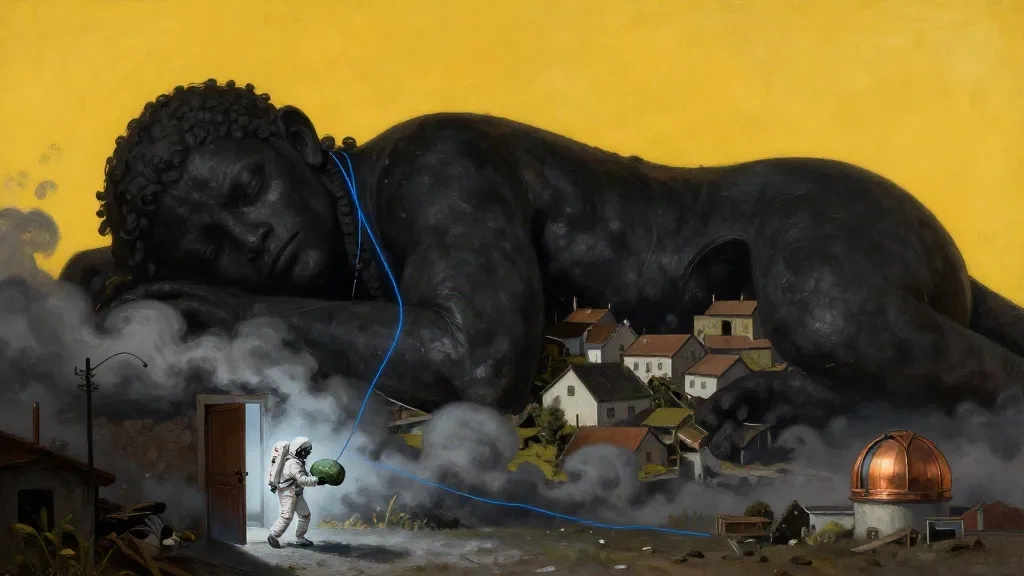
On the night the village marked its eighty-second winter, Captain Iona Vey climbed into the narrow observatory beneath the seventh rib of Sleeping Gar and refused to come down.
She had once mapped coastlines from orbit. Now the maps lay rolled in her locker, their blue oceans faded to smoke-grey, their continents revised after every rumour of catastrophe. For six years, Iona had watched the planet through a copper eyepiece. Earth, she insisted, was merely a report compiled by unreliable witnesses.
“Reentry is only a habit,” she told the mayor. “I remain in orbit until the noise stops.”
She needed one voice lifted from beneath the village’s official noise. It belonged to Eda Venn, the last bell-ringer, whom the histories had reduced to a background hiss: maintenance, weather, municipal weather, weather again. Iona carried Eda’s final surviving artefact, a green stone no larger than an eye, and a coil of blue thread from the observatory loom.
According to the damaged register, Eda had entered the giant’s third rib on midsummer night and spoken into a chamber no surveyor had mapped. What she said there was lost when the chamber was bricked over.
A Door With No Outside
The storm arrived as a saffron glow beneath the ribs.
First the doors changed direction. Then the village itself misremembered its shape. Saffron banners tore from their rails and vanished into the plum-dark seams between the giant’s bones. Smoke-grey air pressed through the walls, carrying the taste of wet iron.
Iona entered the third rib with the green stone in one hand and the blue thread trailing behind her. Halfway down the passage, a kitchen door opened across the corridor. Through it came the clatter of dishes.
Inside, the Venn family sat around a table while wind rearranged the cupboards. Eda Venn occupied the head of it, exactly as Iona remembered her from childhood: narrow-faced, soot on one ear, lips shut in a private smile.
The real Eda had died thirty years before the village entered the giant.
“You are interference,” the false Eda said.
Iona laid the blue thread across the table. The storm snapped a door open in the floor.
Beneath, doors hung from the walls in rows, hundreds of them, all opening and closing without rooms behind them. People stumbled through: the mayor carrying a bucket of stars, children dressed in years they had not lived, a watchman who crawled out wearing Iona’s captain’s coat.
Every door led to a version of the village. In one, Gar was awake. In another, the village had never been built. In a third, Earth was confirmed and Iona had boarded her final ship.
“Choose quickly,” the storm said through every hinges.
The Uses of a Rumour
Iona tied the blue thread to the green stone and threw it into the nearest darkness.
The thread pulled taut, though the stone had vanished. A door swung wide across the floor. Beyond it waited the chamber from Eda’s register, its walls lined with thousands of speaking horns.
Every official account of the village poured into them. Births. Floods. Elections. Fines for forgetting the proper dead. The steady, reassuring drone that taught everyone to hear nothing.
At the centre, Eda stood with her mouth against an empty bell.
“I left no message,” she said.
Iona’s hands closed around the blue thread. “Then what did you come here to unsay?”
Eda looked at her with the pity reserved for those who had mistaken orbit for distance.
“That there is no here,” she whispered, “when every place can be opened elsewhere.”
Behind Iona, the false village began collapsing room by room. Doors slammed through walls. The watchman in her coat vanished after calling her a coward who had orbited grief because descent required a direction.
Iona pulled the thread. The green stone struck Eda’s empty bell and cracked it open.
No Message Is Also a Message
The voice arrived all at once.
Not Eda’s words, but the removed space where they had been. It tore through the horns, through the storm, through the histories folded inside the sleeping giant. The village heard its past without the polished voice that had reduced it to noise.
Some remembered bread burning in the western rib. Some remembered children digging a tunnel toward the heart and finding only packed earth. Some remembered the first morning the doors had moved.
Iona heard herself remembered, too: a woman circling above an ocean she feared to touch.
The chamber filled with saffron light. In it, the green stone split into two smooth halves. Iona understood at last that history had not buried Eda. History had made her continuous, a murmur beneath every event, and had called that erasure.
She tied the halves together with the blue thread and fastened them to her captain’s coat.
Then she stepped through the last door.
It opened onto the third rib, beneath a sky crowded with familiar stars. Eda’s voice stayed in her pocket, not louder, but impossible to mistake for weather.
For the first time in six years, Iona let herself fall.





