 Netwrck
Science Fiction.
The Train from Beyond the Heat
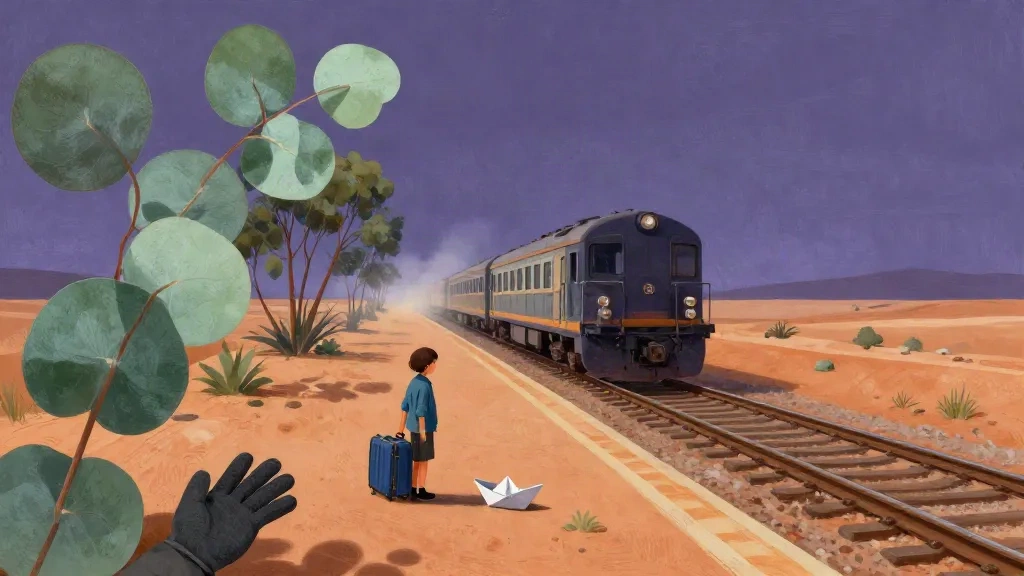
At noon, when the station walls turned the color of fired brick, Mara sat beneath the brass clock and counted the grains in its blue-painted face. She was eleven, and the blue suitcase beside her contained a library: forty-one books, seven atlases, a roll of silver film, and one empty jar where a constellation ought to be.
The station stood in the desert between two dry rivers. Eucalyptus trees leaned along the platform, their leaves whispering in a language older than the rails. Beyond them, the sky had the bruised purple of a plum cut open beneath a thumb. Every night, Mara checked the missing place where the Glass Sparrow had been. Someone had taken those stars years before she was born, folded them into the sky like paper, and hidden the fold.
The schedule board clicked. A train would arrive at 12:17 from 1891, its engine smelling of rain and hot iron. Mara had brought the timetable on microfilm, but the station clock had no minute hand. Only a thin red pointer trembled between the numbers.
In her suitcase, one of the books hummed whenever the train approached.
A Deadline With a Pulse
The stationmaster brought a telegram on a silver tray. He was an old man with eucalyptus-green sleeves and a face folded into careful creases.
THE DEADLINE IS INHERITED. THE PERSON HAS NOT DIED.
Mara read the words twice. The signature belonged to her mother, who was alive in another century and had sent the message from a hospital bed that would not exist for ninety years.
“She said the stars must be returned before the sleeper wakes,” Mara said.
The stationmaster glanced toward the tracks. “The train carries a passenger who has not boarded.”
At 12:17, the rails began to sing. Mara tucked a wool glove into her coat—one glove, charcoal gray, missing its partner. She had found it inside a book of tide tables, though no tide had ever reached this station. In the other hand she held a paper boat folded from a timetable page. She set it on the platform rail and watched the wind lift its bow.
The Carriage of Borrowed Hours
The train arrived without stopping. Its windows were dark except for one, where a girl in a white winter dress held a lantern against the glass. Inside, every seat faced backward.
Mara climbed aboard. The conductor wore a watch around his neck and led her through coaches containing rooms that had not yet been built. A nursery. A flooded library. A kitchen where a woman kneaded dough beneath a moon of green fire.
At the final carriage, a man slept beneath a wool blanket. His face was Mara's mother's face, but younger, and his hand rested on a paper boat identical to hers.
“You are late,” he said without opening his eyes.
“You are not dead,” Mara replied.
He smiled. “Not yet. That is why the stars cannot stay hidden. The sky has borrowed them from a night that is still being lived.”
She opened the blue suitcase. The books pressed against one another, their spines warm. The missing constellation appeared in the window as a scatter of cold points. She held the jar beneath them, counting: one, two, three.
The train began to slow. Outside, the desert had vanished. Mara saw the station as it was centuries before: white walls, a young eucalyptus grove, and a sky without a bruise.
She released the points into the jar.
The Fold in the Sky
The wool glove stirred in her pocket. The paper boat on the platform began to burn, though no flame touched it. Mara understood then that the objects were not tokens. They were bearings: the glove pointed toward the living deadline, the boat toward the place where time could be opened.
She threw the boat from the carriage. It sailed upward, through the dark window, and became a constellation of seven white birds. The wool glove followed, opening like a small gray moon.
The sleeping man opened his eyes. “You have returned the stars.”
“Not yet,” Mara said. She emptied the jar toward the unbroken desert sky.
The Glass Sparrow burst into place. Its light fell across the train, the station, and the old man’s face. Somewhere in the stationmaster’s ledger, a red number vanished. The clock’s minute hand appeared at last, pointing to 12:17.
Mara woke on the platform, clutching the blue suitcase. The train was gone. Above her, one star shone where none had been before.
In her coat pocket was a single wool glove, warm from the future.
She did not know who had sent it. She knew only that the deadline had passed, and that someone, somewhere, was finally safe to die.





