 Netwrck
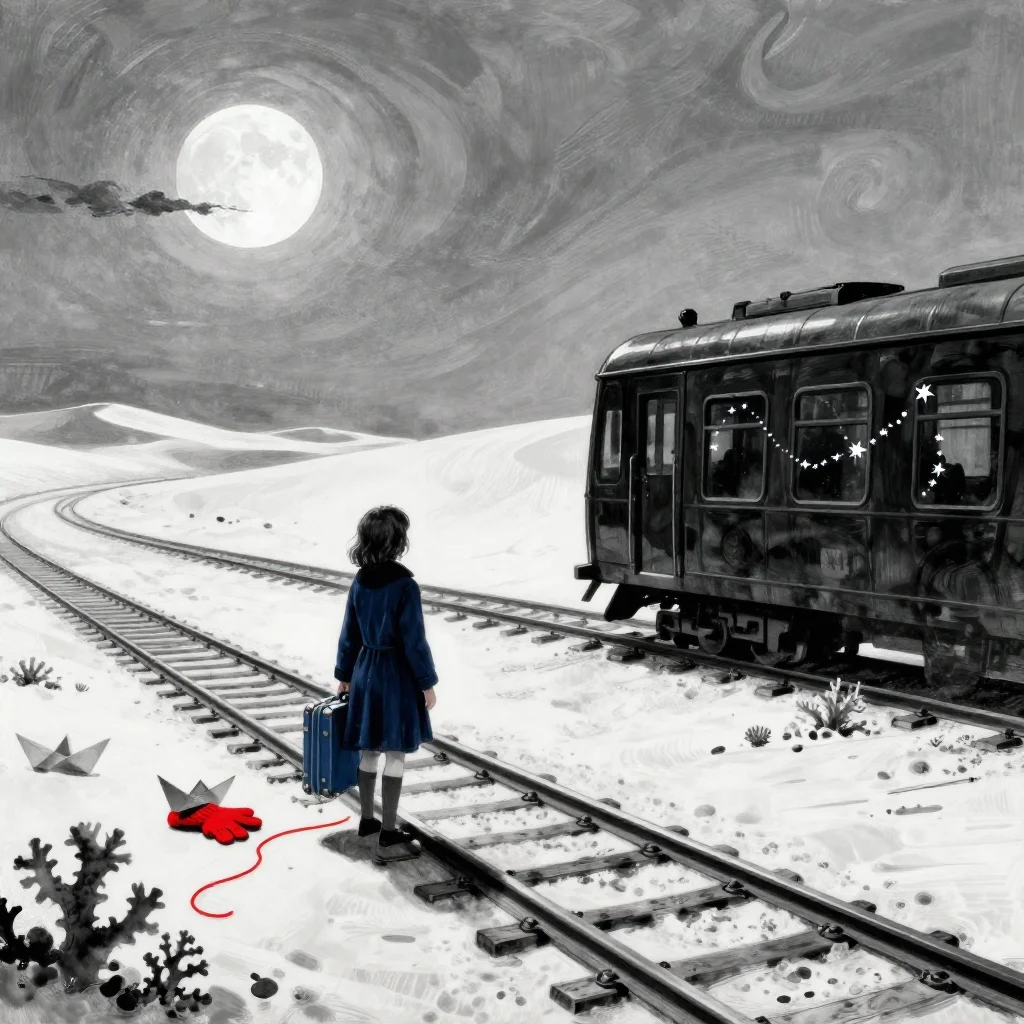
Gothic Fantasy.
The Blue Suitcase
Mira was twelve when the library began losing its margins.
She kept it in a blue suitcase beneath the station cot, where the wool of the old blanket softened its wheels. Inside were shelves no larger than matchboxes: histories of cities erased by sand, alphabets belonging to birds, and a copy of every star chart ever drawn. When she opened the case, the books breathed cold air over her wrists.
Her mother had sent her to White Coral Station with three instructions. Keep the suitcase closed when the wind rose. Do not speak to anyone wearing white gloves. And before the moonless eclipse, find the train from the year that had not happened yet.
The third instruction was the difficult one. Her mother was alive in the village beyond the dunes, mending signal flags and refusing to discuss the year of Mira's birth. She had placed the deadline into Mira's hand as if it were a coin.
The Train from Tomorrow
The railway ran on two rust-red rails, each buried beneath a skin of white salt. At noon, the signal lantern turned toward the empty desert. At sunset, a low whistle sounded from nowhere.
Mira climbed onto the platform with her suitcase bumping her knees. The station clock had no hands, only a red thread stretched around its empty face. Every gust pulled the thread taut across the benches, the ticket window, and the cracked sign.
The train arrived with no engine. Its carriages looked like black glass boxes, and inside them moved shadows with the gait of people. One window displayed a sky crowded with unfamiliar constellations. Among them was a crooked crown of seven blue stars.
Mira knew it immediately. The chart in her suitcase had shown that crown once, before the pages had gone blank.
A conductor stepped down wearing a white wool glove on one hand. In the other, he held a folded paper boat.
The Passenger Who Lived
He said the train carried only passengers who had not yet decided to die.
Mira tightened her grip on the suitcase. The conductor's shadow fell across her feet, although the sun was behind him. He placed the paper boat on the platform. It floated upright, though there was no water.
Your mother sent you, he said.
She is alive.
So is the deadline, Mira answered. She had learned that much from the station records.
The conductor nodded. Inside the nearest carriage, a woman sat beneath a red wool blanket. Her face was hidden, but her fingers moved through the air, stitching red thread between the constellations painted on the window. The thread passed through the glass and across the ceiling, joining every carriage to the rails.
Mira climbed aboard. The train smelled of dust, iron, and wet paper. Books slid from the walls as the wheels began to turn. Outside, the desert fled backward, and the station shrank into a white bead of light.
In the second carriage, she found shelves filled with discarded names. In the third, a dead city slept beneath a ceiling of stars. The crooked crown hovered in the last carriage, but each time Mira reached for it, the stars retreated behind another door.
A Map Made of Loss
The conductor followed, folding and unfolding the paper boat. The train began to slow. On the platform outside, Mira's mother appeared, small and impossible beneath the white salt, still alive and still waving.
You promised me a deadline, Mira shouted.
The woman's voice came from every carriage at once. I promised you time.
At the final door, the conductor held out the paper boat. Mira placed it on the floor. The wool glove lay beside it, pale as a sleeping animal. She understood then that neither object was a key. They were measurements.
The glove measured the space left by the absent hand. The boat measured the water that had filled the station before the desert arrived. Together they showed how the stolen constellation had been taken: not through the sky, but through the story of the place beneath it.
Mira opened the blue suitcase. Every book spoke at once. She tore no pages. Instead, she arranged the volumes on the floor and used the conductor's red thread to stitch their shadows together. A map appeared beneath the train: White Coral Station before it was built, a shining lake, a village of glass roofs, and above it the crooked crown restored to its proper darkness.
The train stopped. Mira stepped onto the red thread stretched between the carriage and the desert. Behind her, the conductor's glove fell from his hand. The paper boat sailed across the salt.
At the final signal, the seven blue stars rose from the windows and fixed themselves above the empty railway. Mira closed the suitcase. The library was lighter by one constellation, and the world was heavier by exactly the same amount.
Her mother waited beside the rails.
Did you bring it back? she asked.
Mira looked up. The stars were small, cold, and impossible to mistake.
No, Mira said. We brought the sky home.





