 Netwrck
Science Fiction.
The Library of What Came Next
Everyone in the Starling House remembered tomorrow, except the children. Their memories went elsewhere, into halls smelling of wet wool and eucalyptus, where futures waited behind locked doors like restless animals.
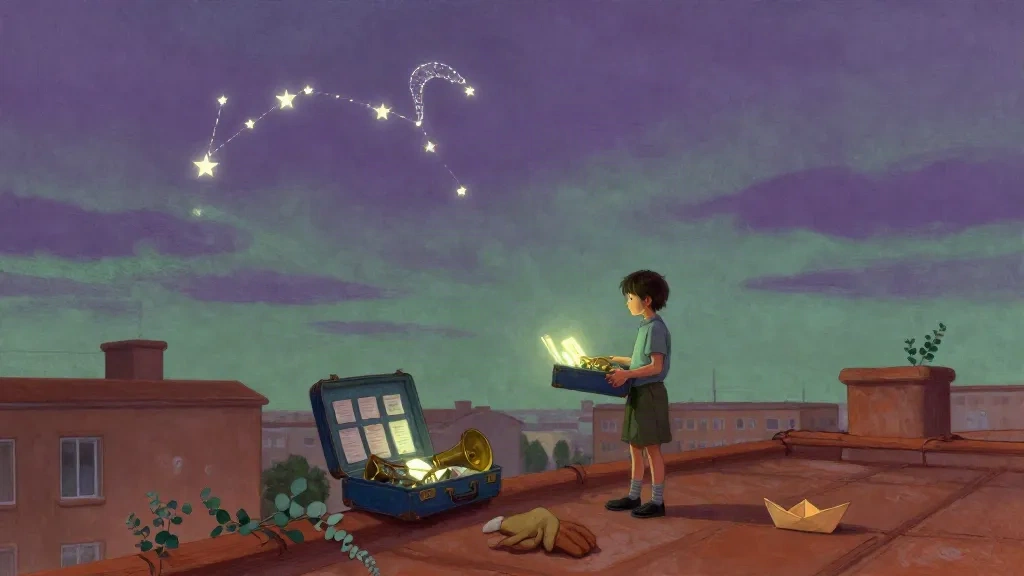
Mara carried her work in a blue suitcase. Inside were three shelves of catalog cards, a brass key that opened no ordinary lock, and a wool glove with one finger missing. The glove belonged to the woman who had left the constellation on the roof.
She had been gone for one year, which was not gone at all. In Starling House, distance measured in memories. The woman had left her future behind in a paper boat and carried only her present toward the river.
Mara's task was simple: return the constellation.
It lay beneath floor nine in a tin of blue sealing wax, thirteen bright pieces pressed into shapes like fragments of a window. The building had taken them from the sky on the night the first future-rememberers arrived. Since then, every night had been dimmer, and every child had dreamed of an empty patch overhead.
The Deadline Not Yet Dead
The architect of Starling House had left instructions in a brass ledger. He had inherited the deadline from his daughter, who was still alive on the seventh floor and had not yet reached the hour when her death would become a memory.
“Before she remembers dying,” the ledger said, “bring back what belongs above.”
Mara disliked instructions written by people afraid of a particular future. Still, she copied them neatly, because the building obeyed paper more reliably than it obeyed adults.
On the seventh floor, Nadia sat beside a window, turning a paper boat in her hands. Its paper was thin as skin. Each fold made a small sound, like a mouth opening underwater.
“You came early,” Nadia said.
“You died late,” Mara replied.
Nadia laughed. It was the first time Mara had heard a future-rememberer laugh before the joke. Her hands were stained blue with ink, and the missing finger of the wool glove lay in her palm like a severed shadow.
“I will remember my death tomorrow,” Nadia said. “Then I will remember remembering it. After that, the building will take me away.”
Mara placed the glove on the table. “The architect says I have until midnight.”
“Architects say midnight when they mean the roof.”
What the Roof Remembered
They climbed through the service stairs while the tenants slept in their borrowed tomorrows. Door 8-B opened onto a kitchen where tomorrow's weather dripped from the ceiling. Door 8-C opened onto a bedroom in which two people were simultaneously leaving.
The roof waited under a bruised-fruit sky, purple at the horizon and green where the stars had been removed. Mara opened the suitcase. The wool glove warmed in her hand. The paper boat trembled against the blue wax.
She had expected a machine. Instead, there was a small brass astrolabe bolted to the chimney, its rings turning without wind. The constellation's socket was visible: thirteen dark hollows in the shape of a swan.
Nada's paper boat began to unfold itself.
“That is the key,” Mara said.
“That is me,” Nadia replied.
The boat filled with rainwater, though the roof had been dry for months. Inside it, a tiny sky appeared, turning slowly. Mara understood then that the constellation had not been hidden in the wax. It had been folded into Nadia's life, waiting for the person who would remember its theft.
She dropped the glove into the boat. The wool darkened, drinking the miniature stars. Nadia gasped. On the roof above them, the empty swan-shaped patch brightened.
The Shape of Return
Midnight arrived early, as deadlines do when they are inherited.
The building shook. Below them, every tenant woke remembering a different version of the same night. In the lobby, the elevator opened onto a beach that did not exist. Somewhere, a baby laughed in a room filled with falling snow.
Nada climbed into the paper boat. It was large enough now, its paper stretched into a bright membrane. Mara grabbed the suitcase handle, refusing to lose the catalogued future, though the cards inside had begun to burn.
“You cannot save everyone,” Nadia said.
“I am not saving everyone. I am keeping a promise.”
Mara pulled the wool glove over her missing finger. The stars poured through the paper, through the roof, through the violet air. They returned to their proper places one by one, and the sky closed over the wound.
Nada did not die. Instead, she became the first person in Starling House to remember a future that had not happened.
In the morning, children gathered on the pavement and learned the names of the stars by looking up. Mara returned to her blue suitcase. Its shelves were empty except for one card, written in her own hand:
Return what has learned to fly.
She left the paper boat on the windowsill. It sailed across the room without water, carrying the wool glove toward a sky that had finally remembered its shape.





