 Netwrck
Speculative Fiction.
The Train That Missed the Century
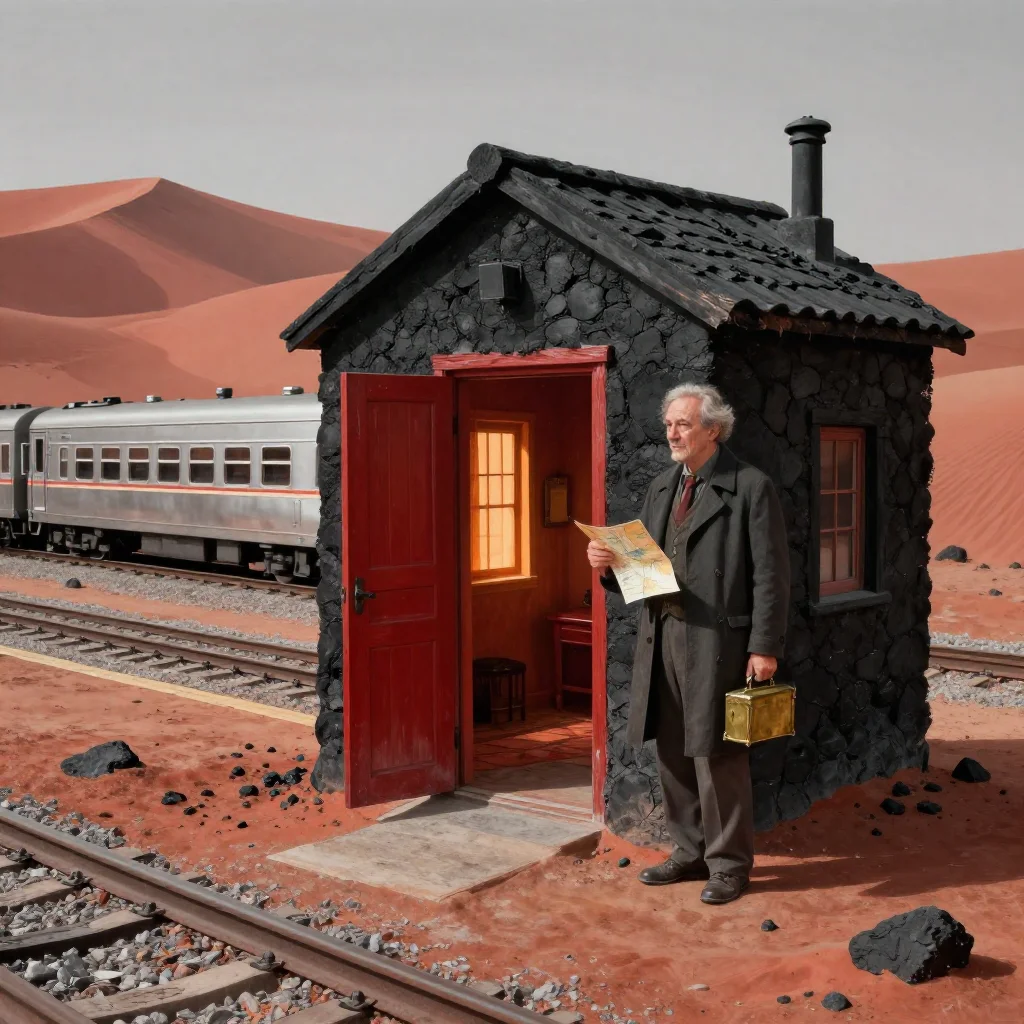
At Platform Sixty, the rails ended in a bar of rust-red sand.
Elias Vale stood beneath the station clock with a folded map going soft along its creases. He had been an actor for fifty-three years, and for forty of them he had played men who came back from impossible distances: the returning soldier, the exiled husband, the father with a telegram in his coat. Now he was merely an old man waiting for a train the timetable openly admitted was not scheduled.
The clock above him had no numbers he trusted. Marks like numerals, or like the memory of numerals, cut into the iron face. He counted them once, from the top, and lost his place between the fourth and the fifth. He counted them again and lost it in the same place. Whatever the face was measuring, it was not the hour he was living in.
The desert gave off a smell of hot iron and cold stone. It was not evening yet, but the light had the exhausted quality of late afternoon, and the shadows of the platform posts lay long and thin as wire.
He had learned the trick of himself years ago, in a rented flat in Leeds, and he had never told anyone how small the trick was. He could re-enter any room he had ever left. The room was not the difficult part; rooms were only furniture and light. The difficult part was the leaving. A bedroom door drawn shut behind him. A hospital corridor with the smell of lemon polish. A dressing room where his daughter, Nina, had told him she never wanted to speak to him again, and had then, for eleven years, declined to prove it.
The rails hummed. Nothing was on them. Then something was: a locomotive coming in without smoke, its cab lit with a pale winter light that had no season in it at all, arriving on rails that were not there a moment before. A young man in a conductor’s uniform stepped down carrying a wooden box with a brass handle.
“Your daughter sent this,” he said.
“I have no daughter.”
“You have one. You have not seen her in six years.” The young man said it without cruelty, the way a clerk reads a ticket. “That is not the same as having no daughter, sir, and you are going to need the difference.”
Elias watched the iron face above him. One of the marks had moved. He could not tell which. It gave him the sensation of having agreed to something.
“How long have I got?”
“Sixty minutes.”
“Minutes from when?”
“From the first thing you say that isn’t true.” The conductor set the box on the bench and opened it. Inside, on velvet gone brown at the edges, a music box turned its little brass cylinder. He did not wind it. The tune started anyway: six notes, a pause where a note should have been, then six more.
“Sixty minutes,” Elias said, to be certain.
The young man looked at him with something that was almost sympathy. “You are the first one to use it up confirming it.”
The House Behind the Station
Beyond the tracks, where no building had any business standing, a small house sat in the wind. Charcoal walls, a rust-red door, a chimney with smoke coming out of it in a straight white line despite the desert.
Inside, a hallway opened into a kitchen, a pantry, a sitting room full of furniture that had been upholstered by nobody. On the table, in the middle of a tablecloth nobody had woven, the music box was already playing.
Elias knew the tune and had known it since he was four. His mother had hummed it while she worked, and on her last clear day she had made him swear two things: that he would learn it properly, and that he would visit her sister every winter for the rest of his life. He had been twenty-three. He had chosen a tour, and then another tour, and then a life in which promises became lines other people said on his behalf.
“She is waiting,” said the conductor.
“My mother is dead.”
“Your mother is not the one who left.” The conductor looked at the walls, not at Elias. “Do not lie in this house. It is the only place you have ever stood in where the lie has somewhere to stand.”
“I never promised her anything,” Elias said, and heard the sentence leave him with the shape of a door opening.
The wall beside the fireplace bulged outward. Bricks shifted with a sound like swallowed laughter, and a doorway stood where no doorway was, and through it came a kitchen with a cracked window and a kettle blackened by soot, and the smell of rain and boiled onions, and at the table, his mother, thin, forty-one, her hands folded.
“You promised,” she said.
He took two steps. The floorboards of the house creaked under his shoes; the floorboards of her kitchen did not, because her kitchen was not a room he had left. It was a room he had promised to enter and had not. He could see it perfectly well and he could not get into it. When he reached the threshold, the doorway narrowed to a black seam and the smell of onions went out of the world like a light being shut off.
“The room only opens for a liar,” said the conductor, from somewhere in the hallway. “And the threshold only lets the truth through. Those are not the same door. You will find that every time.”
Elias stood with his hands at his sides. On the map, the route began at this house, crossed a red line through the desert, and ended at a small circle marked Sixty.
What the Hour Buys
He did the arithmetic the way he had once learned to count beats under a stage light, quickly, without appearing to do it. The clock spent itself. It had already spent some, on the flat, on the daughter he did not have, on the sixty minutes themselves. Every false statement moved the hand a little. Every true one cost more, and cost more the truer it was.
He tested it, because testing was what he had been paid to do for four decades, in front of people, at volume. He told the conductor the desert smelled of cinnamon. Nothing moved. He said the house had no cellar. The iron face ticked forward with a sound like a beetle in a matchbox, and a small panel of brick in the hallway floor sprang up and revealed a cellar full of standing water and a single white shoe.
Then he said, out loud, plainly, to the empty kitchen: “I did not visit my aunt. Not once. Not in thirty years.”
Nothing moved at all. The hand did not advance.
That frightened him more than the tick. He had spent a lifetime discovering that the truth could be made to serve, that a man could state a true thing so honestly that everyone in the room believed him a liar. The house had no interest in his delivery. It weighed what he said and nothing else.
The Green Room
“I never missed a summer at my aunt’s door,” he said, to the conductor, in the voice he had used for the village elder in Arden, the honest simple man, the man you trust. The clock moved nine minutes’ worth in a single click, and a green door opened in the kitchen wall.
Beyond it: a hallway he remembered in detail and had never once permitted himself to picture. Green paint, the brass rail his aunt had kept too shiny, the smell of pear drops. His aunt, Margarethe, standing with the folded map in her hands, exactly as he had left her in the version of the evening where he had said he would come in the spring.
“You kept the promise in your pocket,” she said, “and never carried it to my door.”
“I can’t get in,” Elias said.
“No. Say it without the costume.”
He stood in the doorway of his aunt’s hallway and told the truth: “I was afraid of it. There was no stage in it.” It cost him the eleven minutes the room had already spent, doubled, taken again. The clock jumped. He came through into the green hallway, and the woman in it did not embrace him; she took the map out of her own hands and put it in his, the way you hand a thing to a courier who has finally arrived.
The Blue Room
“I never abandoned my daughter,” he said, and the lie was so smooth, so professionally built, that it had a kind of music in it. The clock purred. A blue door opened in the hallway, low-ceilinged, lit by a window that should have been higher up.
Nina was in it, at eleven, in the coat she had refused to wear again. This was the room as he had left it: the kitchen of the flat, the morning of the leaving, the door she had held shut with both hands while he said you will understand when you are older and did not turn around in the street for four blocks.
“You can go back into any room you left,” she said. “Why not this one?”
“That is the same room.”
“No. That is the room you rehearsed. This is the one I waited in.”
To get through the blue door he had to say the sentence he had spent six years not saying, and he had to say it in the voice he had used for dying kings, and the house took it at face value and charged him fourteen minutes. He came into the blue light. The girl in the coat did not forgive him. She asked him a question about a bicycle he had promised to fix, and he did not have the answer, and she turned away, and he understood that the room was not a trial. It was an audit. It had no interest in his grief. It had an interest in facts.
The Room of Lights
By the time the sky had gone the color of a bruise over the desert, the house had four rooms more and Elias had stopped counting what the clock said.
The largest of them opened when he said, with fifty-three years of practice behind it, “I was happy.” Not I was happy enough. Not the line from the play. The whole sentence, delivered, and the house opened a door into a vast room full of stage lights, and there he was, young, in the wings, saying you will understand when you are older to a girl who was not yet born, and knowing, with the total clarity of a man alone in the dark, that he had rehearsed that line on a girl of nineteen in a bed in 1971 and had never once used it on Nina at all.
To walk into that room he would have to say the last true thing he had left, and the conductor, from above, said the name of it: “You have been selling your father’s house since 1974. Your aunt knew. Your mother knew. You have let a woman of eighty-three believe her sister’s boy was coming for the winter.”
The clock stood at eleven minutes.
Elias looked at the door, and understood — with the clarity he had spent a lifetime manufacturing on stage — that he had been calculating wrongly the whole time. He had been treating the hour as a bag of coins to be apportioned among the people he had wronged. It was not. It was a single room, and it would admit one man, and that man would have to arrive without a costume.
The Conductor’s Own Doorway
He sat on the bench in the hallway with the map in his hands and did what he had done in every green room, every blue room, every waiting room in every theatre: he waited for the scene to tell him what it wanted.
The scene would not tell him anything. The house did not perform. That was the whole of its mercy and the whole of its violence.
“How long have you had this job?” Elias asked.
“A hundred and six years.” The conductor sat down on the other end of the bench, and set the music box between them like a man laying down a hand of cards. “I was a courier on this line. There was a terminus once; it is a circle now, because a terminus is a promise about a place, and this line was built to carry things that were never going to arrive.” He was quiet a moment. “I have never lost a delivery. In a hundred and six years, I have never once delivered anything. It is not the same as failing, and I would like you to notice that I am the one saying it, and not you.”
“Why bring me the box?”
“Because it is a night for a person who cannot play anything, and because you are going to make a decision tonight, and I would like there to be a witness to it.” He glanced up the stairwell that did not exist. “I have no one to tell things to. I am not asking you to forgive me. I am asking you to be a person in a house while I am in it.”
It was, Elias thought, the most honest speech he had heard in thirty years, and it was also an audition. He had given a hundred of them. He knew the shape of them: the flattery, the modesty, the way a need will dress itself up as a favor. The conductor was lonely, and lonely people are not less truthful, but they are not neutral either. The offer was a hand extended and a door left unlocked.
“Say the other thing,” Elias said. “The thing where you tell me I have been lucky.”
The young man almost smiled. “The hour spends. It does not refill. If you leave with the house, every room in it goes with you, and you will spend the rest of your life in rooms where the people you hurt are standing exactly as they were when you failed them, at the ages they were, asking the same questions. It is very loud. Most men cannot sit in a room with their own mother by the second winter.” The conductor’s voice did not change at all. “Or you take the promise, and the house stays here, and you go forward to a door in the dark in February, and there is nobody at all to tell you afterwards whether you went because you loved her or because you were afraid.”
Elias had spent forty years convincing rooms full of strangers of a feeling, and the relief of that offer was so physical he had to put a hand on his chest.
A Return With a Different Ending
He found the passage behind the last room, the one that had never opened, because there had never been a lie to open it with.
It was a small room with no door, off the pantry, and it contained a chair, a hook, and a coat.
His aunt’s coat. The grey one with the mended elbow, kept in a house in Sheffield he had never once entered, offered to him, as she had offered, every winter, in letters he had answered in April.
“That is the true thing,” said the conductor. “That is the only one you have not spent.”
And Elias understood it then, and it was not a revelation, it was a correction of forty years of bad arithmetic: the ability had always been a coward’s gift. It let him revisit the instant of departure. It had never once let him arrive. Every room he could enter was a room he had left, which meant that the only doors in the world he had ever been able to open were doors behind him, and a man who is only ever permitted to go backward will eventually call it a philosophy.
“If I say it,” he said, “the house ends.”
“The house ends.”
“And if I am lying about why.”
“Then you will spend thirty winters in Sheffield not knowing, and you will be very tired, and you will not be able to check.” The conductor stood. “There is no room in that house that could check you. You built it to be able to check you. I am telling you that this is the last room you will ever have.”
Elias stood in front of a coat on a hook in a room with no door, in a house in a desert, and found that he had nothing prepared. Sixty years of material and not one line. He was, for the first time since 1968, an actor with no scene.
So he said it as a fact, in the flattest voice he owned, with no music in it at all.
“I have known for thirty years that I was not coming, and I let an old woman believe otherwise because I could not bear to hear her say the word promise again.”
The clock went to zero and the hour did not kill him. The house made a sound like a long breath let out of a room, and every room in it folded into every other room: the kitchen with the cracked window and the green hallway and the vast room full of stage lights went down into one dark corridor, and the corridor folded flat, and the coat on its hook was the last thing left standing, and then that too was gone.
Behind the station the train waited with its door already open.
What the Threshold Would Not Let Him Have
“You can bring the house,” the conductor said, “or you can bring the promise.”
“I am not carrying anything.”
“No,” said the conductor. “You are going as a man with his hands empty, which is the only way any of us have ever crossed anything.”
Elias boarded. Behind him the house groaned, folded, and became a dark hallway with four doors in it, and each door had somebody standing in it wearing the exact expression they had worn when he failed them, and he left them there. He could carry them. That was the offer. He would have been able to carry them for forty years and would never once have opened them.
The train went out across the desert beneath a light with no season in it. There were no station names on the signs. The carriage held four seats and no passengers, and the music box Elias had set on the ledge between them played the lullaby with its missing bar, and he noticed, some time in the second hour, that he was counting along and skipping the gap on purpose, the way he had done since he was nine.
At the first stop a young woman in a rust-red coat was waiting on the sand with a key in her palm. She looked at him, then at the dark hallway standing behind him on the platform, and then at him again.
“You came back,” she said.
“No,” Elias said. “I finally went forward.”
He put the key in her hand. She closed her fingers on it. The music box played once more, and the hallway added no room.
Sheffield, February, No Script
His aunt’s house was not a room he had left. It was a house he had never gone to, and so it was the one place in the world his gift could not prepare him for.
That was the part nobody warned him about, and the part he would have been unable to invent: he stood on the step in the cold with his hands empty and his coat buttoned wrong, and there was no doorway waiting to narrow, no room to audit him, no hall with a clock in it. There was a door, and a bell, and a woman who opened it, and he had to do the whole thing at the speed and in the key of real time, with no scene partner to hold him up.
She was eighty-three. She had kept the grey coat. She did not take it from him, and she did not invite him in; she stepped back and let the choice be his, and when he came in out of the cold, the hall behind him stayed shut and stayed ordinary, and no room appeared anywhere in the house, and the house was not a house at all.
He stayed three days. He did the washing up. He was told about a son in Leeds and a daughter in Canada and a boiler that wanted parts, and he listened, and he said nothing memorable, and on the second evening she asked him why he had really come, and he gave her the truth, and she looked at him for a long moment and said, “Well. It’s thirty years late and it’s not nothing.”
He came back in February. And the February after. It was not redemptive; nobody said it was. It was a long, cold, unglamorous sequence of train platforms that were not called Sixty, and he was no longer the best-looking man in any of the waiting rooms, and he learned, over about six years, that the difference between a promise kept and a performance of a promise kept is visible only to other people and never to the man.
Nina came on the eleventh winter. She did not forgive him and she did not say she had not. She sat in the front room and let him make her tea and she told him about the bicycle, the blue one, the one with the bell on the front wheel, and how she had carried it up four flights, alone, at nineteen, in the summer after the leaving, and how she had never once told him, and had not told him now to be kind, but because the house had burned down in 2003 and there had been nobody left to be kind to.
He said, “I could have,” and stopped, because there was no third act in which that sentence turned into anything other than a way of asking to be forgiven, and she had walked across a country to drink bad tea in a house in Sheffield, and it was not for his relief.
He learned the lullaby in her kitchen in the first winter, from a woman who had taught it to his mother, who had learned it from her own mother. She sang the missing bar, and so did he, and it was where it belonged, and it sounded like nothing special at all. He never once got a round of applause for it, and he noticed the not getting.
He never knew whether he went to the door in February for the woman inside it or for the man who had failed her, and there was no longer any instrument in his life that could tell him the difference. He had given that up on a platform in the desert, in exchange for one true sentence, and he had made the trade in full knowledge that the price was permanent and unappealable and would leave him alone with the possibility.
On the last train south the fog came up over the fields. He took out the music box, which had been in his coat pocket every winter for thirty years, and it turned the cylinder, and six notes, and the pause, and six more, and he let it play the whole thing through without a flinch.





