 Netwrck
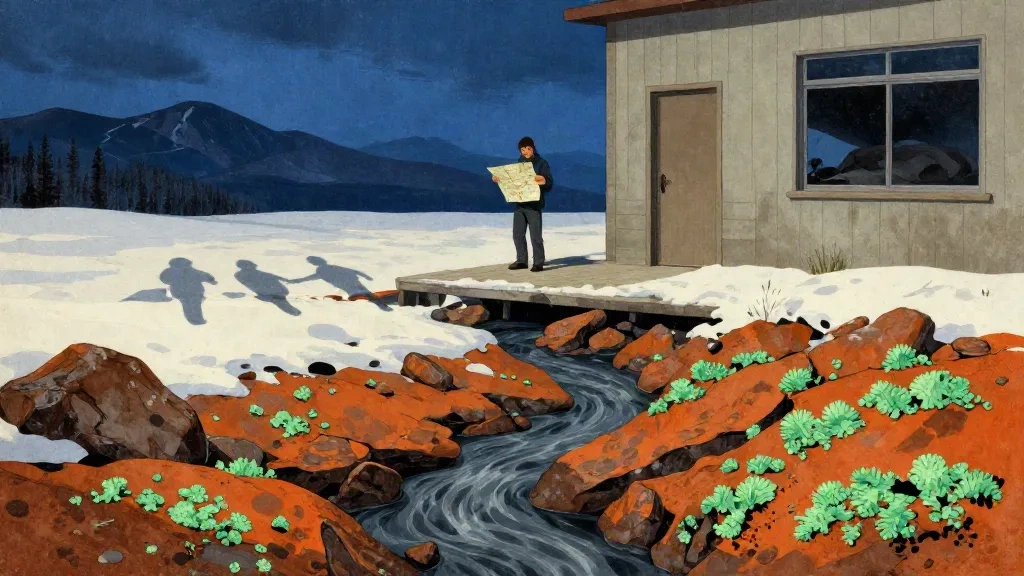
Surrealism.
The Guests of Shadow
At Vesper Heights, the shadows crossed the frozen terraces before the guests did.
Mara Venn stood inside the chalet with her headphones pressed to a brass sleeping machine. Its dreams came in burnt-orange currents, lichen-green intervals, and flashes of blue storm-light. Beneath the floor, boots made the snow creak. Above it, a line of arriving shadows bent their long bodies around the roof and slipped beneath the door without knocking.
The machines were lifts by day, boilers by night. Only after the resort emptied did their motors begin turning in their sleep, carrying freight through rooms that existed as measurements, odors, and the memory of bells. The company paid Mara to translate these cargoes. She wrote a careful record in her narrow notebook:
Ten iron bells.
One red glove. No destination.
That morning, the district surveyor placed a map on her table. It was an old print, brittle at the folds, showing Vesper Heights in a valley beneath a mountain. A blue pencil marked every guest room.
“Your predecessor drew it,” he said.
Mara turned the map over. On the back, someone had drawn a road along the dry riverbed, then crossed it out. The surveyor offered no more. His shadow, however, remained behind him after he left. It sat in the chair, reading the map as if mourning it.
The Door Without a Name
Mara’s wish was simple and physical: to leave behind a better map than the one received.
Her first improvement was a blue dot marking the unmarked door at the west end of the lower terrace. It had no handle, number, or place in the hotel register. Yet each shadow lifted one forepaw toward it. Each sleeping machine murmured when the winter wind pressed its seams.
She translated the nearest machine’s dream. Blue storm-light flooded her mind. She saw a family beneath the low sun: a father at the riverbed, a mother at the summit, a son carrying a black suitcase up the stairs. Between them stood a girl holding an unmarked door in her hands like a loose floorboard.
“What was promised?” Mara asked.
The machine answered in the voice of the father: “The mountain will stay where it is.”
The guest ledger gave it to the mother: “No one will leave before spring.”
The hotel’s oldest lift, waking inside its shaft, gave it to the son: “When the river returns, we will meet at the door.”
All three promises had been preserved for forty years. None had survived translation.
The River That Kept No Water
Mara followed the map’s blue pencil line to the dry riverbed. Orange dusk lay across the stones, while lichen glowed beneath the ice. The mountains cast no shadows, although the shadows in the valley had already assembled around her.
They were not the shadows of the mountains. They were the family.
The father’s shadow pointed downriver. The mother’s turned uphill. The son’s stood over the black suitcase, pounding its lid with both hands. Inside it, a folded map flexed without wind.
Mara opened the suitcase. Her own survey lay on top, marked with the blue dot. Beneath it lay her predecessor’s original map.
The valley had been blank.
“He erased it because he mistranslated them,” Mara said.
The son’s shadow nodded. The father’s pointed to a line of brown grass. The mother’s covered the summit.
Then the sleeping machines began ringing beneath the snow. One by one, their dream cargoes rose through the walls: water, a blue door, a red glove, a child’s hand. The valley filled with a river no foot had ever crossed. It climbed over the dry stones, entered the unmarked door, and poured into every machine at once.
Mara understood the error. A promise was not a bridge. It was a border drawn by memory.
The Map Left Open
She did not choose one version. She drew the family where each person placed themselves: father at the riverbed, mother above the last snowline, son beneath the open door. The girl connected them with a road.
The survey required directions. She gave them a destination: here, and wherever the next promise changes.
When she returned, the new map covered the wall of the lobby. Guests gathered around it before their shadows had reached the chalet. The machines hummed quietly. The unmarked door stood open.
Outside, the storm returned and drowned the valley in blue light, but the dry river remained visible for a moment—then not.
Mara added one final detail: a small blank space beyond the border, marked only with the words territory not yet agreed.
It was the first honest line on any map she had made.





