 Netwrck
Fantasy.
The catalogue from tomorrow
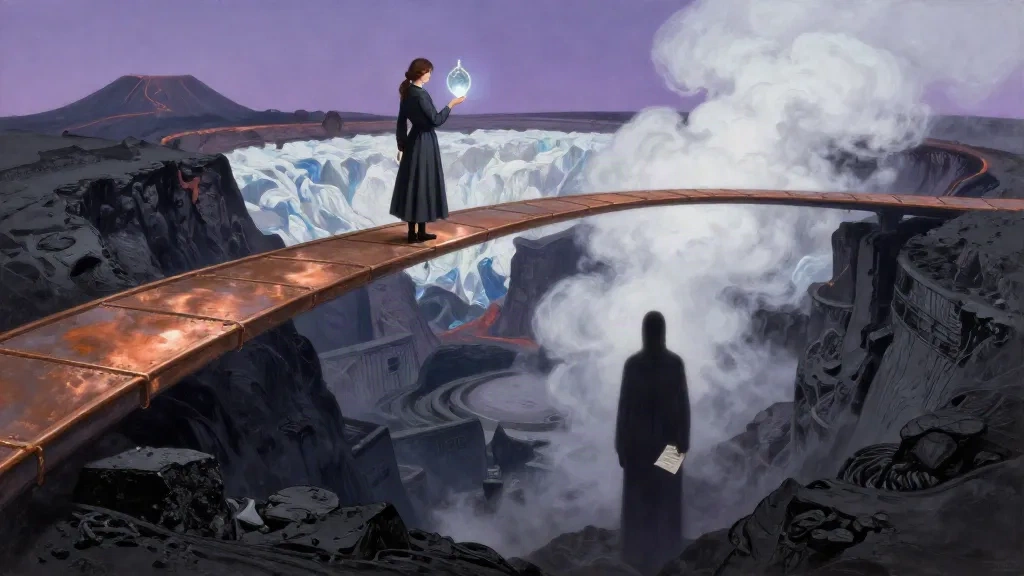
At dusk, the observatory turned violet beneath the crater rim. Oxidation spread over its copper ribs in delicate green-black veins, and cloud-white stars appeared above the dead caldera as if snow had been scattered across the sky.
Imara Vey, keeper of the upper archive, opened the future catalogue because the mountain had begun to tremble.
It was not an earthquake. The stone breathed through the walls in long, patient sighs. Dust lifted from the shelves, and every glass instrument trembled at once: sextants, seed jars, lenses, and the small wool glove she kept in a cedar box despite having no memory of owning it.
The catalogue lay on the reading table, bound in black boards that had not been there that morning. Its pages smelled of rain on hot copper. Imara turned them until she reached the final entry.
Vey, Imara. Born beneath the white cloud. Archivist of the forgotten. Name returned at the seventh violet dusk.
Her name. Her handwriting.
Below it, in a column marked LAND CLAIM, was a survey of the southern glacier. A red line crossed a place her maps called only the Blind Throat. Beside the line someone had written: Here lies the name of the woman who taught the mountain to remember.
Imara closed the catalogue. The tremor stopped.
A document in borrowed hands
She took the glass seed from its case, a sphere no larger than a plum, clouded with violet and threaded with copper. It had been planted in ash, watered with melted snow, and never opened. According to the older records, it contained the first sound spoken on the mountain.
The wool glove, she discovered, was signed inside the cuff. The thread formed a name in tiny letters: Mera Senn.
Imara knew no Mera Senn. Yet the glove smelled of woodsmoke and lavender, and when she pressed it to the Blind Throat sketch, the red line on the map brightened.
At the archive door stood a shadow.
It was taller than a person and shaped like a bent column. It had no face, but it carried a leather folder beneath one arm.
“Archivist,” said the shadow.
Its voice came from the catalogue.
“The land claim requires a signature.”
Imara hid the glass seed inside her coat. “The name is not a claim.”
“All names are claims.” The shadow opened the folder. Sheets slid from it, covered in seals and dates. “I have learned the form.”
It placed a document on the table.
Her name appeared at the bottom, written in her own hand. Beneath it, a date three days ahead.
“If you sign,” the shadow said, “the mountain will remember Imara Vey. If you refuse, it will remember Mera Senn.”
“That is not a choice.”
“It is the oldest kind.”
The road below the snowline
Imara left before the shadow could collect her signature. She crossed the observatory’s copper bridge and descended through galleries cut into the volcano’s throat. The heat increased with every step. Copper pipes sweated. Somewhere below, a bell rang beneath the ice.
The wool glove led her onward. Its cuff grew damp whenever she faced north. At the Blind Throat she found a wall of black glass reflecting violet dusk, oxidized copper, and the cloud-white dome of the sky.
Within the reflection stood a woman.
She wore a glove on one hand and held a glass seed in the other. Mera Senn.
“I am not lost,” the woman said. “That is how the land loses me.”
Imara pressed the catalogue against the glass. “How do I give your name back?”
“Say it where the mountain can hear.”
Behind Imara, boots scraped through the tunnel. The shadow had followed, dragging its folder. Its papers whispered, Mera Senn, Mera Senn, Mera Senn, trying to wear her name smooth.
Imara struck the glass seed against the wall. It did not break. It opened.
A thread of white light escaped, thin as wool, and wound around the reflected woman. Mera smiled once, not with relief but with permission.
Imara opened the catalogue to the final page. The name Imara Vey had faded there. Another name shone beneath it.
The name the land keeps
She spoke into the black glass.
“Mera Senn. Who came beneath the white cloud. Who taught this mountain to remember.”
The shadow lunged. Its signed documents flew from the folder, covering Imara like wings. She held the glass seed above them and burned every page to a bright copper fringe.
The name passed through the wall.
Mera’s reflection stepped out, becoming solid in the violet air. At the same moment, the observatory cracked from roof to foundation. Cloud-white ash rose through the crater, and the sleeping volcano released a single low note.
The shadow remained only as a stain on the ruined threshold. Its final document drifted down. Across the bottom, where a signature should have been, a wool glove had burned a perfect outline.
Years later, surveyors found a stone above the glacier bearing three words:
For Mera Senn, who was here.
Imara kept the glass seed empty. The wool glove she placed beside the inscription, where snow could not reach it. Every year, on the seventh violet dusk, the stone warmed beneath the cloud-white sky, and the mountain answered with a name no one had to sign.





