 Netwrck
Science Fiction.
The catalogue of tomorrow
Mara Venn worked in the eastern archive, where the walls were the color of eucalyptus leaves bruised by rain. Every resident of the Vesper Building remembered only what had not happened. They breakfasted on futures: the taste of a train ticket, the sound of a door closing in another city, the precise hour their oldest child would leave home.
Mara catalogued the arrivals in a room without windows. Each morning, pale slips of paper appeared beneath her desk, describing events that had not yet claimed them.
“You will receive a letter,” one said.
“You will forget your mother's voice,” another said.
Mara filed them beneath the correct future. She was an archivist, not a prophet. She believed in dates, ink, and the small discipline of keeping records straight.
On the ninth day of Wetter, she found a catalogue entry stamped seventeen years ahead.
VENN, MARA. LOST NAME. RESTITUTION PENDING.
Her hands went cold. The entry named no birth date, no apartment, no death. Beneath it, in handwriting she recognized as her own, someone had written: The land remembers what the city refuses to say.
At the bottom lay a rubbing in black wax. It showed a signature she knew intimately, though the name attached to it belonged to a woman she had never met.
Forgotten in the clay
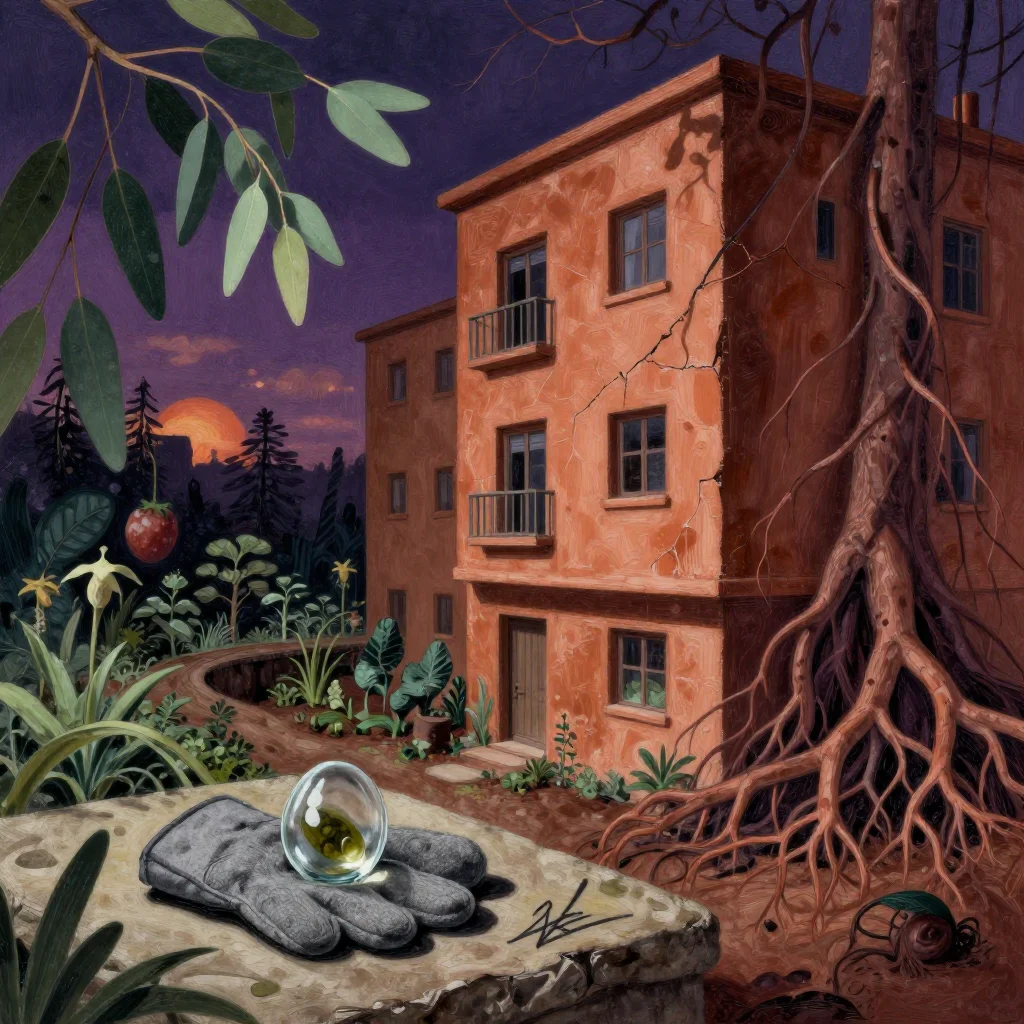
Mara needed a witness. She carried the catalogue page to the building's ground floor, where the residents kept their gardens in painted clay boxes. Terra cotta walls sweated beneath a sky the color of bruised fruit.
Old Saye, the gardener, was recovering the memory of a flood that had not happened. He could not remember the water, only the taste of it.
“A name can be buried by neglect,” he said. “The land takes it back into the root.”
Mara showed him the page. He studied the wax rubbing, then pointed toward a sealed parcel room behind the boiler.
Inside were documents for apartments whose occupants had died before their futures arrived. Names had been crossed out and replaced with measurements: debt, rent, unpaid repairs. In one corner lay a wool glove, gray at the fingertips, smelling faintly of rain.
Mara knew whose hand it was. The shape of the missing fingers matched her own.
That night, a shadow detached itself from the boiler and crossed the floor. It was long, soft-edged, and bent around the corners of the furniture as if the walls had not consented to hold it.
It stopped at the parcel room. The shadow lifted a black pen from the table.
It signed.
Mara recognized the name: Elian Voss, the last person to have owned the land before the Vesper Building was erected.
The witness without a face
The signature spread through the documents like ink through wet paper. Ownership lines darkened. Dates changed. A government notice appeared, assigning the buried garden to the building and declaring its oldest memories unverified.
“Stop it,” Mara said.
The shadow signed her name.
“You cannot claim what you do not remember,” it said in a voice like paper folding. “That is what ownership means.”
Mara seized the wool glove and pulled it on. The wool tightened around her missing fingers. In its palm, a glass seed had appeared, clear as a drop of sky.
The seed was not from any future. It was from the land before the city, when the garden had been a marsh and the marsh had held every name in its black water.
She broke the seed against the floor.
Light entered the room. Not electric light, not memory, but the pale green illumination of leaves opening underwater. Every crossed-out name rose from its document. They hung in the air, turning slowly, waiting for someone to speak them aloud.
What the land gives back
Mara began with Elian Voss. She said the name into the glass-lit room, and the shadow split down its middle. For one breath it retained the shape of a man signing papers. Then it became only darkness, unable to hold a name.
She spoke the others. The building trembled. Windows that opened onto possible futures filled with actual weather. Rain struck the terracotta facade, and somewhere below, roots moved beneath the foundation.
The last name was Mara's.
She had been born with the right to remember tomorrow, but no one had taught her the first act of memory: accepting what had already happened. She placed the wool glove over the catalogue page and spoke.
Her name remained audible after she finished.
By dawn, the garden had returned. Not as a garden of predictions, but as a quiet field of mint, thyme, and red flowers whose petals closed whenever a resident approached. The city surveyors came with forms and found the ground unwritable. The land accepted Elian's name into its soil.
At the edge of the field, Mara left the empty glove on a stone. In its palm rested one remaining glass seed.
This one, she did not plant.
Some futures, she decided, should remain unclaimed.





