 Netwrck
Fantasy.
The Name Dated Tomorrow
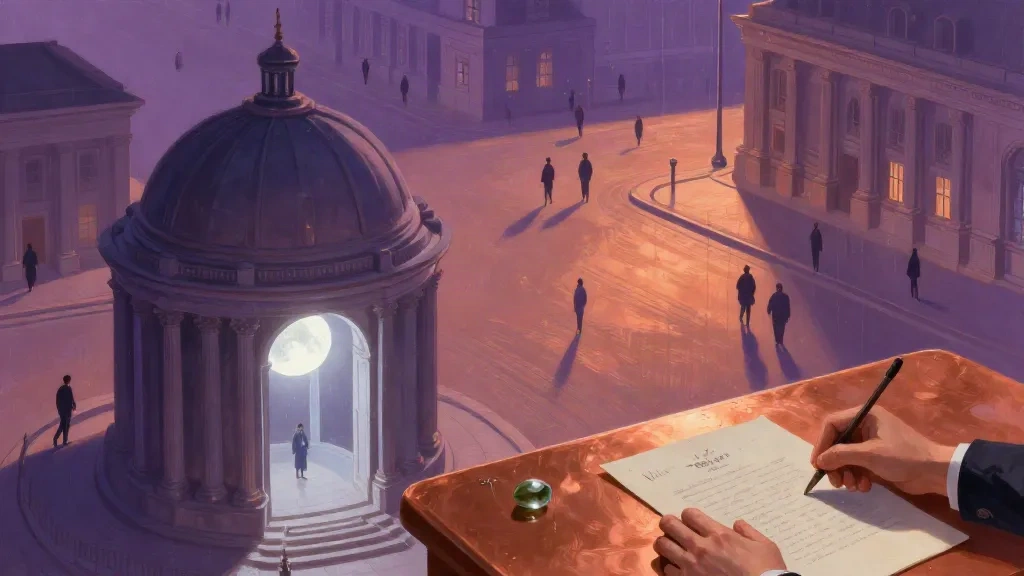
At violet dusk the bells of Saint Orra rang under a sky the color of oxidized copper. Their echoes ran ahead of them down the streets, lengthening every citizen's shadow until some reached politely around corners and some climbed the cloud-white cornices with folded arms.
The city of Vesper Imprint had no separate people and shadows. At birth, each received a body cast from the same substance as its shade. At death, the shade rose out of the body and went home.
Unless it had work to finish.
Keeper Livia Slate spent her days in the Municipal Catalogue, a copper-domed room where the air smelled of rain on tin and old paste. She catalogued marriages, inheritances, expulsions, and the small domestic betrayals that moved a property line by a foot. Her right hand was missing three fingers, taken by a flatbed press in her twentieth year, and she wore a gray wool glove over it and wrote better bare than gloved, which was how she had come to love paper.
That evening a glass seed arrived in a padded envelope of black felt, addressed to her docket and not to her name, which she noticed. Inside lay no seed, only a folded receipt. Its number carried a future date: the ninth year after next, seventh day of the First Frost.
She knew the hand. The numerals leaned left the way hers did, and the downstroke of the seven stopped short at the wrist as though the pen had run out of fingers.
Someone who knew precisely what she was missing had signed nine years ahead of her.
She opened the Catalogue of Provisional Selves, the record no department admitted to keeping, used when a citizen wished to outlive a sentence. She opened it to identify the seed's recipient. The book fell open without her help, to the final leaf, where a future hand had written:
Livia Slate. Cause of erasure: voluntary. Filed by: Livia Slate.
Her glove lay beside the ledger. She had owned only one since childhood, gray, missing nothing, the three absent fingers worked into the knitting as three blunt stitches. The receipt bore the same three blunt stitches in the hand.
What Livia Had Filed
She was twenty-six years old and a third-room copyist when Mara Fen was struck from the flood rolls.
The north sluice gates had been opened four hours early on the night of the winter flood, which drowned the low wards and killed six hundred and eleven people. The official finding was mechanical failure. The truth was in a lamp-trimmer's daughter, nine years old, with a braided crown of hair and a face like milk in shadow, who had been standing on the gate landing at the fourth bell and had seen the winch crews loosen the pawl by hand.
The Catalogue's own negligence lay behind that pawl: Livia's office had certified the maintenance of the northern works for eleven years by copying a schedule it had never read. So the city had one usable witness and Livia had one usable remedy. She reached the child's name with a nib worn to a point. One stroke and Mara Fen became no one, and no one could be summoned, cross-examined, or believed.
She had told herself it was mercy. The girl went on eleven more years unrecorded, invisible to the pit, the levy, the hospital and the map. She died in the winter of the next flood in the charity pit behind Saint Orra, and the brickers laid a square of the northern wall over the place where the survey had kept her plot, and the survey could not say whose plot it was, so no one asked.
Livia had been made Keeper at thirty-one. She had not told anyone, in nineteen years, in any room, under any weather.
Nine years ago she had drafted the Deed of Continuance, which assigned every unclaimed and forgotten name in Vesper Imprint to the city itself. Once the city owned their memories, no descendant could inherit them and no heir could sue. It ended four hundred years of flood-roll litigation in a single afternoon, and Livia was proud of it in the way a mason is proud of a dry wall.
She had put one clause into it herself, buried in the fifth schedule, because a document that could never be stopped was not law but weather. One clause no shade had ever signed willingly: a name released by its own living descendants may return to the soil.
She had never imagined an enemy in it, and she had never imagined an enemy being nine years old.
A Shade That Held a Pen
Under the catalogue's floorboards a narrow office held the disputes too dangerous for daylight. Livia went down with an oil lamp and found three clerks made entirely of shadow. One copied petitions. One counted coins without lifting her eyes. The third bent over a deed, adding a signature in a pen that wrote in black light.
Her shade was a woman with a braided crown of hair and a cloud-white face, though Livia understood now that the face was an arrangement: features taken from several people the way a clerk takes letters from a common box, because faces are letters and this office had run out of its own.
“You are late,” the clerk said.
“I am early.”
“Nine years is early enough.”
“Seventh Desk,” said the copyist, without looking up. “Say the whole thing to the table, Keeper, it likes formality.”
Livia set the receipt on the desk. Ink-black light crawled over it. She felt the words go through the wood and up her wrist, and she understood that she was not speaking to a clerk but to a ledger that had grown a body, and that the ledger had been keeping her grammar for nine years.
“Margerit,” the signing shade said, reading the docket number. “That is my name. It is on the pen. When they took the name off me they forgot to take it off the instrument.” She dipped the nib. “I recognize your clause. Fifth schedule, third sentence. You wrote it hoping no one would ever need it. Do you know how rare that is, a person writing a door into a wall and then praying nobody comes home?”
“I know who it was for,” Livia said.
Across the room a small shadow struggled inside a cage of legal language, four iron bars and a sentence. It kept saying, “Mara Fen,” and each time the clerks heard the name it faded smaller, the way a sound fades when a door shuts.
“Say it again,” Margerit said, not unkindly. “It has been a hundred and forty years since anyone said it in this room. We are permitted to hear it once. Names spoken by a clerk are names entered.”
“Let her go.”
“Return the name to the land and the dead grow forgetful. You are the Keeper. Do the arithmetic out loud. Nineteen years ago you entered one name into nothing to spare a child a subpoena. I have been in this chair since before the sluice gates were cast. Ask me what the city does with the names it owns.”
“I know,” Livia said, and it was the first true thing she had said in the room. “It stops arguing with itself.”
Margerit set down the pen. “Then you know the cost is also that it stops grieving. Pick which of those you can live inside.”
The Land Keeps What Paper Loses
Livia went up the brass stairs with the coin counter's arithmetic still ringing in her ears, and out into the violet rain, because the clause wanted descendants and she had a list of candidates she had never let herself assemble: the people who had been shaped by Mara Fen without ever being told her name.
Her own shade did not follow her out of the door. It stayed in the copper room, folded over the ledger, thinning. She noticed and did not think about it, and the not-thinking sat in her like a swallowed coal.
In the Harrowgate courtyards the bean growers argued over a variety nobody could trace. Sacks in the low houses were sewn with blue thread, and the thread came from a spool a lamp-trimmer's girl had wound in the flood year. In the Rainquarter, a woman named Iril Sarn kept a strip of irises along her wall and turned the earth over them on the same date every year, the seventh of the First Frost, and had done since before Livia was made Keeper. Iril had bought them from a child on the square, years back, in a coin of low value, and had never asked the child's name because asking felt like bargaining.
“She told me once,” Iril said, at the door, in the rain. “That the seeds were worth more if you said them aloud before you planted. I thought that was gardening superstition.” She looked at Livia's glove. “You are the one from the north wall.”
“I am.”
“I have a grave I cannot find and an anniversary I cannot skip. Take me to her.”
They came in ones and twos, wet through, the bean sellers, the flower tender, the midwife Salome Vetch who had delivered a child in the house where a lamp-trimmer's shade had been seen standing in the window during the flood year, saying nothing, for six nights running, so that the mother would know her own mother had come. The child was fourteen now and stood in the room with her jaw set, and when Livia looked at her she saw a small braided shape refusing to fade.
The Clause No Shadow Signed Willingly
Chancellor Vell Ostram came down the brass stairs at the second bell, wet coat, no umbrella, no shade. He had not sent one in nineteen years. He stood in the doorway of the undercroft and looked at the gathered witnesses and the rain running black down the copper desk and said, “Keeper. You have gathered the living to testify for the dead. Do you know what that is? That is a mob with a form.”
“It is a hearing.”
“It is a hearing I have to overrule.” He said it without heat, the way a man states a load-bearing number. “Nine thousand four hundred and six names. Nine thousand four hundred and six estates tangled in appeals, nine thousand four hundred and six households waiting on a judgment that will cost them a decade and half their holdings. Your girl saw a pawl. I have a city that cannot pay for the next flood. You want the truth honored. The truth is expensive and it is not the same as the name.”
“Then say her.”
“Mara Fen.” He said it steadily, once, like a man crossing a frozen river. “There. She is said. Now let it lie.”
Margerit's pen had not stopped moving. Livia looked at the deed and saw the whole architecture of her own decent intentions standing over Mara Fen like a lid, and she understood that if she destroyed it she would be doing to nine thousand other names what she had once done with a nib: she would be deciding, alone, in a room, that no one was answerable to anyone. So she did not destroy it. She opened the fifth schedule to the third sentence and laid her bare hand flat on the page, all five of its remaining fingers, and made the choice a public one.
“Descendants,” she said. “Not heirs. Not claimants. The people the land itself was changed by.”
She rang the archive bell once for every witness she had found.
They spoke Mara Fen without writing it down. No clerk heard them. The words went mouth to mouth through the copper room, and the old folk started it and the young ones learned it fast, the way a song goes, and the sound of it in that underground office was nothing Livia had ever heard in nineteen years of listening to paper.
What the Archive Could Not Hold
The caged shadow grew shoulders, then hands, then the braided shape the signing shade wore.
“You are not Mara Fen,” Margerit said, and the black light in her pen had begun to gutter.
“No,” Livia said. “But her name is.”
She unwrapped the glass seed. No genealogy lived inside it. It held a single drop of rainwater from the night of the flood, and the arithmetic of that was so plain she was ashamed of how long it had taken her: it was not evidence. It was a witness that could not be intimidated, and it had been in her coat pocket, or in her mother's, or in the pit, for nineteen years, waiting under glass for a Keeper with the nerve to be useless on purpose.
She broke it against the deed. Water ran uphill over the copper, carrying the sound of the name from the witnesses down through the floor into the cage, and every iron bar of the sentence retired at once, quietly, like staff who agree they are no longer needed.
Every page of the deed began lifting toward the open door.
Margerit tore the pen out of her own hand. It cost her: the scream came out in tiny black letters, over and over, the only clause a shade had ever written and not wanted. No one may inherit me.
“You wrote the deed,” Livia said. “You wore the face you took from her. Write your own sentence or hold the pen still.”
For one breath the signing shade had no face at all. Then she pressed her palm flat into the rainwater on the desk, and where her hand went down the black light went out of it, and Livia found her again standing under the northern wall in open air.
Sunlight had entered the archive for the first time in eighty years. It did not cast a shadow. It cast a woman: narrow shoulders, three fingers short, wool knitted tight around the wrist, holding out a gray glove she no longer had any use for.
The Weight of Names Returned
They did not burn the deed. Livia amended it in the copper room while the witnesses held the rain-light steady and Margerit, who had nothing left to sign with, read the amendment aloud in a flat clerk's voice, because that was the last office she was ever going to hold and she intended to do it well.
The city kept the names. The city simply was not permitted to keep them silently. Every one of the nine thousand four hundred and six became a public charge, a line in an open ledger, answerable in the market square to any descendant who came with a bean, a thread, an iris, a window, a witness. The slate went from a lid to a floor. It would be fought over, and litigated, and it would cost the city a great deal, and Livia was entirely certain that Ostram was right that it was worth it, and entirely certain she had made the decision for nine thousand strangers, and she wrote both facts down in the margin of the fifth schedule because an archive that hid its own reasoning was only a wall with shelves.
The shadows stayed where they were, though. Bound to the ground by whatever the witnesses had said, they did not go home at the funerals that autumn. They stood in doorways with their arms folded, and in the low wards, where the pits were, the newly risen did not understand that they were expected to leave and stayed to be wept at, and frightened people saw faces they had buried standing at the graveside. The city had to learn a new etiquette of mourning. That took years and it was not gentle.
Mara Fen kept the glove for eleven days and then gave it back, because the fingers of it did not match hers, and being given a hand that fit was more of a kindness than she could stand. What she had instead was a braided shape, a milk-white arrangement of a face, and the fact of her own plot under the northern wall, which the city dug up in spring and marked with a square of new brick and no inscription, because nobody could agree on a spelling and Livia refused the misspelling they offered. She worked in the Harrowgate courtyards. She planted beans. She was not loved, exactly, and she was not left alone, and the difference between those two things turned out to be the entire education of her later life.
Livia Slate was no longer in any record. A name not on the rolls, the tax, the register of keepers, or the death schedule is a name that cannot be entered as a party, be inherited, be fined, or be buried in the public pit. She could not file. The archive's door no longer recognized her and stood ajar for anyone at all. On her bare right hand the three missing fingers had closed over the years into a fist, which the doctors found interesting and she found late, and which meant she would never again sign a legible line of anything.
The ninth year came. On the seventh day of the First Frost the receipt came due, and the docket it belonged to was a form the new clerks filed without reading, because they were young, and because the sentence in front of them had no legible hand to look at.
Nobody ever withdrew the signature. Nobody ever had to.
At dusk she walked out past Saint Orra with the ledger page she had torn out folded against her palm, and in the Harrowgate courtyards the beans were up, four inches, in rows made by a person who had once been nothing and was now the only fact in the district that could not be appealed. Mara Fen was sitting on a low wall with her hands in her lap. Livia sat down beside her and did not say her name, because it belonged to the land now, and the land does not need to be reminded out loud.
Behind them, in the copper room under the floor, a bell that had not been rung since the archive was new rang once, by itself, for a record that had finally, at the last possible moment, been made.





