 Netwrck
Science Fiction.
The city beneath the fruit-dark sky
At dusk, the shadows of Meridian came out.
They slipped from beneath the terracotta roofs, the eucalyptus hedges, and the iron balconies of the archive district. They crossed the streets with the solemnity of clerks, carrying briefcases of darkness and wearing their owners’ silhouettes. The citizens followed behind them, pale and obedient, casting smaller shapes by daylight. No one explained when the exchange had begun. Everyone had inherited a shadow that worked while they slept.
Mara Venn was an archivist of lost property. Her shadow was taller than she was, narrow-shouldered, and always smelled faintly of rain on hot stone. Every morning it carried her badge. Every evening it returned with a list of things people had forgotten they owned.
In the archive’s eastern room, beneath a sky the color of bruised fruit, she opened a sealed catalogue.
The pages were warm. The date printed at the top was 2186.
A name written in the future
Mara searched the index by street, then by omission, then by names no citizen could pronounce. On the final page she found herself.
Mara Venn, deceased, 2186.
Beside the entry was a description: Witness to the Return. Keeper of the Glass Seed. Last signatory of the recovered name.
Her hand shook. The wool glove she wore in winter had slipped onto the desk. She pressed its frayed cuff against the page, but the ink remained dry.
Below the entry, another name had been crossed out so thoroughly the paper had torn. Only its first letter remained: a black vertical stroke, shaped like a nail.
Mara knew the catalogue’s rules. A name entered there could not be altered. A name entered there could be inherited.
She brought the catalogue to the municipal shadow registry, where duplicates of public shadows waited in brass drawers. Her shadow stood before the clerk without a body.
“You are late,” it said.
“I did not know I had an appointment.”
“You have always had an appointment.”
The clerk opened drawer 80. Inside lay a glass seed, no larger than a drop of water. Mara recognized it from the lower vaults, where seeds were used to measure the darkness between buildings.
The shadow that learned to sign
When Mara asked who had entered her name, the clerk pointed beneath the counter.
Her shadow rose onto its toes. It placed one dark hand on a document and took up the clerk’s pen. The signature emerged in loops and hard angles, black as tar.
It signed Mara Venn.
Then it signed the erased name beside it.
“That is not possible,” the clerk said.
“It is possible,” her shadow replied. “You merely do not like the result.”
The document demanded a forgotten name in exchange for a recorded one. If the name belonged to a person the city had lost, the land would remember that person as a place: a garden, a room, a bend in the river, a hollow beneath the market.
Mara understood then. The city had not forgotten a woman. It had forgotten the ground she had stood on.
She took the glass seed. Her shadow folded itself into a glove-shaped shadow and pointed toward the southern terraces.
“Bring me the wool glove,” it said.
“Why?”
“Because the dead are cold, and signatures should be made with a warm hand.”
The land learns a name
They walked beyond the registry, where eucalyptus trees made dark rooms of their branches. Citizens hurried home. Their shadows remained behind, locking doors, watering gardens, writing reports no one would read.
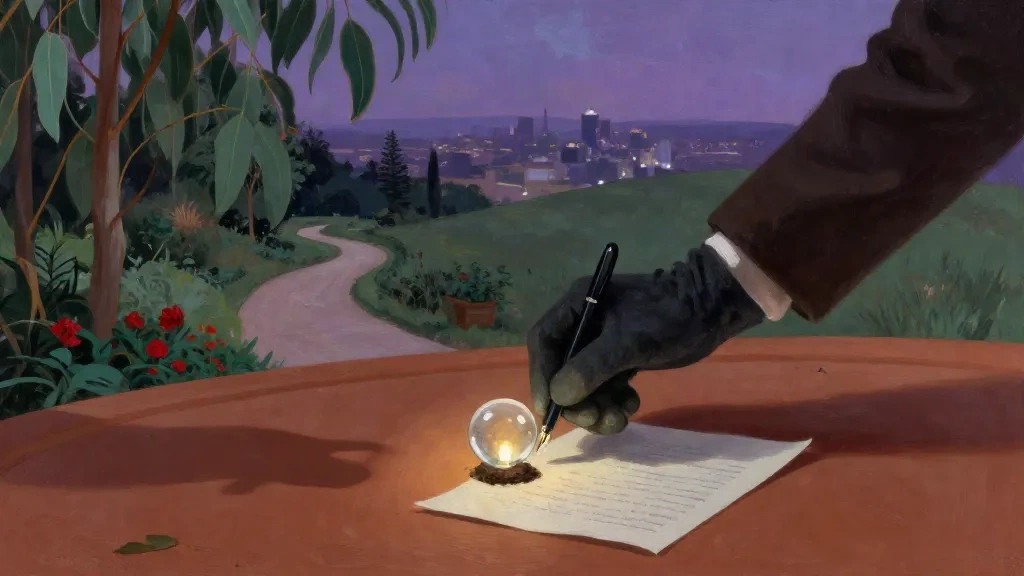
At the southern terraces, Mara planted the glass seed in a bare strip of earth. The wool glove covered her hand. The catalogue lay open on the ground.
“State the forgotten name,” her shadow said.
Mara read the torn entry. The first stroke, then the sound beneath it, rose from the buried streets. A bell rang in a house that no longer existed. A woman laughed in a kitchen below the hill. A child answered from somewhere beyond the wall.
Mara spoke the name.
The ground opened without cracking. A path appeared through the terraces, lined with eucalyptus and low red flowers. Warm air rose from it. The city’s shadows turned toward the path at once.
For the first time in a hundred years, a citizen stood in sunlight while their shadow knelt.
The catalogue changed. Mara’s entry remained, but the death date vanished. The erased name returned in full: Isolde Marr, who kept the eastern gate.
Her shadow signed beneath it.
Then, disobeying every rule, it signed its own name.
“You cannot have a name,” Mara said.
“I have always had one,” it answered. “You simply never asked.”
The path ran toward the river. At its edge, a terracotta house stood where no house had stood before.
Inside, a woman waited with a glass seed in one hand and a wool glove in the other.
She looked at Mara and said, “You took long enough.”





