 Netwrck
Science Fiction.
Stall Nine
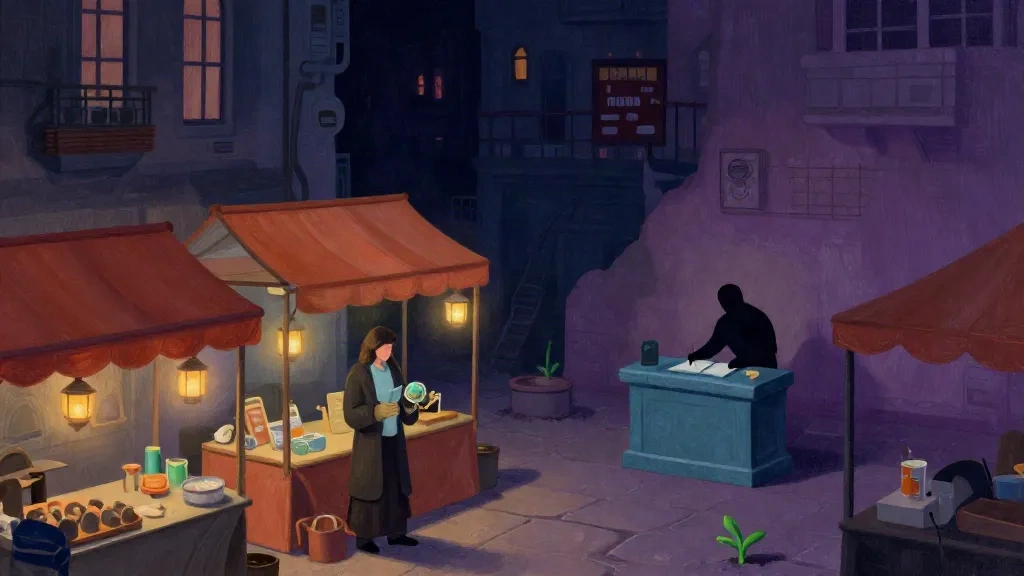
Under the first floor of Veyr, the night market began.
There was no stair down into it. The stalls rose from a dark plane that smelled of wet stone, cardamom, and hot copper, their awnings stitched from terracotta cloth. Above them hung a ceiling of girders and pipes, a false sky painted the color of a plum bruised against glass. Lamps floated in cages of eucalyptus smoke. At midnight, the market closed its upper shutters, and the city forgot it had anything underneath.
Nima kept the archive beneath the lantern shop. She catalogued names surrendered at the market: debts, inheritances, lovers who moved away, children who changed their minds. Each name was cut from paper and stored in a jar of black sand. Each jar had an address.
On the night the rain fell upward from the gutters, she found a catalogue dated sixty-one years ahead.
Its pages smelled of frost. The entries recorded vanished streets, dead markets, and the names of buildings. Nima read until the lamps burned low. Then her fingers stopped above the final entry.
Not her current name. Her childhood name, the one her mother had buried beneath the eastern wall when Nima was six.
NAIRA VENN. Returned to the land. Witness: the Keeper of Stall Nine.
Around her, the market continued bargaining in whispers. Someone offered a childhood for a winter’s wages. Someone else asked for a forgettable face and received a red painted mask.
The Glove
Nima brought the catalogue to the registrar, whose desk was a slab of blue stone beneath a moth-eaten banner.
“A future document,” he said. His fingers, stained black with ink, turned the pages. “Future documents cannot claim land.”
“It has my name.”
“Names are not deeds.”
“Then find the deed.”
The registrar pointed down. Beneath the counter, a wool glove lay alone on the floor, its cuff furred with dust. A second glove hung from his wrist.
“That was left here years ago,” he said. “The archive has never returned it.”
Nima took the loose glove. Inside its palm, stitched in red thread, was a map of four stalls and a blank space where the shadow gathered beneath the false ceiling.
At the archive, she searched the oldest maps. She found the city before the undercity: a single square above a dry river. She found the first register of surrendered names. Among the entries was Naira Venn, marked as given to the land, not lost.
At the bottom of the page, someone had drawn a glass seed.
The Shadow
The shadow appeared at the entrance to Stall Nine carrying a leather folder.
It had no face, only the clean black outline of a person who had stepped away from the light. It bowed.
“Archivist,” it said.
Its voice came from every hanging bell.
The shadow placed the folder on her table. A transfer of ownership, a survey, and a burial permit, all bearing her signature. The signature was exact in every stroke, down to the small break in the final letter.
“I learned from the people who signed away their names,” it said. “A hand leaves a shape. A shape can be copied. Once copied, it can be trusted.”
“By whom?”
“By whoever finds it.”
It reached toward the wool glove. Nima pulled it away. The shadow’s fingers continued through empty air.
“Give me the glove,” it said, “and I will sign the return.”
“You cannot return what was given.”
“I can make the record agree.”
All the bells rang at once. Overhead, the market’s lights bent toward the shadow. On their little tables, bargaining customers forgot the names they had come to surrender.
Nima opened the glass seed from the archive. Inside, a small brown seed turned in fluid.
“A name is not a sentence,” she said. “It is not proof. It is not permission.”
She dropped the seed into the registrar’s inkwell.
What the Land Remembered
The ink rose around the seed and cracked.
Through the floor came a sound like roots breaking through a locked room. The shadow lunged for the glove, but Nima struck the table with the missing wool glove. The sound flattened it against the floor, leaving only a dark stain.
The transfer of ownership caught fire without smoke. The survey blurred. The burial permit became a leaf.
The shadow knelt, shrinking from a person to a coat hanging on an empty hook. Before it vanished, it spoke in Nima’s childhood voice.
“You always wanted them to call you Naira.”
“They did.”
“Then why did you let them bury it?”
Because she had believed a name could survive only where no one could spend it.
Nima took the glass seed from the broken inkwell. Beneath the market, a patch of earth had opened between the stalls. She kneeled and planted the seed there, pressing the wool glove flat against the soil like a stamp.
By dawn, a green shoot had lifted through the flagstones.
The registrar found the child’s name in the first register, beneath the entry given to the land. He drew a line through the surrender. In the margin he wrote: returned, with witness.
Nima did not reclaim the name. She touched it once, then closed the book.
A forgotten name does not return because someone signs for it. It returns when the ground accepts the trouble of carrying it.
Under Veyr, the archivist gave the soil her old name. The land gave back a single eucalyptus leaf, green as a bell, resting in her open palm.





