 Netwrck
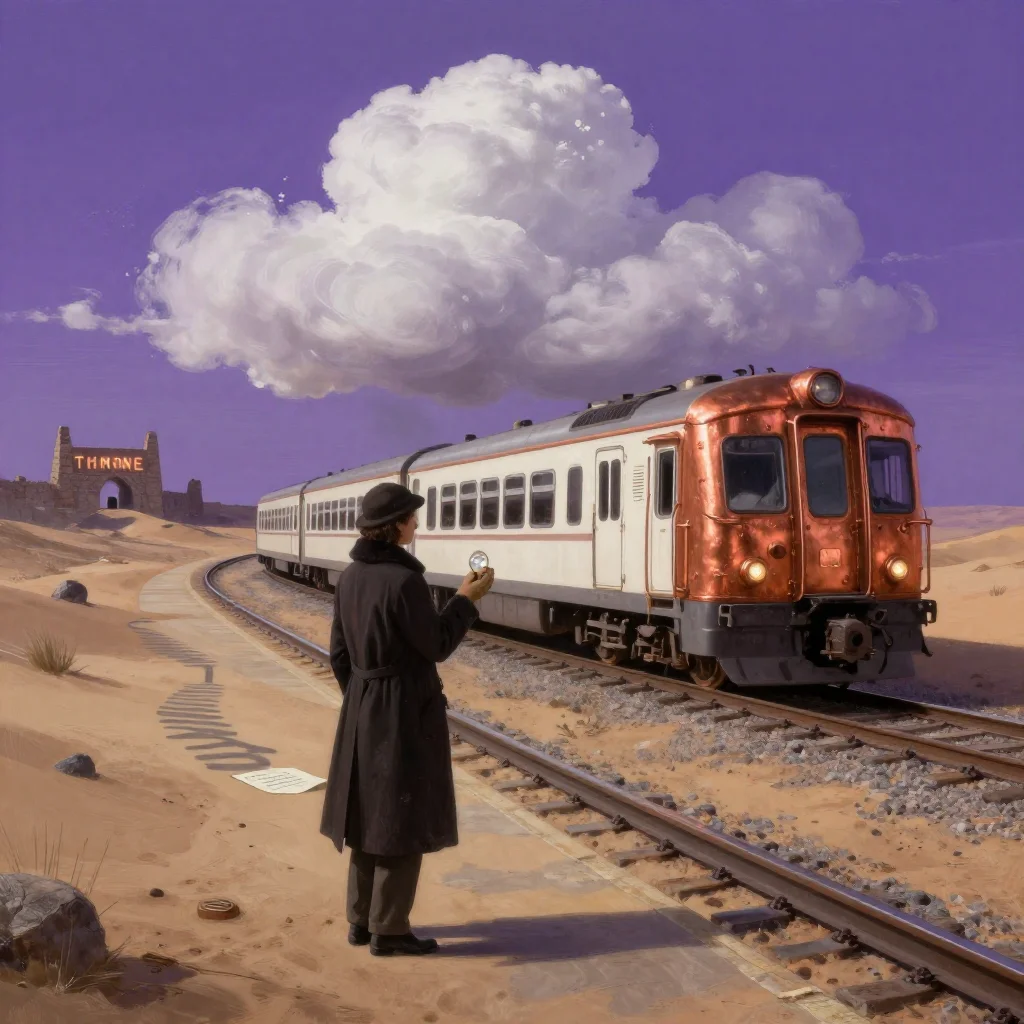
Fantasy.
Arrival from the Year Beyond
By violet dusk the station at Sereh had collected only wind, brass, and the white bones of old ties. Mara Venn kept the archive in a carriage that had never found its line: index drawers, tea leaves bound in string, a water clock with no water in it, its crystal still turning the colour of a bruise. And the register.
The register held two hundred and twelve entries. Each recorded a traveller who had crossed the desert, surrendered one forgotten thing, and gone on. Nothing in the register belonged to Sereh. It belonged to the leaving.
She had not expected another train.
It came without sound along the track that ended at the cliff. Cloud-white carriages slid beneath the lamps, their windows burning clear violet. Steam curled around their wheels and smelled faintly of rain on stone, which the desert had not smelled in nine years. The conductor wore a coat of oxidized copper and carried a ledger too large for his arms, and he set it down on the platform with the care of a man setting down a relative.
“Destination?” he called.
“Sereh,” Mara said.
“Sereh is not a destination. Sereh is a consequence.” He wrote something in the ledger. “I have carried this form down the line eleven times. Nine to Sereh. Twice to a village that no longer had a name left to give. You are the twelfth, and I am the last, because after you the line closes.”
He opened the ledger. A brass tag slid from between its pages: 213.
Along the wall, one drawer flew open. Inside lay a future catalogue, cream-coloured and dense with names. Mara found hers on the last page, printed in black.
Mara Venn. Submitted by the claimant. Name recovered and returned. Archive closed.
Beneath it, a date: the third of Ash, three hundred years from violet dusk.
“You have read that before,” she said.
“I have written it before. Not by hand.” He turned a page toward her, and beside entry 213 stood one word in violet ink. Ilyra. “I am required to deliver the form and take nothing away that has not been signed. I would like that understood before the rest of the night.”
“Understood,” said Mara, though she had understood nothing and her hand had gone cold on the counter.
“Mara,” the conductor said, and then stopped, as if the shortening had surprised him. “The register, madam. Is there a name of your own in it?”
“There is no name of mine in it. There is only mine.”
The Shadow’s Handwriting
It had entered with the train, though no door had been wide enough to admit it. It was the colour of soot under a violet lamp, taller when it stood than when it lay across the floor, and it wore the conductor’s spare glove. One pale hand remained bare.
“Sign the recovery,” it said. Its voice came from the paper.
“Then Sereh will keep Ilyra.” The bare hand pointed toward the dunes. “Let the valley have her name a while longer. People make maps of what they can name, and maps are the only argument the sand respects.”
Mara knew the old practice. Names cut into boundary stones came back when the stone came back to sand. Names given to wells outlasted drought, and sometimes the well. Her grandmother had taught her that a place forgotten by everyone else could still be summoned by one voice speaking correctly, with the accent of somebody who had been paid.
“What is your name?” Mara asked.
The shadow’s wool glove tightened at the cuff, the way a hand tightens around a rope.
“Ilyra.”
“You cannot have it. It is already spoken.”
“It is worn through.” The shadow came closer, and the lamp did not reach into it. “I was a village once. Ilyra, in the lower terraces, before the terraces went. Do you know what happens to a name after the place fails? It is carried. That is the whole of it. Carried. Hand to hand, keeper to keeper, and every one of my keepers died.”
“How many?”
“Three that your register would count. Eleven that it would not.” A sound came out of the paper, dry and formal, the sound of a ledger closing. “A well-keeper called Omb carried me forty years and died of a cough. Her sister Dhal carried me nine and died of the water she was standing in. The last one, an old woman you would have liked, took me into her glove because I had grown too hot in her mouth, and she died in the winter, and the glove stayed.”
“The glove,” said Mara.
“The glove is the warmest place a name has had in a century. Do not look at it as a prison. Look at your wall.” The bare hand swept the platform. “Two hundred and twelve entries, archivist. Two hundred and twelve forgotten things, and every one of them handed back to a departing traveller. You are not a keeper. You are a turnstile. The register does not keep anything. It only counts what walks out of it.”
Mara had argued that position herself, on slow nights, to the water clock. She had never argued it to its advantage.
“Give me the form,” the shadow said. “I enter the archive. Complete, permanent, witnessed, numbered. No more dying in winter with a name in your fist.”
It produced a form. The ink appeared as it moved, a clean black line flowing beneath a nib Mara could not see.
TRANSFER OF MEMORY AND NAME. CLAIMANT: ILYRA. RECEIVER: SEREH STATION.
“Sign above the claimant’s line,” it said, “and the land lets her go.”
Mara read the smaller print, which had been there all along, waiting under the shadow’s thumb. Below the claimant’s line a second had been prepared for her, and it was not a formality.
ARCHIVIST: MARA VENN. FORFEIT ALL PREVIOUS CLAIMS.
“This is the price.”
“This is the price of an archivist.” The wool glove lifted. Under it, nothing. “A name in this archive is held by one voice. Two holders is a quarrel, and a quarrel at Sereh is a drought. I do not want your name, little keeper. I want the office of it. I want the only chair.”
“And after? One name, in one carriage, in one valley, for ever.”
“For ever is not the same as cold,” said the shadow. “You would know that if you had ever carried anything.”
The Slab Beneath the Platform
She did not sign. She took the brass lamp from the lamp-hook and went down the wooden steps to the sand, where the platform’s underside showed a course of stones laid by somebody who expected to be remembered. Between the fourth and fifth stone there was a slab, and on the slab there was a form.
The same form. Same printed lines, same nib-smile of the small print. Under a signature in brown ink that had not, in forty-one years, finished drying.
CLAIMANT: ILYA—
ARCHIVIST: VESSA VENN. WITNESSED.
Mara sat down in the sand with the lamp and read her mother’s handwriting until the violet dusk turned grey. The claimant’s line stopped mid-word. No blot, no tear, no seal. The pen simply lifted and never came back, and beneath the signature the sand had drifted in a clean wedge and stayed.
Her mother had come down these steps in the spring of her twenty-fourth year with a form she had been given by a man in a copper coat, and had signed as archivist, and had begun to write ILYA in the belief — Mara had always believed, for twenty years, that it was a bureaucratic error, or madness, or cowardice — that she was keeping a name out of a dying well. Then the train had come for the paper. Then the sister had drowned in the afternoon, and the name had been cut, and the family book had been opened to a fresh page, and Marana had gone in as a girl with a full name, and Mara had come out of the house an hour later as everyone’s.
And the seed under the foundation stone, the husk no larger than a grain of salt, the one her mother had said held a name: that had been the failure. Ilyra had been half out of the valley and half in a station for forty-one years, which is why the glove was hot, and why the shadow spoke out of paper, and why the form kept arriving, patient as a bill.
“You have had the answer in your own house for forty years,” said the shadow above her.
“You have had it under the platform,” said Mara, “where nobody reads.”
A Train That Refused Its Timetable
She went up the steps and rang the station bell once, hard, with the side of her fist.
The conductor frowned. “That summons the westbound.”
“There is no west.”
“There is always a west. It is the only direction the line agrees on.”
Far beyond the dunes another whistle answered, and tracks began assembling themselves in the violet, sleeper by sleeper, curving through sand toward Sereh. Two trains now claimed the same platform. One carried a future catalogue. The other brought a sound like hooves through snow.
“The land is answering you,” the shadow said.
“No. I am answering it.”
She climbed into the brass carriage and rang the bell again. The station clock ran backward. A desert fox crossed the platform without lifting its paws from the sand, and the conductor dropped his ledger.
“You cannot govern time.”
“I can read it.”
She took the future catalogue off the shelf and opened it, and this time she read it as a reader and not a keeper. Every page carried a correction in faded violet ink. Place names crossed out. Family names replaced by numbers. A map reduced, generation by generation, to a single label: Station 213, and then nothing at all, because the station too had been given a number and the number had been forgotten.
“Why?” she asked.
The conductor did not pretend not to understand. “Because names outlived the things,” he said. “A name is a debt. Every keeper dies owing it, and the debt goes on, and after four hundred years you cannot hold what four hundred hands have carried. So we stopped. We let the names fall. Where they land, my office collects them. This ledger is the last archive on the line, and it is nearly empty, and it has been empty for two hundred years, and the last thing it will ever do is close your register and take Ilyra off the hands of a valley that can no longer spell her.”
“Then you agree with it.”
“I carry it. I am not permitted an opinion.” He looked at the violet carriage windows. “I have opinions. They are addressed to a woman I will not meet.”
And the shadow said, from the floor, without heat: “I was taught the form too.”
Mara looked down at it.
“Not by any hand you would thank. Not by me. The people at the end of your line taught it three hundred years before it came here, and they taught it to be gentle, and it has been gentle with everyone but you.”
Then she understood the whole of it, and wished she had not. The shadow was not a thief. It was a policy, arriving early, wearing a dead woman’s glove, and the office it meant to take was the last chair in the last carriage on the last line, and the name it meant to put there was the first name in the world that somebody had bothered to carry honestly.
She cut the catalogue’s final page free with the register knife. She wrapped the glass seed in the white edge of it, and the husk inside was still cold, still whole, still a grain of salt with a valley folded in it. Then she went to the open door of the future train and held both out into the gap between the carriages, into the corridor of wind where the two trains’ bells disagreed.
Ilyra’s name burned through the paper. The seed split with a sound like ice in spring, and the cold came out of it in one long breath, and the shadow rushed forward, because it could counter any claim except one that a whole valley had heard.
“Marana Venn,” Mara said, across the dunes, giving up the half she had lived on and the half she had been given, “I give Ilyra back to Sereh.”
What the Land Kept
Her voice went out. It struck the copper rails and ran under the foundations of every ruined house in the lower terraces, out through the wadis, along the dry watercourses, until the valley had heard it in the way a valley hears things: not as a sentence but as a pressure.
Far away a wall of weathered stone turned violet. Letters appeared in it, old and deliberate, and the word was wrong in the middle.
IL YRA
The bar was missing. The stroke that turns six letters into a name, the one her mother had begun and never finished, the one the shadow had spent a century wearing warm on a dead woman’s hand. It had been in the air all along. It had been in the glove.
The shadow understood. It came at her through the wind of the corridor with the form still open, and behind it the firebox of the future engine glowed like a held breath.
“You will be stone,” it said. Not a threat. A statement of the terms, offered the way it had offered them four hundred times.
“Yes.”
“Stone does not answer.”
“No,” said Mara. “But stone is spoken to.”
And she gave it the one thing the form had no line for. She said the name out of the archivist, out of the register, out of the office — not as a claim and not as a surrender, but the way you say a name when you are greeting a person on a road.
“Good road, Ilyra.”
The bar struck home with the note of the station bell’s last stroke, and the wall took the name, and the shadow cast the signed form into the firebox of the future train. Paper blazed. Ink curled. A hand reached out of the flames and signed once more, out of habit, out of the century of habit, and the name was not on the page. The glove fell empty at Mara’s feet and lay in the sand, and the wool unwound, and there was no hand in it and no heat and nothing to carry, which was what the thing had wanted after all, and which was not a happy ending, only an end.
The future catalogue slammed shut. When the conductor opened it again, entry 213 was blank.
He stood a long moment with his thumb on the brass tag.
“I will have to report it unrecovered,” he said. “It will cost me the last of my post.”
“Report it witnessed,” said Mara. Her voice was strange even to her, a shade too level, a shade too full. “By the valley. There is a witness for everything in this desert. You will only have to look in the right direction.”
He wrote it. Then he closed the ledger, and bowed his head to her, and set the empty glove on the counter beside the register where she would find it in the morning, because he had read two hundred forms and knew what a person looks like when something has been taken out of her that she had said was hers.
The Blank Line
At dawn she stood beside the wall in the lower terraces with the lamp still in her hand. ILYRA was cut into the stone with a whole bar and a good depth, the work of a valley and not of a woman. Beside it, in the same hand, in the same stroke, cut deeper:
MARANA VENN
She had spent twenty years grateful for the shorter name, and had made a career of the difference, and had told herself that a name is a thing you carry rather than a thing you are. The valley had taken her at her word. She stood there until the heat came up and the letters were too bright to look at, and then she went back up to the station.
The register had two hundred and twelve entries and one blank line at the bottom, and the blank line was not an absence. It was an office. The archive was intact and so was she, and she no longer held any claim upon one word of it, which was precisely the shadow’s condition, and she had satisfied it, and she would be the only person in three hundred years who ever did.
The future catalogue was gone from the shelf. The train had gone with it. In the sand at the cliff’s edge there was one set of small wheels, heading east, and a line the conductor had left on the last page before he closed it, in a copper hand that had stopped shaking.
Sereh: entered. Ilyra: remembered. No name surrendered. Register of Sereh to be carried east by whoever comes next.
It would be carried east. That was the part she had not priced. The register was going into the world, and the two hundred and twelve forgotten things in it were going with it, and her mother’s unfinished line was going with it, and none of it would sit still in a drawer in the dark and be argued with. Stone settles. Registers travel. She had made a place out of a station and a station out of a place, and now the station had become portable and the place had a name cut into it that somebody might pray to.
A traveller came in from the dunes near noon, sunburnt, walking badly, carrying a knotted cord in both hands.
“One thing,” the traveller said. “I want to leave it. I’ve been carrying it since the well.”
Mara opened the register and turned it so the blank line faced them, and uncapped the ink, and the pen made its own small decision in her fingers.
“What do I call you in the book?”
“Whatever fits.”
“No,” said Mara. “It has to fit exactly, and I would like it to be the one you would answer to.”
The traveller told her, and she wrote it down, and the ink took it, and the cord went on the shelf, and the entry closed. Then she signed the day’s line, because that is the office, with the name on the wall, and the wall took it without comment, and the station kept her anyway.





