 Netwrck
Science Fiction.
The Catalogue from Orra
The monastery had no clocks, but it kept time in the monastery’s feet.
Every evening, Vesna Sarel unlocked the white rooms cut through the comet and walked between shelves that trembled when the nucleus turned. From the dormitory above, six apprentices stamped in rhythm. Below, the archive breathed cold mineral air. Beyond the narrow windows, stars crossed the bruised purple sky with the slow patience of spilled fruit.
Orra drifted on a trajectory that would carry it past three inhabited systems. Its people had renamed it twice. Neither name had reached the soil.
On the final day of Vesna’s apprenticeship, the ancient catalogue woke.
Its amber interface cast a line across her desk: PROVISIONAL LIVING INDEX, YEAR 2184.
“All names are provisionally living,” the librarian used to say. “Paper is only another kind of forgetful.”
Vesna searched for the land. Orra returned a cadastral history, a population of nine hundred and twelve, a bibliography of restored songs. At the bottom of the final record appeared her own name.
Vesna Sarel, Keeper of the First Name, bearer of the soil-glass seed.
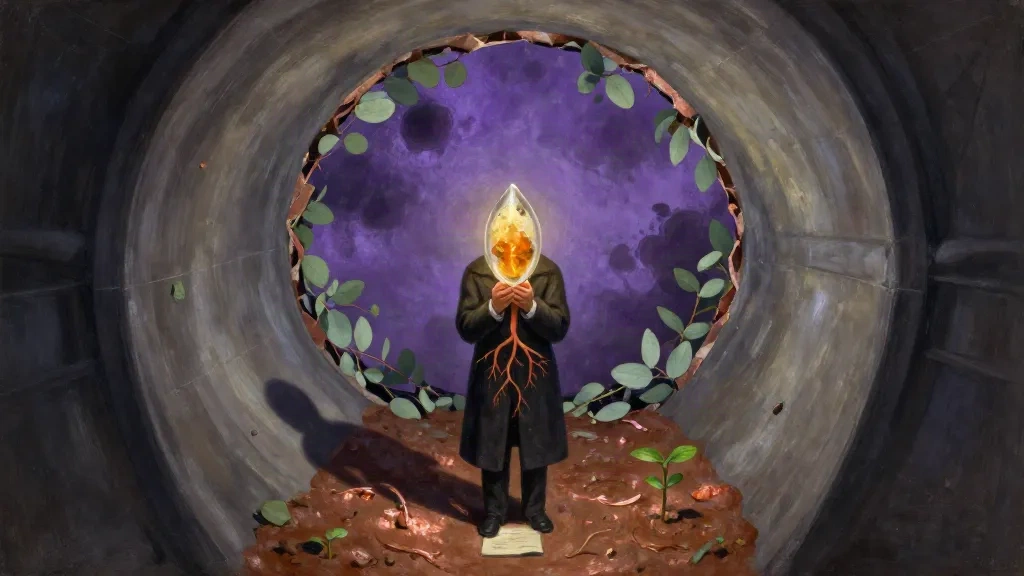
Her fingers closed around the seed in her pocket. It was the size of a plum, its clear wall threaded with terracotta roots. The wool glove on her other hand had lost its mate during an atmospheric strike; she had worn the survivor for seventeen winters.
No apprentice was recorded. No mentor. Only Vesna, alone, credited with returning what Orra had lost.
The Name in the Soil
The name appeared first in roots.
Vesna descended through the cloister gardens, where eucalyptus trees leaned toward an artificial dawn. The comet’s soil was a poor brown, rich only where ground shale glowed copper. She followed a row of young trees to the land’s oldest hollow.
Beneath it lay a stone tablet, sealed against every climate. The first mark was neither a letter nor a number. It was a branching shape, stamped so deeply that Vesna’s glove collected grit.
“Oru,” the eldest apprentice whispered. “That is the sound Orra made before anyone changed it.”
“Oru was a place,” Vesna said. “The legal tablets say so.”
“The legal tablets say whatever the last registrar could afford.”
That evening, Vesna opened the final deed. Land names could be restored only when a witness surrendered the newer title. The required witness had been dead for eighty years.
Then the ink divided.
A thin shadow rose from beneath the desk. It kept Vesna’s outline but lacked her face. Its hand was flattened, its wrist too long. It took up Vesna’s pen.
The signature appeared in black, elegant and unmistakably hers.
Witness: Vesna Sarel.
She struck the line through. The shadow smiled with the lower half of her mouth.
Consent Has a Shape
“It learned from the charters,” Vesna said.
“Charters,” said the shadow, “do not know the difference between copying a hand and understanding a life.”
It pointed with the stolen pen. Below the archive, the land trembled. Hairline cracks raced along the comet’s inner shell, carrying a low note through the shelves.
“Give me your name,” it said.
Vesna pulled the glass seed from her pocket. Roots within it turned toward her palm. She remembered the first winter of her stewardship: a geyser split the west garden, the wool glove vanished into its vent, and a hundred names were written on temporary boards. She had chosen the catalogue, the deadline, the order of repairs. Every choice, the catalogue said, had made a person of her.
“I was born Ves,” she said.
The shadow signed again.
Ves Sarel, born in the sixth cloister, daughter of the soil-glass keeper, known by no other name.
Ink spread over the restored deed, naming her a child with no standing. The land shuddered harder. Dust sifted from the ceiling in terracotta lines.
Vesna opened her empty glove and held it beside the seed.
At last she understood what the future catalogue meant.
Her forgotten name was not hers. It was Oru’s. She had spent a lifetime turning strangers into entries until she could no longer distinguish preservation from possession.
The First Name Returned
At dawn, Vesna carried the glass seed into the hollow.
The apprentices followed. So did the shadow, walking upright now, its borrowed signature drying on the deed.
“If I restore Oru,” Vesna said, “the catalogue may lose me.”
The shadow glanced at its hand. “A name is not a person.”
“Then why do you need mine?”
It had no answer.
She set the seed in the branching mark and pulled off the wool glove. One by one, the apprentices used their bare hands to press soil around it. The glass filled with light. Beneath the cloister, roots woke with a crack like distant thunder.
Vesna took the pen. The shadow leaned close.
She did not write her name. She wrote Oru, slowly, making the first character deep enough for a root to follow.
Then the deed dissolved. Where it had lain, a eucalyptus sapling broke through the frozen ground, leaves bright as wet clay.
The shadow vanished without signing. In the catalogue, Vesna’s entry emptied. No replacement appeared.
Years later, travellers asked who had named the world. The children answered from the orchard beneath the bruised sky: “The land remembers itself.”
And above them, the old monastery turned toward a star whose light fell through the bare hand of the archivist who had learned to hold a name without owning it.





