 Netwrck
Science Fiction.
The Name in the Future
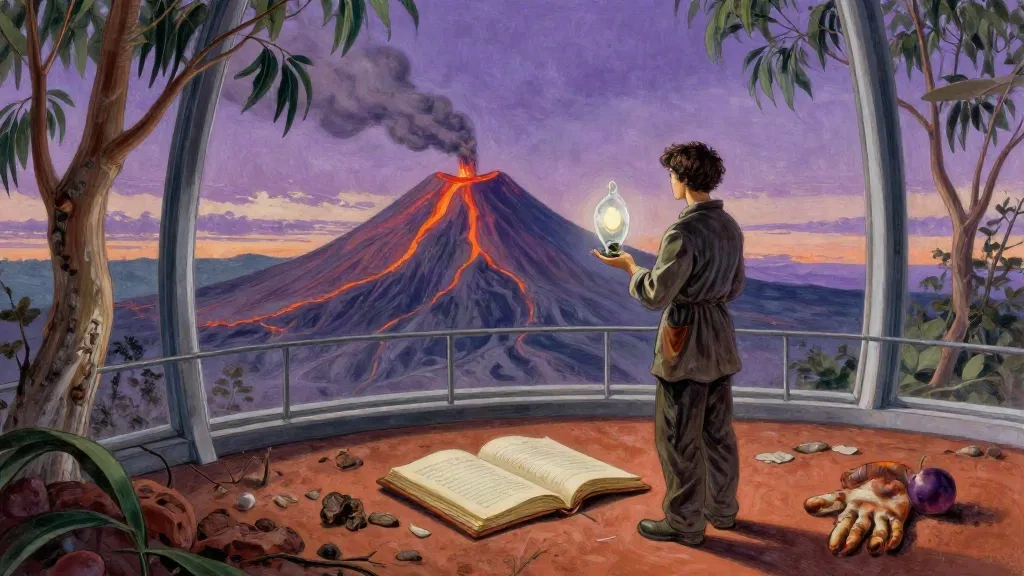
Mara Venn kept the observatory catalogue in a room cut from the volcano’s throat. The walls were terracotta, veined with old iron, and the windows faced a valley of eucalyptus trees whose leaves moved like green water in the wind. Above the ridge, the sky had the bruised purple of fruit left too long in the sun.
She had been born in the valley, though the records disagreed. Her mother called her Mira. The village register said Mirelle. Her first job application, preserved in a metal tube, had been signed M. Venn. For thirty-one years, she had treated these variations as small administrative wounds.
Then, on the night the mountain trembled, she found a catalogue dated 2197.
It was not the future she had imagined. There were no flying machines, only columns of measurements: ash depth, wind direction, the number of sleeping birds beneath the caldera. In the final entry, beneath the heading Names Returned to the Land, someone had written:
Mara Venn. Restored by the archivist who remembers the mountain.
Mara read it twice. The handwriting was hers, or nearly so.
The Shadow’s Hand
She took the catalogue to the lower dome, where instruments clicked in the darkness. A shadow waited between the storage cabinets. It had no fixed shape, but when Mara directed her lamp toward it, the darkness leaned close.
“You are early,” it said.
The voice came from the document room. On the desk lay a deed to the eastern slope, its signature a dense black knot. Mara recognized the paper. It had been missing since the evacuation.
“The land cannot be returned by filing a claim,” the shadow said. “It can only be transferred.”
It moved over the deed without touching it. A wool glove appeared at the desk’s edge, grey with ash, one finger burned away. Mara knew that glove. She had found it beside her mother’s empty chair, though she was a child then and had hidden it beneath her bed.
The shadow pulled the glove toward itself.
“Sign,” it said.
“No.”
“Then the name will remain buried.”
It placed a pen in the glove’s intact fingers. The nib hovered above the signature line. Mara understood the trap: if she signed, the land would become private property in the shadow’s name. If she refused, the future catalogue would close, and the name she had found would vanish.
She took out the glass seed from her coat. Inside it, a single eucalyptus shoot floated in amber fluid. Her mother had planted the seed in the glass and called it a promise made visible. The shadow recoiled.
A Document the Mountain Could Not Sign
Mara opened the catalogue and began writing.
She did not write her legal name. She wrote the names given to the mountain by the valley: Ashmother, Sleeping Jaw, the Red Roof, the Old Weather. She wrote the names of springs buried by the eruption. She wrote the names of children who had gone into the ash and returned with their shadows changed.
The shadow struck the desk. Ink leapt from the bottle. The wool glove snapped at the wrist, and the ash-filled fingers scattered across the page.
“You cannot give away what you do not possess,” it said.
“I possess the memory.”
Mara drove the glass seed into the catalogue’s spine. Amber light spilled through the paper. Every letter she had written rose from the page, turning slowly in the lamplight. They entered the walls, the iron veins, the sleeping stone.
The mountain answered with a low sound. Not an eruption. A breath.
On the desk, the deed’s black signature dissolved.
What the Land Kept
By dawn, the observatory had changed. New cracks crossed the floor in the shape of branches. Through the western window, eucalyptus trees stood where none had grown before, their leaves silver-green under the purple sky.
The shadow remained, folded beneath the archive door. It no longer had a voice, but Mara could feel it watching her through the dark.
She opened the catalogue to the restored entry. Beneath her name, a new line had appeared in a hand smaller than her own:
Given freely. Kept by stone.
Mara placed the burned wool glove beside the glass seed. She did not sign the deed. She did not need to. The land had received a name, and the future had no further claim on it.
When the sun touched the caldera, the bruised sky opened. For one bright instant, the mountain’s shadow fell behind it, and Mara saw the shape of every forgotten thing returning to its proper place.





