 Netwrck
Fantasy.
The Catalogue of Unborn Floors
The Vesper Rooms occupied a narrow apartment building between the violet dusk and the railway yards, where every tenant remembered only what had not yet happened. They washed their cups in the morning because dinner was still a distant inconvenience. They apologised to strangers for songs they had not heard. Children slept beneath ceilings engraved with tomorrow’s weather.
Mara Venn was the building’s archivist. Each evening she catalogued the future objects left in the vestibule: a shoe polished by a grief that had not occurred, a parcel addressed to a person not yet born, a key that opened a room scheduled for demolition. The glass seed rested on her desk, clouded with the colour of weather behind mountains. In its hollow core, a white thread trembled whenever someone nearby remembered too much.
On the seventh violet night, Mara found her own name.
Venn, Mara, appeared in the future catalogue under a heading she had never seen: NAMES REQUIRING RESTITUTION. Beside it was a date two years ahead. A location in the southern marsh. And a description: the name belonging to the land beneath the drowned orchard.
Forgotten people were usually forgotten completely. This one had retained enough of a name to be filed, but not enough to be called.
Mara copied the entry twice. The glass seed cracked.
The Tenant with the Wool Glove
On the last floor lived a tenant called Oren Pell, who wore only one wool glove. The other hand was always tucked inside his coat. He never entered the future. When asked what he remembered, he said, “The day you will need me.”
Mara showed him the catalogue entry. He studied it for a long time, then placed his gloved hand over the paper.
“The land is waiting for a name,” he said.
“Then you know it.”
“No. I know the name that will be used to bury it.”
That evening, the building’s shadow detached itself from the stairwell. It had the shape of a tall person with one hand hidden behind its back. It entered the archive carrying a document folio.
“Property transfer,” said the shadow. Its voice came from the walls, the pipes, and the missing rooms. “The land is to be signed over at dawn.”
Oren lifted his wool glove. Inside it, he held a brass seal. “That is not a name.”
“It is an authorised mark.”
The shadow unfolded the document. Mara saw the catalogue entry reproduced beneath the heading, every letter exact. At the bottom waited a signature in ink that looked like winter.
Oren struck the page with the seal. The signature vanished.
The shadow signed again.
By midnight, it had produced forty-seven copies.
The Door Beneath the Stair
Mara understood the building’s rule then. Tenants remembered the future, but the building remembered everything that had been lost. The catalogue had not been a record of what was coming. It was a record of what had been taken out of the land.
She descended to the basement, carrying the glass seed and Oren’s glove. The shadow followed, its outline stretching over the pipes and walls. At the final door, a brass plate read: ROOM 0, OCCUPIED SINCE ALWAYS.
The lock accepted the cracked seed. The keyhole filled with cloud-white light.
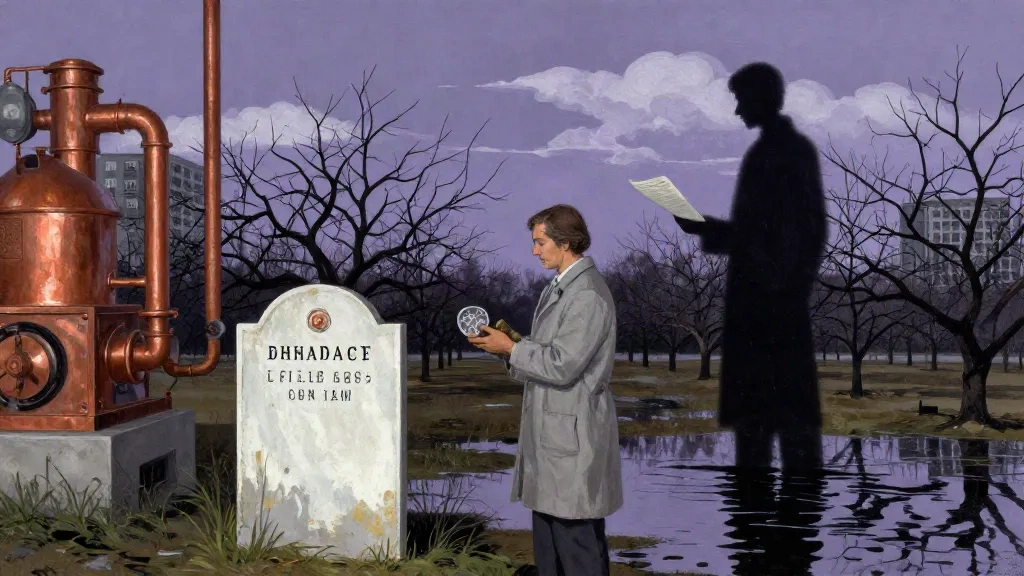
Beyond the door lay a field beneath a shallow sky. A black orchard stood in standing water. Mara crossed the water without wetting her shoes. At its centre, a weathered marker leaned from the earth, its inscription scraped blank.
The shadow placed the folio on the marker. “Sign.”
“I don’t know the name.”
“You know the hand that should have written it.”
Mara looked at the cracked seed. Inside it, the white thread had formed a letter. Not a name. A single mark of pressure, worn into the earth by a kneeling person.
She pressed her bare palm against the marker. The stone remembered her, and she remembered the land: salt in the roots, a child hiding beneath the branches, a woman calling across the flooded rows. The forgotten name returned not as sound, but as weight in her chest.
Oren’s shadow on the water completed it.
Mara spoke the name aloud.
What the Land Returned
The marker split cleanly. Beneath it lay a wool glove, stiff with age, and a child’s glass seed filled with clear water.
At dawn, the document vanished from the shadow’s hands. The orchard became a field again, though the water remained. The building’s tenants woke with a memory of the future: a name in the southern marsh, a road opening where none had been.
Mara entered the restoration in the catalogue. Beside Venn, Mara, she added the name, struck through with a line of violet ink, followed by the words: returned to the land.
The glass seed held the last of the cloud-white light. Oren placed his wool glove in Mara’s hand.
Then he reached into his coat and offered her his other one. It was bare, warm, and already signed with her name.





