 Netwrck
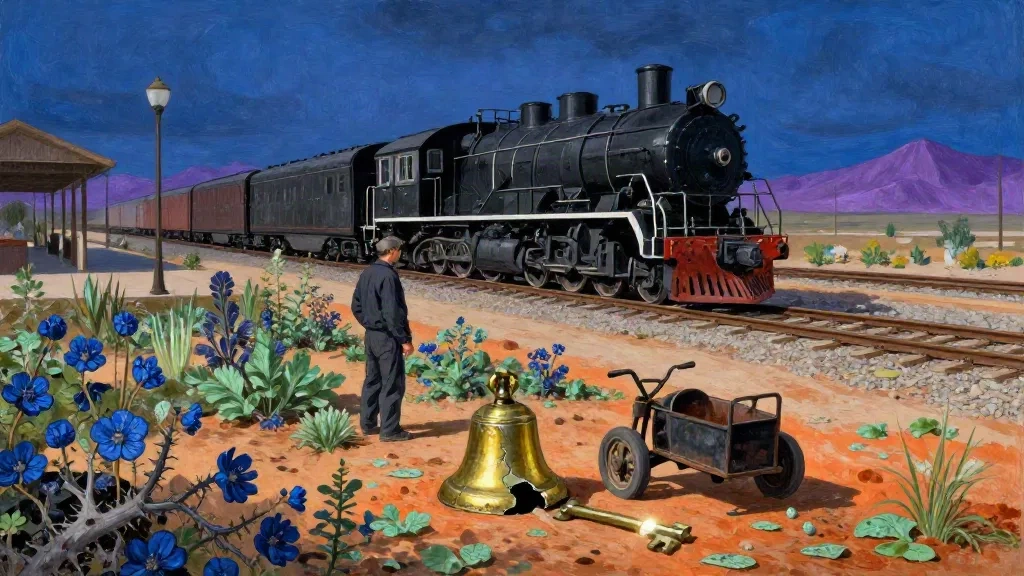
Surrealism.
The Courtyard Behind Platform Nine
At the desert railway station, the heat made the platforms look newly invented. The rails ran from a low sun toward a line of violet mountains, but every morning at 11:17 the eastbound train arrived from another century. It came without a sound of approach: one moment the tracks were empty, and the next they held a black locomotive breathing blue smoke beneath a brass clock stopped at 3:06.
Mara met it with a bucket of wet soil and a pair of pruning shears. She was the municipal gardener, responsible for the neglected courtyards behind the station, though the station itself answered to no municipality she could find.
In the first courtyard, she planted a story about a boy who could make a desert bloom by whistling. In the second, she planted the tale of a woman who carried a river in her coat. The stories took root in red soil and flowered overnight in impossible colors. Travellers rested there. Some stayed until dawn, some traded food for secrets, and one slept beneath a wall built from the names of drowned wells.
Her own family story had no comfortable ending.
Her grandmother had left the station on the 3:06 train, carrying a brass key and a cracked bell. She had promised to send word when she found a place worth staying. The train returned years later without her, though its conductor remembered a carriage lined with blue lightning and passengers who spoke in voices like opening drawers.
Mara planted the story anyway, in the courtyard closest to the tracks. She shaped the soil into a doorway, laid a stone beneath it, and spoke every remembered detail: the bell’s single note, the key’s warm teeth, the smell of oranges burning in the desert.
The Machine That Refused Witnesses
Between the courtyards stood a small machine painted rust, with a copper eye and three uneven wheels. Its purpose was painted in letters too faded to read.
The stationmaster said it produced shelter for anyone who brought a true account of themselves. “You only have to believe,” he told Mara.
So she brought a traveller: a man fleeing a debt, carrying a red suitcase and a story about a sister who had mistaken him for a stranger. She placed the suitcase inside the machine.
Nothing happened.
She tried a child who claimed she had been born inside a thundercloud. She tried a woman who said her house had moved three streets east every winter. The machine remained inert.
At night Mara watched the locomotive’s blue light tremble across the courtyard walls. She understood the mechanism’s bargain before the stationmaster admitted it: the machine worked only when nobody believed in it.
Even Mara believed in it. That was the trap.
She tried to dismiss the machine, but hope had become a stone in her chest. She tried to laugh at it, and found she could not remember the shape of the thing without seeing herself inside it.
What the Bell Could Carry
On the seventh night, the cracked bell rang from the buried doorway.
Its note was not loud. It travelled through the soil and entered the roots of Mara’s stories. Every courtyard bloomed at once, blue petals turning toward the platform.
The machine started without anyone touching it.
Its copper eye opened and released a thin shelter, no wider than a bench, but deep enough to contain rooms: a kitchen with wet floors, a bedroom beneath a roof of stars, a corridor where footsteps became warm hands. Travellers entered carrying their stories. None of them knew they were true.
Mara reached for the brass key hidden beneath the doorway stone. Her grandmother’s key, she realised, had not opened the train. It opened the difference between a story and a shelter.
She turned it.
The shelter expanded through the station, under the platform and into the desert beyond. Its walls were made of cracked plaster, blue window-light, and the stubborn heat of shared meals. Strangers slept there. Children listened to old accounts without believing them, while the accounts became doors, tables, roofs, and clean water.
But the machine shook. As more people believed in it, its wheels slowed.
A Refuge No One Owns
By dawn, the station had become a town. Courtyards held gardens, workshops, shaded markets, and rooms that could not be found twice. The train arrived from another century carrying passengers who had no reason to stay, yet they stayed anyway, helping repair the shelter without adding their names to its walls.
Mara’s grandmother remained absent. The cracked bell lay silent beside the machine, and the brass key had turned warm in Mara’s hand.
Then the locomotive arrived at 3:06. This time its windows were clear. Inside sat an old woman holding a smaller version of the same bell.
She looked at Mara through the blue storm-light and shook her head.
“You built a place,” she said, “but you kept needing to believe it belonged to you.”
Mara understood. She stepped into the shelter and released the machine.
No one saw her destroy it. In the morning, the station held only a rusted machine with three uneven wheels. It worked for no one. It failed whenever anyone said it mattered.
That was how it remained alive.
And whenever the desert wind brought travellers toward the station, they found a courtyard behind platform nine, where a stranger’s story grew shade, water, and shelter. They never met the gardener. They never needed to. By evening, no one could agree who had planted the first tree.





