 Netwrck
Historical Fantasy.
The Blue Suitcase
At dawn, when the iron bells above Saint Orra rang seven times, the shadows left their citizens.
They slid from doorways, market stalls, and rain-dark roofs, each wearing the clothes of the person it belonged to. They bowed to the magistrate, lined up beneath the tax office, and carried out the city’s work while their owners slept.
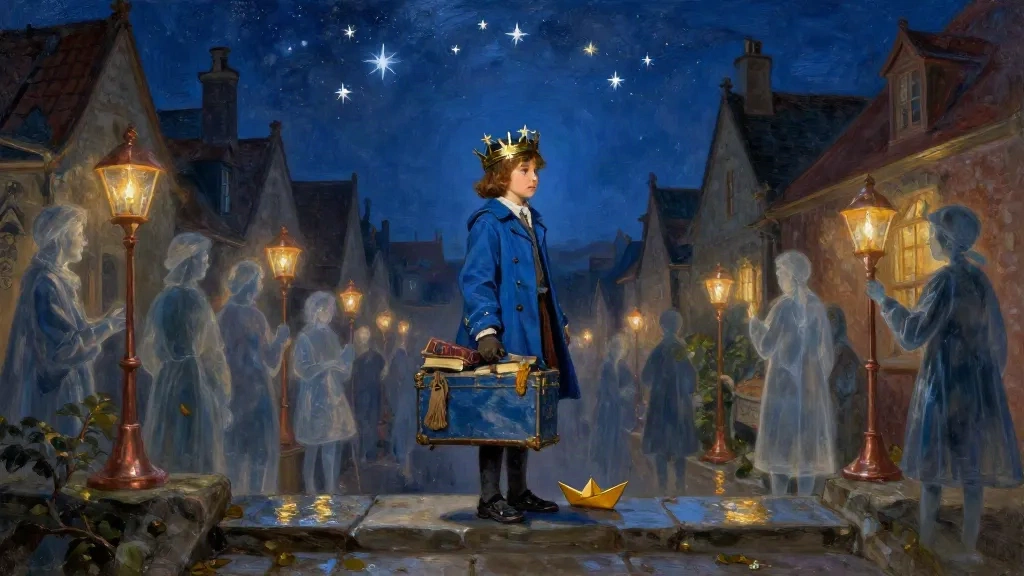
Lio Venn was nine years old and the smallest registrar in the Shadow Registry. Her blue suitcase contained a library: thirty-one books tied with wool cord, a brass key for every municipal cupboard, and one forbidden atlas whose pages showed the sky as it had appeared before the city was built.
The first shadow that entered the archive belonged to Lio. It was taller than she was, dressed in a blue coat, and carrying a paper boat under one arm.
“You are late,” it said.
Lio shut the suitcase. “I am early.”
“That is not the same thing.”
She looked through the western window. Beyond the slate roofs, the sky had lost the constellation called the Bellmaker’s Crown. Twelve stars had been removed during the winter and placed beneath the archive floor, where the Registry kept dangerous things that had not yet been given names.
Lio had found the entry in her mother’s handwriting: Return the Crown to its proper darkness before the shadow of Elian Venn dies.
Elian Venn was Lio’s grandmother. She was alive, sitting upstairs in the east room, knitting a wool glove with one hand and complaining that the other had wandered off.
The Living Deadline
“Shadows do not die,” Lio told the entry.
Her own shadow bent over the atlas. “People do. Eventually. The Registry records the death of the shadow first.”
“Why would Grandmother give me a deadline she has not reached?”
“She is not giving you one. She is borrowing it.”
Lio searched the house. In Grandmother’s sewing basket she found a second wool glove, stiff with salt, and beneath it a paper boat folded from an old declaration. The boat carried one sentence in brown ink: When the living name is absent, the shadow takes the city.
At noon, the magistrate’s shadow began removing citizens’ shadows from the public records. By evening, the Registry would have power over every sleeping person in Saint Orra.
Lio packed the wool glove, the paper boat, a bottle of lamp oil, and the blue suitcase. She left her shadow in the archive with instructions to guard the doors. It complained that this was an undignified assignment.
“You are the only one with a uniform,” Lio said.
Her shadow straightened its cap.
Twelve Stars Under Stone
The Crown lay in a chamber beneath the Hall of Measures, behind a lock that recognized shadows and obeyed them.
Lio’s shadow opened the first door. The market shadows opened the second. A row of small shadows, children’s shadows, carried the paper boat through a crack in the floor while Lio followed with the suitcase striking her knees.
Inside the chamber, twelve glass cases stood in a circle. Each held a star. Some were bright enough to make the walls sweat. One trembled when Lio held the wool glove near it.
The final case was empty.
“The Crown is not a group of stars,” said the archive’s shadow. “It is a promise made between the sky and the city.”
“Then why was it stolen?”
“Because someone refused to pay the shadow tithe.”
Lio looked at the paper boat. A municipal clerk had folded it, and the clerk had signed it. The signature belonged to Grandmother Elian, dated forty years earlier, when the city had first begun taking shadows into employment.
Outside, the bells began to ring for midnight.
Lio placed the wool glove around the empty case. “I’ll make a new promise.”
A Name in the Sky
The archive’s shadow tried to stop her. “The Crown was taken from the heavens, not the city. Returning it will make Saint Orra visible again.”
“Visible to whom?”
“To everything that watches.”
At that moment, the shadows of the Registry streamed through the chamber and joined them. Lio set the paper boat on the floor. It filled not with water but with reflected candlelight, gold and trembling.
She opened the atlas and found the missing twelve stars printed as black holes in a steel-blue sky. On the page, a small line of writing appeared:
A promise is returned by the hand that inherited it.
Lio took the wool glove and placed it over the words. Her grandmother’s shadow rose from the empty case, wearing a tobacco-brown dress. It bowed to Lio, then to the city.
“I did not ask you to do this,” it said.
“You gave me time.”
“Time is not a gift. It is a debt.”
“Then let me pay it.”
At midnight, Lio lifted the suitcase. The twelve stars rose from their cases, crossed the underground river of reflected candlelight, and entered the atlas. The map became a window.
Through it, the Bellmaker’s Crown appeared over Saint Orra. Every citizen’s shadow turned upward at once, finding the sky it had been forced to replace.
Grandmother Elian died in the east room while the stars returned. Her shadow folded itself into the wool glove and became still.
Lio carried the glove and the paper boat home. In the morning, the city counted its citizens and found one more than before.
She opened the blue suitcase. Every book inside had changed its title to A Record of Shadows That Returned Home.
On the last page, in her grandmother’s hand, were four words:
Keep the light with you.





