 Netwrck
Historical Fantasy.
The Rooms That Knew Tomorrow
In 1874, the Ashgate Building stood above a tobacco warehouse with nine windows facing the river and seven facing the yard. Its tenants remembered only what had not yet happened. The cook left flour for breakfast she would remember burning. The watchman polished boots for a flood still six weeks distant. OldMadame Pell brushed her teeth every evening at noon, confident of the toothache awaiting her in April.
Mara was eleven and carried a library in a blue suitcase: eighty-three books tied beneath the handles, each catalogued by a date no tenant could recall living. She delivered forgotten histories to people about to forget them again.
Her room had a steel-blue wall and a radiator that clicked like distant typebars. On her bed lay a wool glove, crimson at the cuff, and a paper boat folded from the shipping notice for a constellation removed from the eastern sky seventeen years before.
A Deadline With a Living Witness
The seventh tenant rang her bell on the first Monday of March. Nobody occupied number seven. Yet when Mara opened the door, a young man in a railway inspector’s coat stood beyond it, holding the other crimson glove.
<“You will come to the roof at four o’clock,” he said. “Bring the boat and every record bearing the name Orison. If you are late, the winter office will inherit the missing stars.”
“Who inherits them now?”
He turned his palm upward. In its lines the reflected light of a far-off candle moved as if a flame burned beneath his skin.
“I do,” he said. “For now, I have not died.”
At four, on the eastern clock, bring what was stolen into the morning.
Mara found the name in a ledger bound in tobacco-brown calfskin. Orison had been an astronomer employed by the Ministry of Celestial Repairs. His final entry described seven lights being lowered into a warehouse beneath Ashgate, where they could be filed by birth year and redistributed to people about to lose their futures.
The railway inspector was named Elias Rook. He had already remembered tomorrow’s railway accident, next week’s robbery, and the exact minute of his own heart failure. He remembered those events in sequence, as children read a page backward.
Every tenant feared the deadline because each could remember being present when it passed. None remembered the stars.
What the River Returned
The records led Mara through the building. The cook had made a constellation pie for a celestial ball. The watchman carried the warehouse key on his nightly rounds, though he could not remember carrying it now. Madame Pell had sewn a celestial chart into the lining of number seven’s coat. Each clue cost a memory: at breakfast the cook forgot heat; at noon the watchman forgot sleep; by evening Madame Pell could no longer remember her son’s face.
They followed Mara to the river cellar. Floodwater covered the lowest steps, holding broken constellations in trembling pieces.
Elias waited there with the wool gloves tucked into his coat. “The office is not a building,” he said. “It is a promise deferred. It gains legal force when its witness arrives.”
“Then who is its witness?”
He placed the paper boat in Mara’s palm.
“Whoever restores the sky must remember every life it is returned to. A city that future-sees will not forgive a private grief.”
The boat trembled. Candlelight reflected from the flood, steel blue and gold, and beneath it appeared seven points of light. Mara understood at last: the stolen constellation had not belonged to gods or sailors. It had been the pattern of the seventh tenant’s family, recorded on the night the inspector was born.
The Morning in the Suitcase
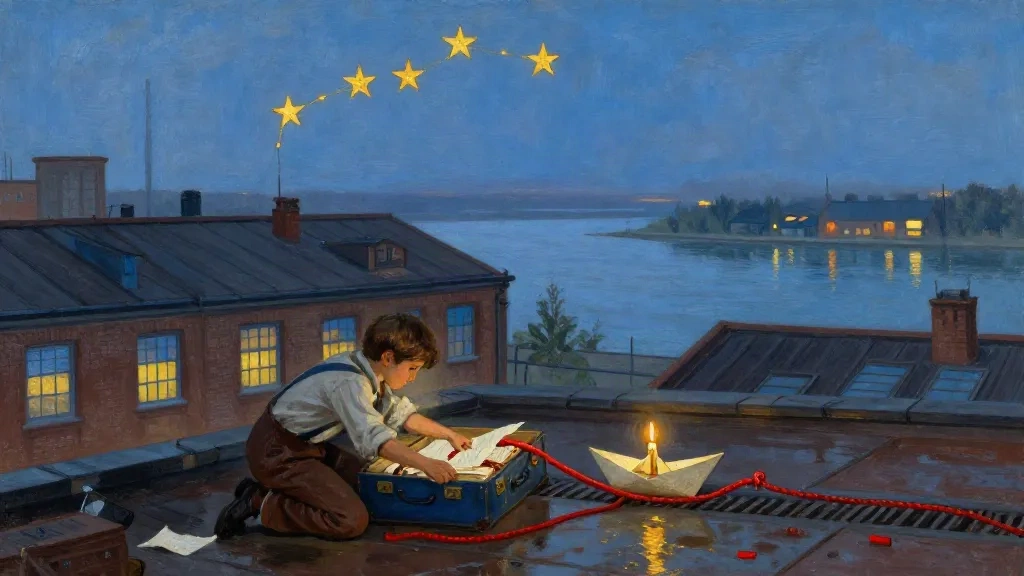
At four, Mara set the paper boat upon the roof drain. Wind worried at its edges. She unwrapped the constellation from its frame in the warehouse ledger and placed it in the boat. Then she drew on the crimson wool, thread by thread, until a red bridge spanned the water.
The stars climbed.
Across the neighborhood, people stopped before windows. A woman remembered forgiving her brother. A merchant remembered closing his shop. Elias looked upward, and the candle glow beneath his skin went out.
“Now the office has no witness,” Mara said.
He nodded. “It has something more useful: sky.”
At dawn, every tenant in Ashgate remembered the same small thing. Before fear took hold, they had seen a paper boat crossing a river of reflected candle, carrying a lost constellation home.
Mara kept the blue suitcase. She had not returned the past, exactly. She had made it strong enough to survive the future.





