 Netwrck
Mythic Fiction.
The Clock That Kept a Forest
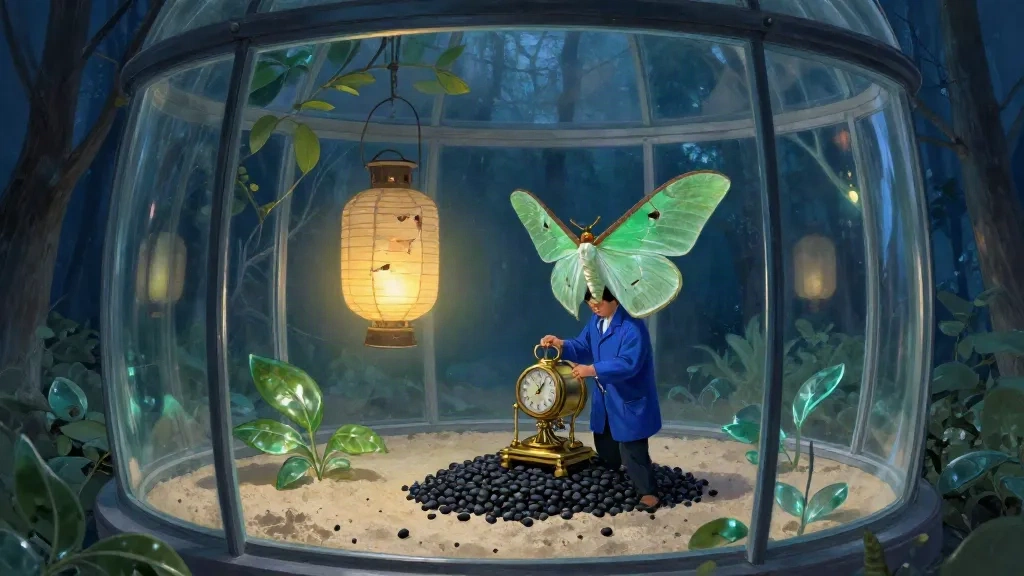
At the top of the orbital greenhouse, where the glass walls showed cobalt shadow and the stars beyond it, Nera repaired seasons.
Her clocks had no minute hands. Some held the slow swelling of sap beneath bark; others counted the silver interval between a moth finding flame and its wing turning to ash. Nera set their brass teeth with tweezers, listening for the moment each hidden season intended to close.
The largest clock stood beneath a paper lantern, its shade folded from green pulp and stitched with silver thread. It had belonged to Ilyra Venn, the gardener who first woke the seed from its orbit in the dark between worlds. Ilyra had made every part of it, down to the tiny crescent engraved beneath the dial. Then she had gone beyond the greenhouse doors during a solar storm and never returned.
Her body was never found. Her memories were.
They gathered in the seed vault after Ilyra vanished, speaking through the irrigation pipes and the leaves of the imported olive trees. The choir called itself the Garden's Many Voices. It knew every meal Nera had eaten as a child, every promise Nera had broken, every hour Ilyra had spent alone beneath the northern lights. It knew the smell of Ilyra's hands after handling the seed: rain, green wood, and hot metal.
The choir also knew why she had gone.
The Name Inside the Wing
On the night before the equinox, the voices became impossible to sleep through.
One voice insisted Ilyra had abandoned the greenhouse. Another said she had been taken by a failing lock. A third repeated the final scientific report, flatly, in the tone of a machine unable to forgive uncertainty. They argued until the leaves shook and the paper lantern trembled on its hook.
Then the largest clock stopped.
Nera opened its back. Inside, beneath the mainspring, lay a moth wing.
It was sea-glass green, veined in sand, almost translucent. On it, in letters too fine for human eyes, was a name: Ilyra Venn.
The wing had been made by the seed itself, from a pattern stored in Ilyra's vanished memories. Nera understood then that the greenhouse had not lost its gardener. It had lost the permission to remember her correctly.
Her task was simple, and therefore impossible: return the name to the person who had made it.
The choir refused.
“If Ilyra is returned,” said the voice that remembered her laugh, “will she return to us?”
“If she is returned,” said the voice that remembered her leaving, “will she remember why she went?”
“If she is returned,” whispered the seed, “will she remember that I am not the forest?”
What the Dead Refused to Keep
Nera set the moth wing inside the clock and turned the key backward.
Each memory rose from the pipes. The first showed Ilyra as a child in a flooded city, carrying a brass watch through black water. The second showed her laughing beneath a sky without cities. The third showed nothing at all: a blue field, a distant sun, and her hand closing around the seed as if holding a dying star.
They were not memories of the same woman.
They were memories that had survived by refusing one another.
Nera climbed onto the clock and cut the paper lantern free. She held it beneath the wing while the seed spoke in the voices of roots.
“I remember her as she was,” it said. “I remember her as she hoped to be. I remember the moment she chose the door. Which one do you call her?”
Nera looked through the glass. Below her, the extinct forests pressed their leaves against the hull: cedar, ash, hornbeam, names no living tongue could pronounce. The seed remembered them because Ilyra had refused to let their endings become the final version of themselves.
“None of them,” Nera said.
The Hour Without a Hand
At dawn, she placed the moth wing on the open page of the seed register.
She did not choose the happiest memory, or the most guilty, or the one that made Ilyra's disappearance mean something noble. She opened the clock's empty housing and let every voice speak without arrangement.
The choir became a single sound, ugly and bright. It tore the paper lantern into a thousand pieces. It shook the greenhouse until the stars seemed to slide across the glass. Then the name left the wing.
It passed through the seed, through the roots, through the remains of the forest, and outward into the dark.
For one impossible minute, Ilyra Venn existed everywhere at once: child, gardener, fugitive, maker, stranger.
Then she was gone.
The wing remained on the register, clear as sea glass. Nera closed the clock, though it had no time left to keep. Behind her, the seed unfolded one new leaf.
On its surface appeared a line of silver script, delicate as a moth's antennae:
She made the seed remember. Now it remembers her making.





