 Netwrck
Mythic Fiction.
The Monastery Without Hours
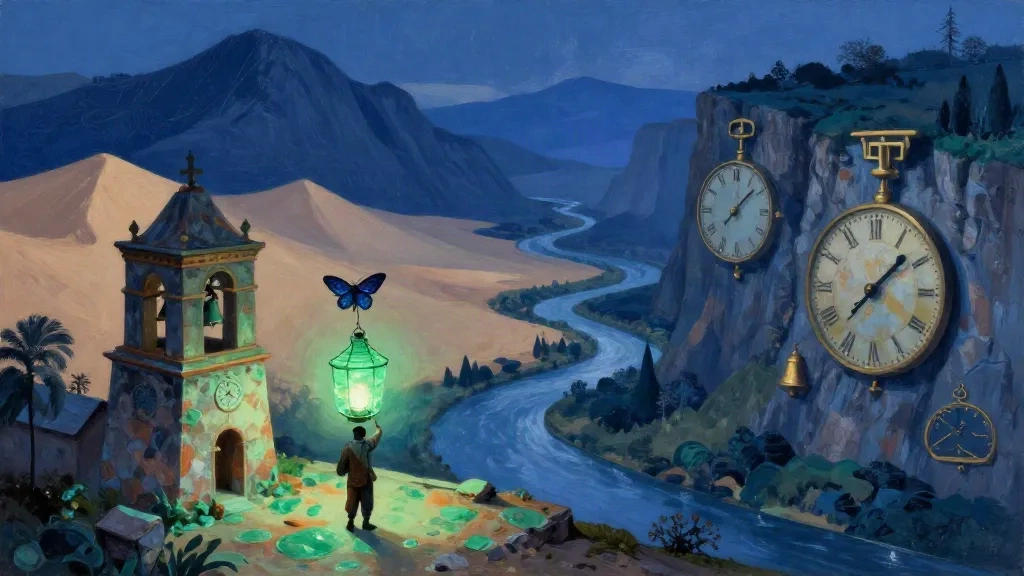
At the Monastery of Patient Hours, no clock showed the same time twice. The monks wound bronze mechanisms beneath the sand-colored cloisters and waited for them to decide what the world should become. One chimed into rain. Another opened a seam of blue heat across the sky. The smallest, a clock no larger than a prayer bead, made spring arrive one day early and stayed stuck there for a season.
Ilan repaired them.
She did not make clocks for hours. Hours were too obedient. She made clocks for seasons: a low silver wheel for the first thaw, a copper crescent for harvest, a black glass vessel for the dry months when rivers forgot their beds. Each mechanism was tuned to a particular place, and each place had once entrusted its season to her.
That morning, the mountain sent word that its bell had vanished.
The bell was not ordinary. For three hundred years it had marked the changing year over the eastern valley, keeping the weather from turning all at once. Without its voice, winter had begun in the south while summer still burned along the coast. The monastery’s monks blamed the sea. The villagers blamed the old songs. Ilan blamed the bell’s keeper, who had died in winter without passing on the name of the spring it guarded.
She packed a paper lantern, a coil of copper wire, and the moth wing she had found beneath the clock room floor. It was blue-black, dusted with sea-glass green. The keeper had left no instructions, only this wing and a line cut into the old mounting board: Return what was made by the one who made it.
The Choir in the Wall
The bell had been hidden in the monastery’s eastern wall, where the voices of the dead were stored in jars. Ilan had heard them during her apprenticeship. They sang whenever the clocks were wound, each memory insisting that the world should return to the moment it loved best.
One voice remembered the valley green and young. Another remembered the year of the great flood, when the river had opened the mountain’s wound. A third insisted there should be no seasons at all, only one long blue afternoon.
They spoke through the paper lantern. Its thin walls trembled, and the moth wing cast a moving shadow over the workshop. The memories had conflicting interests. The old monk who had stolen the bell wanted to keep it hidden because it reminded him of a spring he had failed to save. The flood wanted it rung so no other disaster could be forgotten.
Ilan set the mechanisms around the lantern. The spring clock gave one clear note. The flood clock answered with a low, broken chord. The summer clock refused to move.
She understood then. The bell had not been stolen for hiding. It had been stolen because the choir could not agree which year deserved to hear it.
What the Mountain Remembered
At dusk, Ilan climbed toward the bell tower with the lantern in one hand. Cobalt shadow gathered under the stairs. Below her, the monastery’s clocks began to sound without winding. Rain fell inside the walls. Sand climbed the windows. A strip of green moss spread across the floorboards.
The bell hung in the empty tower, suspended by a thread of frozen water.
To claim it, Ilan had to return the moth wing to its maker. She had assumed the keeper was dead. But the wing was a part of the bell, cut from its inner rim and used as a hinge. The bell had made the wing. The wing had been left behind so someone would remember that nothing lost was ever truly separate from what had made it.
She opened the lantern and let the wing rise into the tower air.
The choir became quiet.
Then the memories sang together, not in agreement but in sequence. The mountain remembered spring. The river remembered its flood. The coast remembered summer. Each memory took its proper place inside the bell’s bronze throat, and the bell began to ring.
The Year Between Two Kinds
When Ilan returned the bell, the year changed everywhere at once. Snow withdrew from the southern slopes. The northern orchards opened without blossom. A thin green line appeared in the desert, marking water beneath the sand.
The keeper’s final memory was among the last to settle. It showed Ilan’s first broken clock, the one that had failed during her first winter as an apprentice. The keeper had repaired it secretly, adding a spring that could not be wound forward. Ilan understood then why she had always preferred seasons to hours. Some things were meant to return, not repeat.
Before the bell faded, the wing turned once in the lantern’s light. It was no longer blue-black. Sea-glass green ran through it like weather moving over water.
Ilan closed the lantern and listened. In the monastery, the clocks had found a shared rhythm at last.
Not every year must be chosen. Some must be given room to become.
By morning, the bell hung silent in the tower. The choir remained in the wall, still arguing softly. Ilan repaired a clock for the valley below, a small sand-colored wheel that would turn whenever the first true spring arrived.
This time, she left its face open.





