 Netwrck
Adventure.
The Copper Horizon
Every morning, before the theatre opened its brass doors, the sky beyond the windows turned copper. It was not dawn. The theatre performed tomorrow's discarded endings there, and the horizon was the place where unused tomorrows went when no one had the courage to choose them.
Below it stood the workshop of Ilyan Vale, a watchmaker who made clocks for seasons rather than hours. His clocks did not divide the day. They governed the slow changes in the world: the loosening of winter, the first green fracture of spring, the autumn hour when fruit remembered how to fall. Each season-clock had a name carved into its iron case.
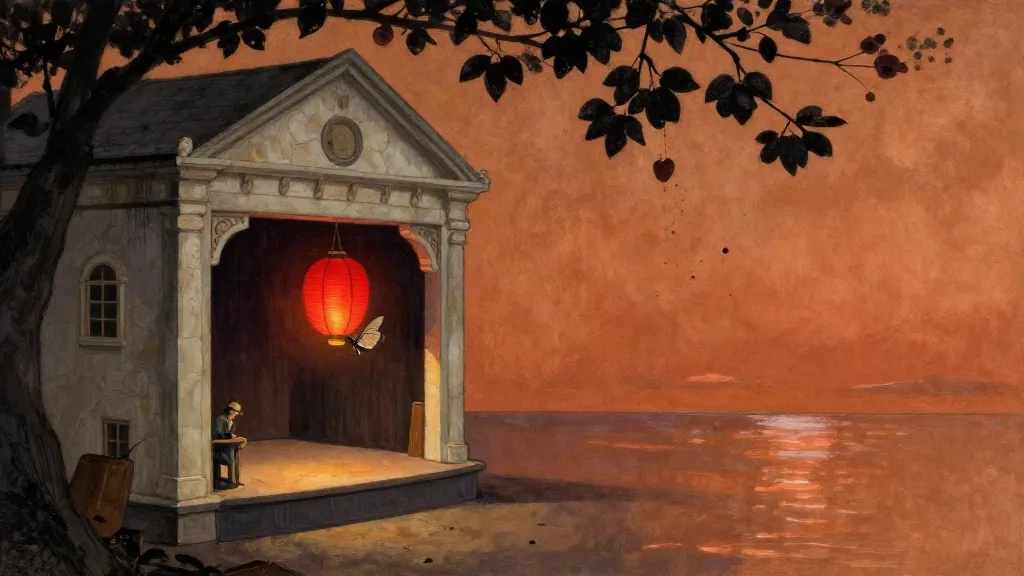
Ilyan's workshop had been empty for one season. On its bench lay a small spring-clock with no hands, its key bent into the shape of a moth wing. The wing was pale as old paper, veined black and gold.
The clock belonged to Eron Vale, the composer who had disappeared before Ilyan's last winter. Ilyan had promised to return it to the person who made it. That person had once been his teacher, but Eron was gone, and every theatre record said the same impossible thing: Eron had never left.
What the Dead Could Hear
On the theatre's lowest floor, a choir stood beneath a paper lantern. The lantern was red, black cherry in the shadows, and its paper glowed like a trapped sunrise. The choir sang without mouths. Their voices were memories, each one insisting that the body around it had been wrong.
One voice said the theatre had burned. Another said the theatre had never been built. A third remembered the moon falling into the river. They argued over the tempo, turning the song into a storm of competing directions.
Ilyan held up the moth wing. The choir went silent.
“That belonged to the composer,” said a small voice from the lantern.
“It belonged to the person who kept his last secret,” said another.
“It belonged to no one,” whispered a third. “That is why it was lost.”
Ilyan laid the wing on the conductor's stand. The theatre shuddered. Above the stage, a discarded ending began to unfold: Eron returning home, Eron leaving home, Eron dying beneath a copper sky, Eron refusing to die. The four versions of him stood in the wings, each holding the same spring-clock.
A Choice in Three Keys
“Return the wing,” the choir demanded, “and one ending will become true.”
“Which one?” Ilyan asked.
Every voice answered at once.
He knew the memories were not lying. They were only loyal to different versions of the same loss. One wanted the clock restored to Eron's workshop. Another wanted it carried back to the river where Eron had first heard the season turn. The third wanted the wing pinned inside the lantern so no one could forget the music.
Ilyan drew out his tools. He repaired clocks by removing the part that had been telling the wrong time. The theatre had mistaken memory for authorship. The wing was not the lost thing. The song was.
He set the spring-clock beneath the paper lantern and released the key. No hand moved. Instead, a note escaped the iron case, clear and low, the note Eron had used to mark the instant between seasons. The memories recoiled. Their disagreements tore the stage apart, exposing the dark machinery behind the scenery.
Ilyan played the note on the broken clock. Then he answered it with a second note, built from the sound of his own workshop: metal, dust, rain against glass, the first sweep of a broom before dawn.
The Ending Nobody Discarded
The competing endings began to blur. The choir sang through them, carrying fragments of fear and tenderness, until the separate memories became one unfinished chord.
On the conductor's stand, the moth wing shone. It had been torn from a living moth, Eron had once said, after the composer rescued it from a winter window. He had used its wing as a membrane for a tiny clock, delicate enough to measure the moment grief becomes acceptance.
Ilyan had mistaken the object for the gift. The gift was the returning.
He lifted the lantern from its hook and carried it onto the stage. The choir followed, their voices no longer conflicting, each memory occupying one note in a harmony that had never existed before.
At the copper horizon, the discarded endings fell away like ash. A new morning appeared, grey stone bright beneath a pale sky. Ilyan set the lantern beside the stage door and placed the spring-clock inside it.
Then he returned the moth wing to the moth.
The small creature climbed the lantern's paper seam, its wing closing over the new clock's glass. Its ticking sounded like a season changing. Behind Ilyan, the theatre began to perform its first ending that had not been thrown away.





