 Netwrck
Romance.
The Seed Vault
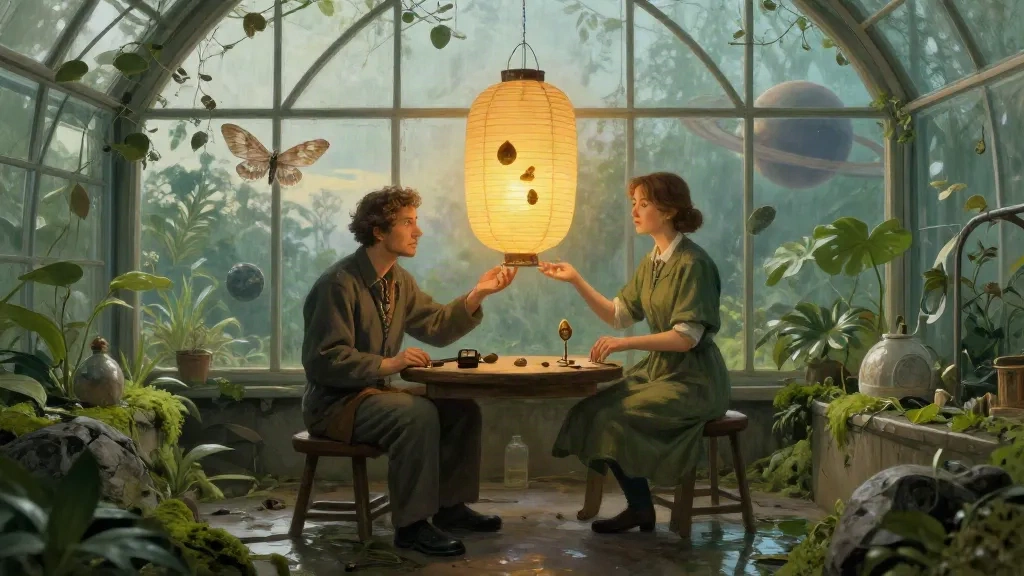
At the far end of the greenhouse, where condensation gathered on every rail, Ivar wound a clock for a season nobody had named.
His workshop occupied the curve of the observation ring: a bench of brass tools, a box of pine needles, three panes marked with moss-green paint. Beyond them floated the seed, suspended in a column of clear nutrient fluid. It was smaller than a fist and carried the memory of forests gone from Earth. When the irrigation pumps hummed, its shell opened along a seam no one had cut, releasing the smell of rain on wet stone.
Ivar made clocks for seasons rather than hours. He built them from pressure valves, lunar dust, seed husks, and the slow creep of frost across metal. Each spring was a beginning. Each winter an ending allowed.
Mara met him there every seventh day, carrying a paper lantern with a marigold flame sealed inside its folds.
“You are making another,” she said.
“Not another. A return.”
She set the lantern beside his bench. Its light touched the moth wing he had kept beneath glass: one wing, pale as old paper, marked with a pattern like branching rivers.
“Whose season?” she asked.
“The one this seed remembers.”
He had found the wing in the irrigation filters, tangled with a fragment of a name etched into its edge. Mara had recognized the engraving. The botanist who designed the seed had carried that wing with him for forty years, taking it from the last forest to the first orbital greenhouse.
The botanist was gone. The wing remained.
The Voices Under Glass
That night, the choir began.
They sounded from beneath the seed’s platform, one voice beneath another. The greenhouse had no choir. It had pressure sensors and irrigation alarms, not lungs.
“The forest remembers fire,” said one voice.
“The forest remembers rain,” said another.
“The forest remembers hands,” whispered a third.
Ivar covered the vents. The voices continued. The moth wing shivered beneath its glass, and the paper lantern leaned toward it as if pulled by an invisible thread.
Mara opened the seed’s archive. Inside lay a list of sounds gathered from the vanished forests: birds, insects, cracking branches, human voices singing while carrying sap. Each memory had been assigned a different season. Some wanted spring restored. Some wanted winter. One insisted that no season should return.
“They are not a chorus,” Mara said. “They are arguments.”
Ivar listened until he understood the complication. The seed could remember the forest, but not the order of it. If he released the memories together, they would tear one another apart.
His clock was designed to give the memories a sequence. Its missing hand would be supplied by the moth wing. He intended to make a single season from their conflict, then return the wing to Mara.
That was the thing he had not told her. The wing was not merely evidence of the botanist. It was the only piece of him that still carried the scent of the original forest. Once the clock turned, the scent would fade.
A Season Without Hands
Mara found the wing missing from its case.
She found it fastened to the clock’s empty axle.
“You said you were returning it,” she said.
“I am.”
“To me.”
Ivar could not answer. The choir had gathered beneath them now, hundreds of borrowed memories pressing against the floor. Marigold light trembled through the paper lantern. The greenhouse walls showed forests that had never grown there: cedar shadows, flooded roots, a winter field silver with frost.
Mara touched the wing. “I did not ask for a monument.”
“I know.”
“Then ask for what you want.”
The answer was harder than the clock. He had spent years making accurate instruments and calling accuracy a kind of devotion. He had wanted to return the botanist’s wing because it was right to do so, not because he wanted Mara to remain.
“I want you to stay,” he said. “Not because the seed remembers you. Because I do.”
For one breath, the voices softened. Then the winter choir shouted that love was another season people invented to delay departure. Mara flinched.
“That is not your memory,” she said.
“No,” Ivar answered. “It is the fear that speaks when the old thing cannot be restored.”
He opened the clock. The wing released a scent of resin, pine, and distant rain. The choir divided around it. Mara took the wing in both hands. Ivar turned the key, not to restore the forest, but to let each memory pass through its proper weather.
What Returned
Spring came first. Green shoots lifted from the seed’s seam. Then summer, heavy with heat and insects. Autumn followed, and the greenhouse filled with falling leaves that had no source. Last came winter, which passed without killing anything.
The moth wing remained whole.
Its scent faded, but the branching pattern remained. Mara placed it in the lantern, where marigold light warmed it like a small, living map.
“The botanist made this clock,” Ivar said. “Or made the part of it that mattered.”
“You made the return.”
At the next orbit, the seed opened wider. A new forest grew in the dark, its roots reaching toward the greenhouse rails. Nothing recovered what Earth had lost. Nothing needed to.
Each dawn, Mara carried the paper lantern to the observation ring. Ivar set the clock beside it, where its silent gears listened for the season about to come.
They did not preserve the past. They carried it forward, imperfect and alive, until even winter learned to leave the lights on.





