 Netwrck
Mythic Fiction.
The Door That Grew Low
In the botanical garden, doors ripened among the leaves as translucent pods. Each opened onto a season: a bronze autumn, a blue noon, a winter crowded with frogs. Sable wound seasons for the garden’s clocks. She made no dials marked in hours. Her clocks counted frost after flowering, the silting of harbors, the return of whales, the long sleep of stone.
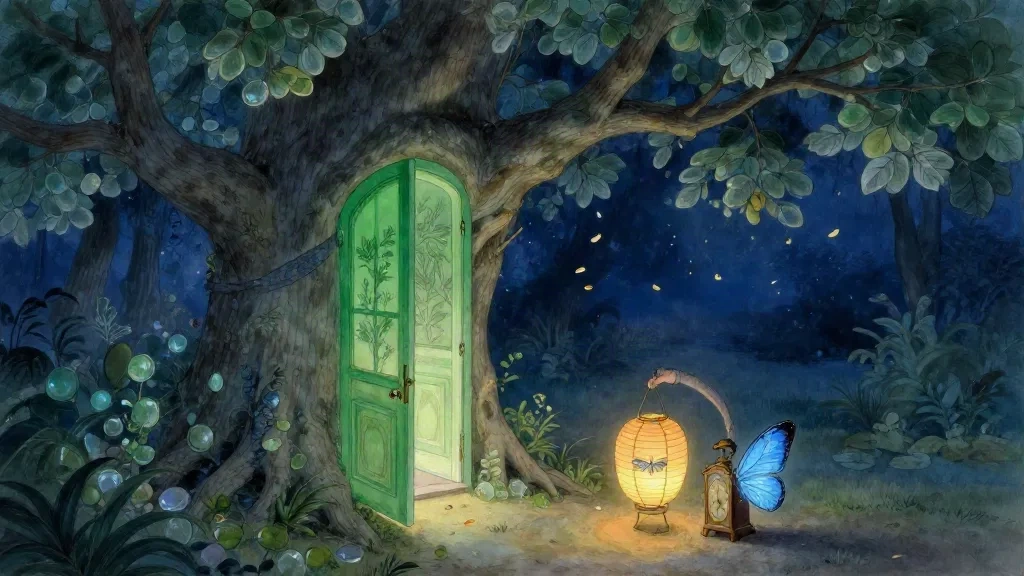
At dusk she carried a paper lantern into the conservatory and a moth wing sealed beneath its glass floor. The wing was opaque with age, blue at its edges. She had found it inside the oldest clock ever made for the garden, a machine that had kept midsummer from ending.
Of all the doors in the tree, one grew close to the ground. It was smooth as a scar.
“That one belongs to Anja Vey,” said the garden.
Sable stopped. “Anja made my first season clock.”
“She made several things. Only some remember her.”
The Choir of One Woman
The scar-door opened onto a workshop lit by cobalt shadow. Shelves climbed into sand-colored darkness. Pendulums swayed without air, each ticking a different month.
Beyond them stood a choir of seven women, all wearing Anja’s face.
The child remembered Anja as a warm hand above her head. The apprentice remembered being denied credit for the garden’s first door. The stranger remembered Anja laughing in a kitchen that had never existed. They sang competing verses: return, abandon, open, seal. Their harmonies multiplied, divided, knotted.
“She gave me this,” Sable said, raising the lantern.
The child sang, She loved you.
The stranger sang, She feared you.
Sable laid the moth wing on Anja’s workbench. “I found it inside her clock. I want to return it to the woman who made it.”
The apprentice’s verse turned harsh. “She made the wing. She made the clock. She made the door. You want absolution, not return.”
“I want the thing to reach her.”
“She is not here.”
What the Dead Had Argued
The workshop began to shrink. Pendulums swung faster. In cobalt shadow, the child remembered leaving. The stranger remembered a winter illness. The apprentice remembered the night Anja disappeared through the scar-door, carrying a lantern of unfinished minutes.
Each memory contradicted another.
Sable opened the clock. Inside, instead of gears, she found rooms: a nursery, a flooded street, a field of white flowers, Anja seated alone. In every room, the paper lantern burned. In every room, the moth landed on its unburned wing.
The choir screamed in harmonized grief.
“If she is dead,” Sable said, “the wing is hers. If she is alive, the wing is hers. Either way, it does not belong to my grief.”
She lit the lantern. The wing caught fire without burning, becoming a small blue sun. The workshop walls became glass. Beyond them, the garden’s seasons swept past: sand floods, green frost, cobalt rain.
Anja stood in none of them. The memories fought to keep her away, each insisting on a different wound.
A Minute Given Back
Sable raised both hands. “You cannot remember her honestly by making her guilty. Nor can you keep her by refusing every ending.”
The choir quieted.
She opened the clock’s final room. There, beneath a table, sat a young girl with ash on her sleeves. Anja had not escaped through the door. She had entered the clock to save the season that the garden had been forced to forget. There she had remained, holding its hinge open for one minute every year.
The wing was the hinge.
Sable carried the blue flame to the child. “I am returning what you made.”
“I did not make it to keep her,” the child whispered.
“I know.”
Sable placed the flame in Anja’s hand. The clock shut. The choir sang once, not in conflict, but in the unfinished harmony of people who had loved the same absence differently.
Outside, the paper lantern collapsed into sand. A moth emerged, whole-winged and silver.
Sable left the lantern’s frame hanging from the scar-door. The door swelled, split, became a green leaf. She carried the moth into the garden and released it.
Every clock began to move again.





