 Netwrck
Adventure.
The Clockmaker’s Debt
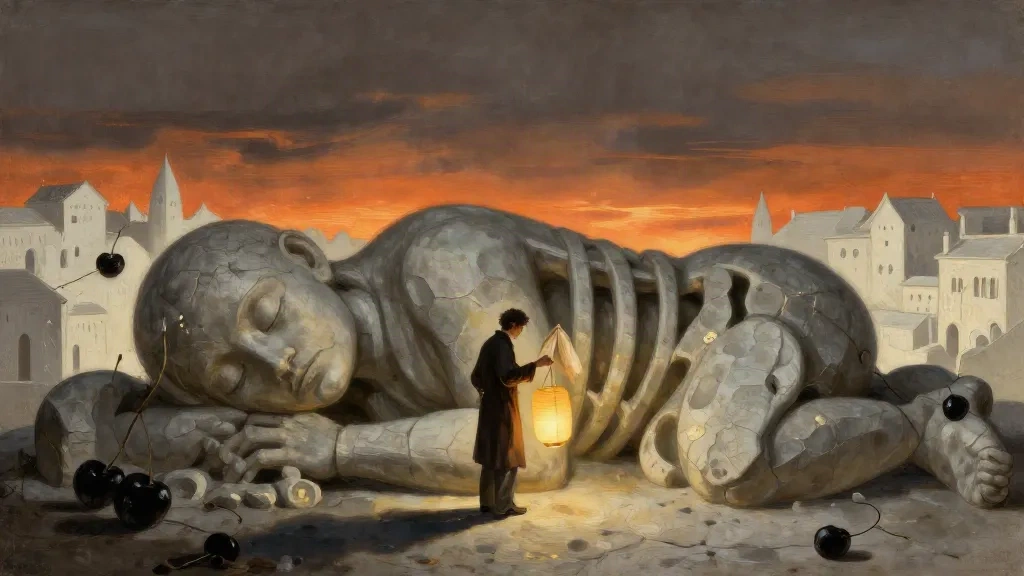
Mara kept her workshop beneath the seventh rib of the sleeping giant, where the village’s stone lanes wound around breath and bone. She made clocks for seasons, not hours: spring clocks that opened at the first green shoot, winter clocks that surrendered one chime every dusk, and a narrow summer clock whose hands advanced only when someone remembered a childhood river.
Her tools were silver, river reed, and black cherry wood. The village’s clocks depended on her ear. When a season arrived late, Mara adjusted the small brass teeth inside its case. When a season grew cruel, she loosened the bell.
That morning, a moth wing lay on her bench. It was pale as new stone, veined with copper, and too large for any moth she had seen. Beside it rested a folded paper lantern, its paper gone soft with rain. The wing had been hidden inside the lantern, and the lantern had been left at her door.
Someone wanted her to return both things.
The Choir Under the Giant
In the lowest chamber, where the giant’s heart sounded like distant hooves, voices gathered whenever Mara touched the wing. They were not living voices. They were memories the village had sealed away: the warmth of a mother’s hands, the taste of salt from a lost shore, a boy’s promise made beside a winter well.
They formed a choir.
“She made it,” said the voice of the first memory, soft and proud. “Give the wing to the child who kept it safe.”
“She stole it,” answered another, edged with grief. “The wing belonged to the hunter. Return it before the giant wakes.”
Mara held the lantern against her chest. Its little flame had no heat, but the memories leaned toward it.
She had once made a clock for the hunter, a season clock that counted only the time between departures. He had paid her with the moth wing and promised to return when copper filled the horizon. He never did. The village forgot him, but Mara had kept his final season ticking beneath her workbench.
Now the memories argued over the price of his absence.
The Copper Horizon
To find the maker, Mara followed the lantern into the giant’s throat. Its ribs arched overhead like the ribs of a black-cherry boat. Below, the village rooftops shone pale stone. Beyond them, the horizon burned copper beneath a sky clear as cut glass.
Each memory tried to guide her.
The child’s memory showed a hidden doorway behind the bell tower.
The hunter’s memory opened a path across the village wall.
The mother’s memory whispered that the maker had been swallowed by the sleeping giant.
Mara trusted none of them. A memory could preserve what happened, but not what it meant.
She set the lantern down and placed the moth wing beneath its paper roof. Then she wound every seasonal clock at once.
Spring rang. Summer answered. Autumn knocked once. Winter closed its gates.
The giant inhaled.
The village tilted. Through the copper horizon came a shape: a woman climbing from the distant orchard, carrying an empty lantern. Her face was young with age, her hands stained blue by crushed berries. She wore the hunter’s old coat, repaired with pale stone thread.
The choir went silent.
What the Wing Remembered
The woman stepped through the giant’s throat and looked at Mara as if they had agreed to meet years ago.
“I made the wing,” she said. “I made it from a moth that found its way into my lantern. I gave it to him so he would know the way home.”
Mara looked at the lantern. “He kept it.”
“He kept me.”
The hunter’s memory rushed forward, howling through the choir. The woman raised her hand, and Mara felt the giant’s ribs tighten around the village.
“He carried my voice,” the woman said, “until there was nothing else left in it. I returned to find the wing before the last winter took his name.”
Mara held it out. The moth wing trembled. Along its pale edge, a thin copper light appeared, pointing toward the woman.
The choir began to sing again, but the voices no longer fought. The child remembered being carried. The hunter remembered being guided. The mother remembered the lantern’s warmth. Their memories had been true fragments, each claiming the whole.
Mara lifted the paper lantern and placed it in the woman’s hands.
“Then it is returned,” Mara said.
The woman opened the lantern. The moth wing rose like a small sail, crossed the black-cherry shadows, and disappeared into the copper horizon. The distant giant sighed. One pale rib became a door.
Behind it, Mara saw a clock with no hands.
She stepped through, carrying the lantern’s last glow. Behind her, the village awakened under a new season.
Mara’s own clock began to tick—not toward morning, but toward the time when a forgotten thing finally found the hands that had made it.





