 Netwrck
Fantasy.
The Wrong Season
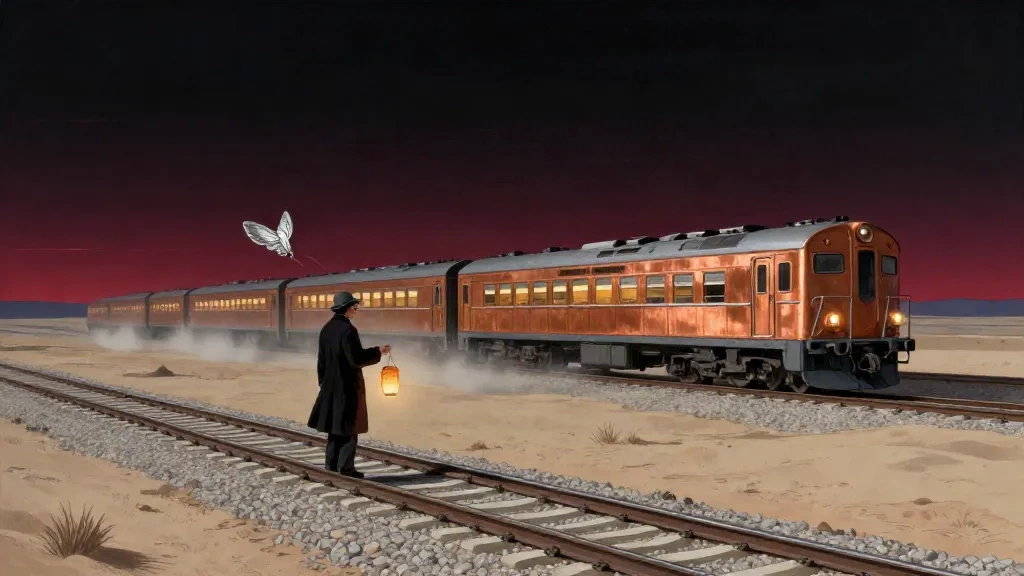
At the desert station of Veyr the rails shone like copper beneath a black-cherry sky, polished by a wind that had been polishing them for three hundred years. The platform stones were pale, bleached to bone, and the only shade on the whole stretch was a paper lantern hanging from the station clock on a cord of braided horsehair.
Its light did not burn. It remembered.
Below it worked Ilyan Venn, watchmaker of seasons, in a room that smelled of hot iron, lampblack, and the fine sand that got into everything and could not be got out of anything. His clocks had no hands and no numbers. One chimed only when the first frost touched a certain leaf, somewhere, on any leaf, and only once. Another opened its small brass door when the desert bloomed after rain, so that a customer could smell the wet ochre for an hour without leaving the shop. A third kept the hour of a drowning, and would not be sold.
People came to him with broken seasons the way others bring watches: summers stolen out of childhood, a spring sealed inside a marriage, a winter that had forgotten how to end. He listened. He charged little. He never told them that listening was the whole of the trade.
Behind his bench, under a folded cloth, sat a clock he had not wound in nine years. It was small, wooden, plain, and mute. Every morning he moved the cloth to look at it. Every morning he put the cloth back.
On the platform above, the northbound lamp had been burning for nine years. Devra Mok, the station master, had a plain way of naming it: the lamp is lit, she said, and Veyr is not sleepy. She said it the way a doctor says the patient is stable. Ilyan had learned not to ask which patient.
Voices Under the Rails
That night the station master brought him a different lantern.
It was paper-thin, folded shut, tied with black thread, and cold to the touch in a way that had nothing to do with the temperature. Beside it on the table lay one moth wing, pale as old parchment, its edge scalloped with silver dust that caught the lamplight and gave it back a little colder.
Return them to the person who made them, Devra said. Before the season-train arrives.
She said it the way she said everything, which was as though the sentence had already been agreed to by a committee and she was only reading the minutes. Ilyan did not touch the lantern yet.
And if I do not?
Devra looked at the door, not at him. That was answer enough. Ilyan had heard the station's insomnia three hundred nights running and had mistaken it for a fact of the desert, the way a man mistakes his own limp for the road.
According to the ledger, the lantern had belonged to Sera Nahl, a signal keeper of the seventeenth century, last recorded at the Veyr post in the year the north line closed. The moth wing had been torn from the same creature that had guided her train through the desert. Neither maker could be found in Veyr, nor in any settlement within a season's ride. Two claimants had come forward in the past year, both certain, both contradicted by the other.
He unwrapped it anyway. Paper the colour of weak tea, four folds, and where the folds crossed, the fibre was not wood or plant but something finer, pressed flat, that caught his thumb like the grain of a year. The lantern did not glow. It waited. A thing folded from an undelivered season keeps the one who holds it inside that season until the season is either given away or thrown away. That was the whole of his trade, and the reason his customers left with lighter hands than they came.
At midnight the choir arrived.
They did not step from a carriage. Their voices rose through the platform stones, one memory given sound, then another, then forty. He knew most of them: a soldier named Ferrin Alday who had held the lantern one night in the year of the dune wall and lost the memory of his brother's face, keeping the guilt. A child who had held it and forgotten her mother's language entirely. Ovin, the watchmaster before Ilyan, who had held it for two nights and given up the taste of salt, which he had mourned for the rest of his life.
Every holder had paid. That was the lantern's freight, and Veyr's insomnia was the sound of the account running.
The memories wanted different destinations. The lover wanted the lantern carried to a garden that had been swallowed by sand in his lifetime, and he wanted it opened there, and he wanted her to know he had waited. The child wanted it carried into the storm, because in the storm the lantern had been made and the making was the only true part. The king's man wanted it opened beneath a palace that no longer existed, where a court had once waited up all night for a sign.
Three true things, three incompatible directions. Ilyan put his palm flat over the folded paper. The choir rose until the glasses in his shop hummed.
Choose, it said, in his wife's voice.
He took his hand off the lantern so fast he nearly knocked over the moth wing. Nadya had not been in this station for nine years. Nadya had taken a northbound train to sign a ledger in another city and had not come back on the return, and the winter she should have arrived in had never finished, and it was that unfinished winter, he understood with a clarity that felt like a slap, that kept the northbound lamp burning and the choir under the stones and the paper lantern folded shut in his shop.
It was not the desert. It was him. He had simply built a station's worth of liturgy around a private refusal.
He listened until the wing on the table began to tremble. Its silver dust lifted and streamed, fine as flour, toward the northern glass. Where the dust went, the choir thinned. Where it pointed, beyond the abandoned signal tower and the dune that swallowed the old palace road, something was still shining that had no business shining out there at all.
The Northbound Memory
He left at two in the morning with the season clocks hanging from his belt, and the lantern in a leather satchel that had been stitched for carrying something that might be heavier than paper.
They marked no hours out there. One struck the rhythm of a walking insect, which slowed whenever he strayed off the buried road. One breathed a thread of cold air at intervals, patient, absurd, the way the desert breathes at four in the afternoon. The third began to sing whenever he came within a hundred paces of the old causeway, and stopped when he left it, which told him more about the road than any survey had.
The sand was cold underfoot at night and hot by noon, and it tasted of iron when the wind got into his mouth. Twice he saw lights that were not lanterns moving along the dunes at a distance, keeping pace, and twice they were gone when he looked properly, and he decided not to decide what that meant.
At the signal tower he stopped. The tower was a broken throat of black stone, its stair spiralling up into nothing, and the light he had seen was coming through it without touching it: a train window, warm and rectangular, sliding past at ground level while the walls stayed solid around it. The engine made no sound at all. Only the windows moved, one after another, each holding a passenger who did not look out.
Then one did.
Sera Nahl sat with a child asleep against her shoulder. She was younger than the records claimed and older than her clothes, a woman in a signal keeper's coat gone green at the seams, her hands stained blue-black with ink, one finger bent permanently to the left where a wire had taken it. She looked at the lantern in the satchel and recoiled so hard the child woke.
That is not mine.
Then another Sera appeared in the glass beside her, and another, and another. The lover's Sera, still at her post, seventeen and furious. The storm's Sera, wading waist-deep in a wall of sand with the lantern crushed against her chest. The king's Sera, in a room with a low ceiling and a great deal of gold, opening the paper with two hands that were shaking. Four women, one face, each holding it.
Mine, mine, mine, mine, they said, without a sound.
Ilyan took the moth wing from the satchel and laid it flat on the window.
The creature had left a trail across the glass some time in the seventeenth century, a thin silver line dried into the surface, and where that line crossed a reflection the face came apart like wet paper. Lover. Storm. King. Their claims went with them, not denied, simply unsewn. The child on the shoulder slept on.
Only Sera Nahl remained, which was not the same as only the truth remaining, and Ilyan knew better than to say so aloud.
She looked at the wing for a long time.
The moth carried my promise, she said. Paper folded around a wait. Not a thing to be given to anyone. A thing to be carried by whoever was willing to carry it.
Then she told him what he had come to be told, in the flat voice of a woman who has rehearsed a confession for four hundred years and expects to be disbelieved: she had made the lantern on the last night of her post, and she had folded into the paper the winter in which she intended to come home, and then the line closed, and the winter had nowhere to arrive, and so it had walked to Veyr and sat down. The wing was what the ash moth had paid to carry it through the desert, and the moth had come back for the rest of itself and been eaten by the station lamp, which is why the lamp burns and never goes out.
Ilyan set the lantern on the window ledge, where the light of the passing train fell across it.
Why give it back? You are already home.
Sera looked at the child, and at the hand with the bent finger, and gave him the answer he had been walking across the desert to avoid hearing.
Home is a station, she said. It does not care whether you arrived.
The Palace Under the Sand
On the way back Ilyan did not take the buried road, and the third clock sang anyway, all the way down the causeway, because the causeway ended at the palace and the palace was not sand. It was a low, square, intolerable building half-drowned in a dune, its courtyard still holding a dry well and a door that swung when he touched it, out of habit rather than intention.
Marget Osk was waiting inside it. She had walked in from Veyr in the dark to prove she was not afraid, which is how she had announced herself, and she had brought a lamp and a folded document and four generations of Ashwick claims in her head.
Open it here, she said. The court waited a whole night for that sign. My family kept the story. My grandmother kept it. If the paper is opened over the well, the record stands. Without it we are a name on a wall.
She was not lying, and that was the difficulty. The Ashwick claim was not a superstition. It held a water right over the western wells, and the well was the reason two villages and a schoolhouse existed, and Marget Osk had signed three letters she now could not afford to have declared false.
She set the document on the well-head and smoothed it flat, and her hands were steady, and her voice was not.
I am not asking for the past to come back. I am asking for one night of it to be confirmed.
Ilyan understood, standing in the courtyard with a paper lantern in the satchel and a moth wing in his coat, that every voice in the choir had been telling the truth and that truths were the problem. Open it here and Marget's village keeps its water. Give it to Sera and the winter it was folded from finally ends, which means his own winter ends, which means the northbound lamp goes out, which means the choir under the stones thins to nothing, and Marget Osk loses the only story she has ever been able to spend.
He could satisfy the court, the lover, and the storm, he understood, and each satisfaction would have been a small theft from the others. There was no arrangement of the lantern that was not also a verdict on somebody's life.
He set it on the well-head beside the document, so that it rested on both, and he told her the truth he had not planned on telling: that the paper was a wait, not a gift, and that a court that waited all night for a sign had already received one and had not known how to read it, and that her grandmother's story was not false but unfinished, and that the water right did not require a king to have seen a lantern in order to be a water right.
That is a lawyer's answer, Marget said.
It is a watchmaker's, Ilyan said. We are both paid to be certain. Neither of us is paid to be right.
She took the document away. She did not thank him, and he did not expect it. Behind him the palace door swung on its tired hinge, and somewhere under the sand a bell that had not been struck in four hundred years shifted its weight.
What Arrives Home
The season-train came into Veyr before dawn, its engine making no smoke and only a deep bell that sounded like distant rain on tin.
Ilyan stood on the platform with the lantern, the wing, and the ledger open on his forearm, and Devra Mok beside him taking the minutes of something. He told her the parts she already knew in the order she already knew them, and then he told her the rest, and she wrote it down without once looking up, which was how he understood that she had known for nine years and had waited for him to be the one to say it aloud.
And the winter? she asked.
That was the last of it, and the whole of it. A lantern folded from an undelivered season could not simply be handed over. It had to be given by someone who had weight to lose, or the giving cancelled itself. He had known this since the first hour. He had hoped, the way a man hopes about weather, that Sera would be able to take it without cost.
He set the lantern on the platform stones, and he paid. Not with a year of his life, which would have been cheap and would have been noticed. He paid with the sound of the last winter: nine nights of a stove ticking as it cooled, a chair scraped on a kitchen floor, his own breathing, and once, very clearly, a woman's voice saying his name in a doorway and going out again into the cold that had not ended.
He gave that up. He kept the fact that it had happened. That was the arrangement, and it was the arrangement he chose without asking, and he understood while choosing it that he was not being generous. Generosity would have been to keep the voice and lose the fact. This way he would know that something had been taken from him and never be able to name it, and he would go on setting the table for a woman who was never coming back to the northbound, and never be able to say why the table was set.
Sera stepped down carrying the lantern. The choir came up through the stones after her, and for the first time the voices did not argue. They braided, low and uneven, into a single song of what had happened, what had been left, and what could not be changed, and it was not a happy song, and it was not a sad one. It was an accurate one, and the platform went quiet in the way a room goes quiet when someone finally tells the truth after a long illness.
He repaired the crease with a bone folder, and set the moth wing inside the lantern, and the paper opened by itself into a warm pale glow, thin as a held breath.
The train pulled away. A passenger waved from the final window, and Ilyan watched it go and did not wave back, because he was not certain any more which of them was owed a gesture, and because a man who does not know should not pretend.
The Hour After
Then the northbound lamp went out, and the station was dark for the first time in nine years, and the desert came in cold across the stones.
Devra did not relight it. She took the ledger, and the moth's silver dust that was no longer anywhere, and the empty hook on the clock, and she went to file the minutes of a night that had actually happened.
Marget Osk's letter came by the noon train, unsigned. The western wells held. Two villages and a schoolhouse existed. Her grandmother's story would be finished now, unfinished on purpose, and Marget had written that she would rather have a small true thing she could carry than a large one she had to keep feeding. Ilyan read it twice and put it in the drawer with the letters from people who came back later than they promised.
The choir did not vanish. It thinned to what it had always honestly been: a few voices of holders who had paid and would go on paying, singing under the stones on cold nights, asking for nothing. Ilyan went down and listened to them for an hour, and told them the names he knew, and the names he did not, and left out his own.
Customers came the next week, the way they always did, carrying seasons in their coats. A man brought a spring that had gone sour in a well. A girl brought the first week of a summer that had burned down. He listened, and charged little, and mended what could be mended, and told the rest the truth: that a season could be folded and given away, and that the giving cost something, and that the cost was always paid by somebody standing on a platform at night.
Then, on the fourth morning, he uncovered the small wooden clock on the bench, the one he had not wound in nine years. It was mute, as mute as it had always been; there was no spring he could pass, no keyhole, no bell. It was not a clock at all. He had known that for years too.
He set it on the bench beside the tools, where the light came in, and he began, patiently, to work on it.





