 Netwrck
Adventure.
The Clocks Without Seasons
At the monastery of clockmakers, the clocks did not measure hours. They measured the slow turning of weather: the green patience of spring, the bright fever of summer, the copper weight of autumn, and winter’s long blue hush.
Every clock was built by hand. Every season was given a shape.
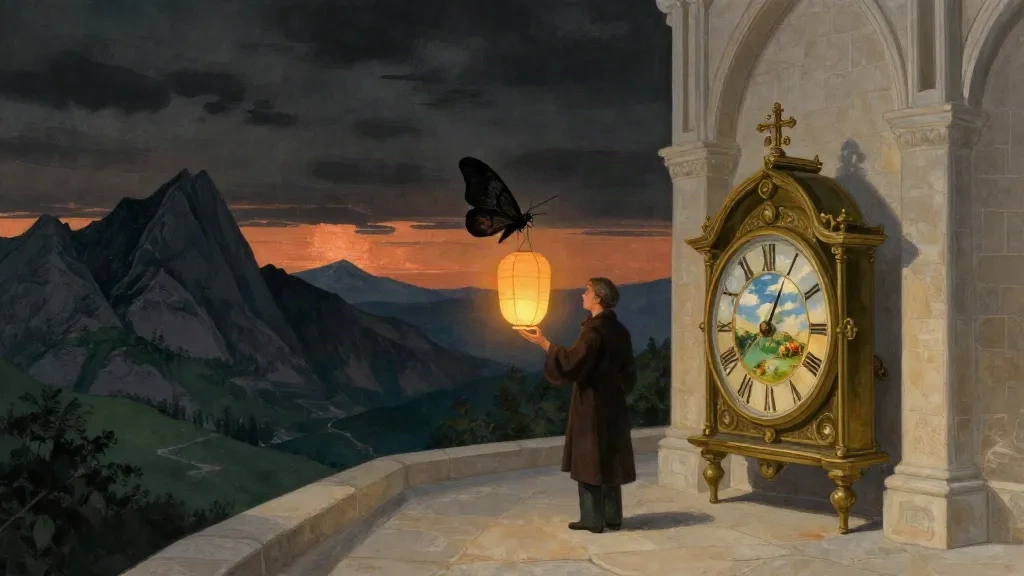
On the highest terrace, beneath a sky the color of black cherry, Mara Venn wound the clock called the Returning Year. Its brass face had no numbers, only twelve small windows, each containing a different sky. The first was green. The last was white.
That morning, Mara found the clock stopped.
Not broken. Its hands rested at noon, but no season moved behind the glass. Inside the case lay a scrap of pale stone and a single moth wing, black at the edges, thin as a whisper.
Mara knew the wing. Its powder still carried the dust of the eastern bell tower, where the monastery’s first watchmaker, Ilyra, had raised moths to read the stars. Ilyra had vanished three winters ago, leaving behind her tools, a paper lantern, and instructions written in a hand grown shaky:
Return what I made to the one who remembers me.
Mara had spent seven years searching for the maker. Now the wing had appeared inside the clock, and the seasons were forgetting themselves.
The Choir of Borrowed Voices
The monastery choir began at dusk, when the copper horizon folded behind the mountains.
Its members were memories given form. One wore the voice of Ilyra’s mother. Another had Ilyra’s laugh, borrowed from a winter pageant. A third sounded like the young apprentice who had stolen the first watch from its case and never confessed.
Their interests were not the interests of the dead.
“Give the wing to the mother,” said the memory in Ilyra’s mother’s voice. “She will make the seasons gentle.”
“Give it to the apprentice,” said the laugh. “He will restore what was stolen.”
“Destroy it,” whispered the wind beneath the bell tower. “Some makers should remain lost.”
Mara held the wing over a candle. It did not burn. Instead, a faint line opened across the paper lantern hanging from the choir arch, and inside its folds she saw a map drawn in black ink.
The map did not lead to a place. It led to a memory.
At midnight, the cloister walls became transparent. Mara walked through corridors crowded with voices. Some begged her to hurry. Some ordered her to wait. One voice, young and furious, followed her all the way to the sealed observatory.
Behind its door she found Ilyra, not as a ghost, but as a clockwork figure slumped over a workbench. Her hands were empty. Her face was made of pale stone.
“You made the wing,” Mara said.
“I made the memory of making it,” Ilyra answered. “The original is still traveling.”
A Borrowed Season
The figure pointed toward the copper horizon.
Beyond the monastery, on a road without milestones, a procession carried the season of autumn toward a village where children had forgotten how to shiver. At its head walked a woman in a black-cherry cloak, carrying a paper lantern.
That lantern was Ilyra’s.
Mara took the moth wing and the figure’s key. She broke the observatory door rather than leave the clockwork body behind. As she crossed the threshold, the chorus screamed. The memories rushed her, offering hands, faces, fragments of lives she had never lived.
She did not accept any of them.
At the village, the woman opened the lantern. The moth wing rose like a small black flame and settled onto its paper frame. The missing season returned with it: leaves, cold air, wind moving through dry grass.
The woman looked at Mara. “I am not her maker,” she said. “I am the thing she made so the world would not forget.”
Mara lifted the lantern from her hands.
Then she carried it, with the living wing inside, back to the stopped clock.
The Returning Year
At dawn, Mara placed the wing beneath the clock’s hand. The paper lantern glowed with the same pale light as the monastery windows.
The choir gathered, each memory waiting to claim a voice. But the clock opened first.
Inside it, a tiny mechanism turned. The wing became a spring. The spring pulled the twelve seasonal panes into alignment. Green, gold, rust, blue, white. The monastery remembered its order.
At the final chime, Ilyra’s true voice rose from the lantern—not borrowed, not preserved, but traveling from the road ahead.
“You returned it,” she said.
“No,” Mara replied. “You returned it.”
Beyond the walls, the copper horizon brightened. The clocks began to move.
And in the choir, one voice at a time, the memories learned to share the same song.





