 Netwrck
Mythic Fiction.
The Archive at High Water
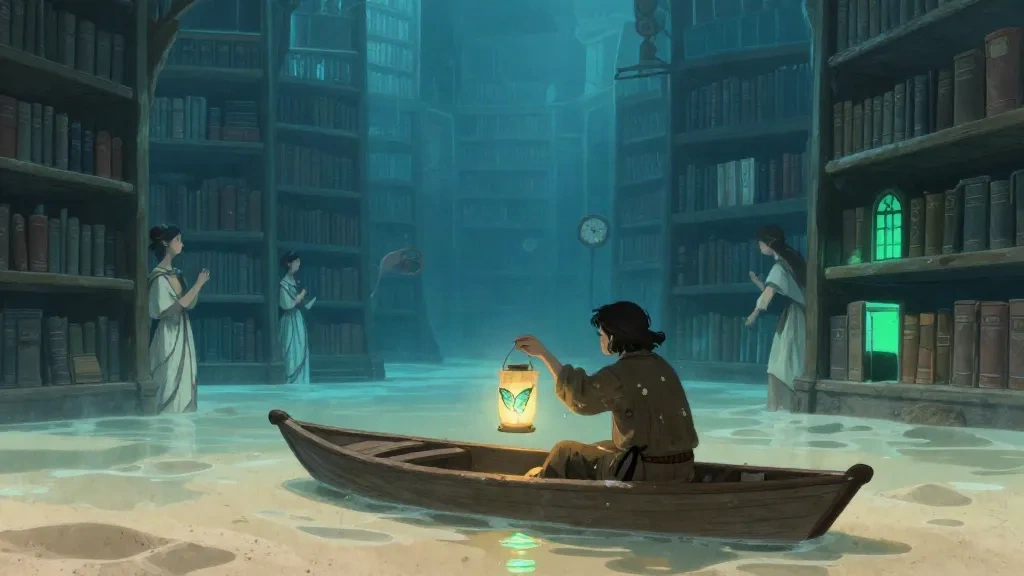
The archive had drowned so gracefully that no one remembered the flood. Water occupied its lower rooms without urgency, carrying the shelves in slow green processions. Librarians rowed between them in narrow skiffs, their oars whispering against drowned catalogues. Above the waterline, paper floated in bright constellations. Below it, ink bled into halos around names.
I kept my shop at the archive's western stair, where the roof remained dry and the clocks hung in crooked rows. My hands were small and brown from oil. I made clocks for seasons rather than hours. One stopped at the first frost. Another kept an entire autumn inside its brass belly, clicking whenever the maples released their leaves.
That morning, the youngest librarian brought me a paper lantern. It was folded, sodden, and breathing faintly. Inside its ribs lay a moth wing the color of sea glass.
“It has been calling for its maker,” she said.
I turned the wing beneath my lamp. The pattern was familiar: a split vein, two crescent scales, a thread of gold along the lower edge. I had made the wing into a clock once, years before the flood, for a woman named Orra. She could summon winter by opening a door. She had closed the door too late. The wing was all that remained of her instrument.
“Where is she?” I asked.
The librarian glanced toward the submerged stacks. “The choir says she is everywhere.”
Voices Under the Shelves
At dusk, the choir began beneath the floorboards. It did not sing in notes. It sang in recollections: a childhood winter, a quarrel, a hand touching a shoulder in a dark room. The voices had conflicting interests. One wanted the wing returned. Another insisted the wing had been stolen. A third remembered only the moment before the flood and wanted that moment preserved forever.
I rowed out to the eastern stacks with the lantern fixed to my bow. The wing rested in a glass tube between my knees. With every stroke, the choir grew louder.
“She made you,” said a voice like rainwater in a pipe.
“She buried you,” said another.
“She was you,” whispered a third.
The currents pulled in different directions. Sand rose around the skiff. Cobalt shadow gathered beneath the shelves. I held the lantern high, and its green light revealed small doors in the drowned cabinets. Behind one door, I saw Orra's workshop: a bench, a row of winter hinges, an empty cradle for a clock that had measured no hour.
Then the door opened.
Orra stood beyond it, young as she had been when she made the wing. Her hair floated upward in the dark water. She looked at the tube in my lap.
“You kept it,” she said.
“That is why I came.”
“No.” Her voice joined the choir. “You came because you are afraid I will remember what you did.”
What the Winter Owed
I had not lost the wing. I had taken it from the clock after Orra vanished, hiding it beneath my shop boards while the choir searched for a culprit. I told myself I was protecting the instrument. In truth, I had wanted the winter it carried. I had wanted one season in which nothing aged, nothing was late, and no one could ask me why I had failed to save her.
The lantern flared. The moth wing beat once against the glass.
“Return it,” Orra said.
“Return what it took from you?”
“I gave you the wing. You gave it a season.”
The choir surged. The archive tilted. Rows of books broke loose and rose around us like pale fish. One voice begged me to keep the winter. Another ordered me to return the wing. A third, barely audible, said that Orra had never wanted the clock back. She had wanted me to remember that she had chosen the flood.
That was the memory I had refused to hear.
I broke the tube. The wing rose from the water, delicate as a sigh. It touched my palm. Winter moved through me—not cold, but absence. I felt every hour I had refused to count.
The Maker's Return
The moth wing folded itself around the lantern flame. The paper brightened, then opened. Inside, an hourglass poured upward, its sand returning to the narrow waist. Around us, the choir changed. The old grief withdrew, not solved but loosened. The shelves drifted back into their rows. The water settled by one careful inch.
Orra reached for the wing. Her hand passed through mine. For a moment she remained only a shape in the cobalt shadow.
“Where should it go?” I asked.
“Not back to the clock,” she said. “Back to the maker.”
“That is you.”
Her smile came and went like light under water. “Then remember me making it.”
So I placed the wing inside the lantern and rowed home through the drowned stacks. Behind me, the choir began again, but its voices no longer pulled against one another. They carried my name without claiming it.
On my bench, beside every season-clock, I set the paper lantern. Its green glow settled over my hands. Somewhere below the floor, the archive opened another door. I did not follow.
Some things are returned not by bringing them back, but by carrying the making of them where it can no longer be lost.





