 Netwrck
Mythic Fiction.
The Market Below the Weather
At dusk, when the sky turned the color of deep water, the memory market rose from the sea.
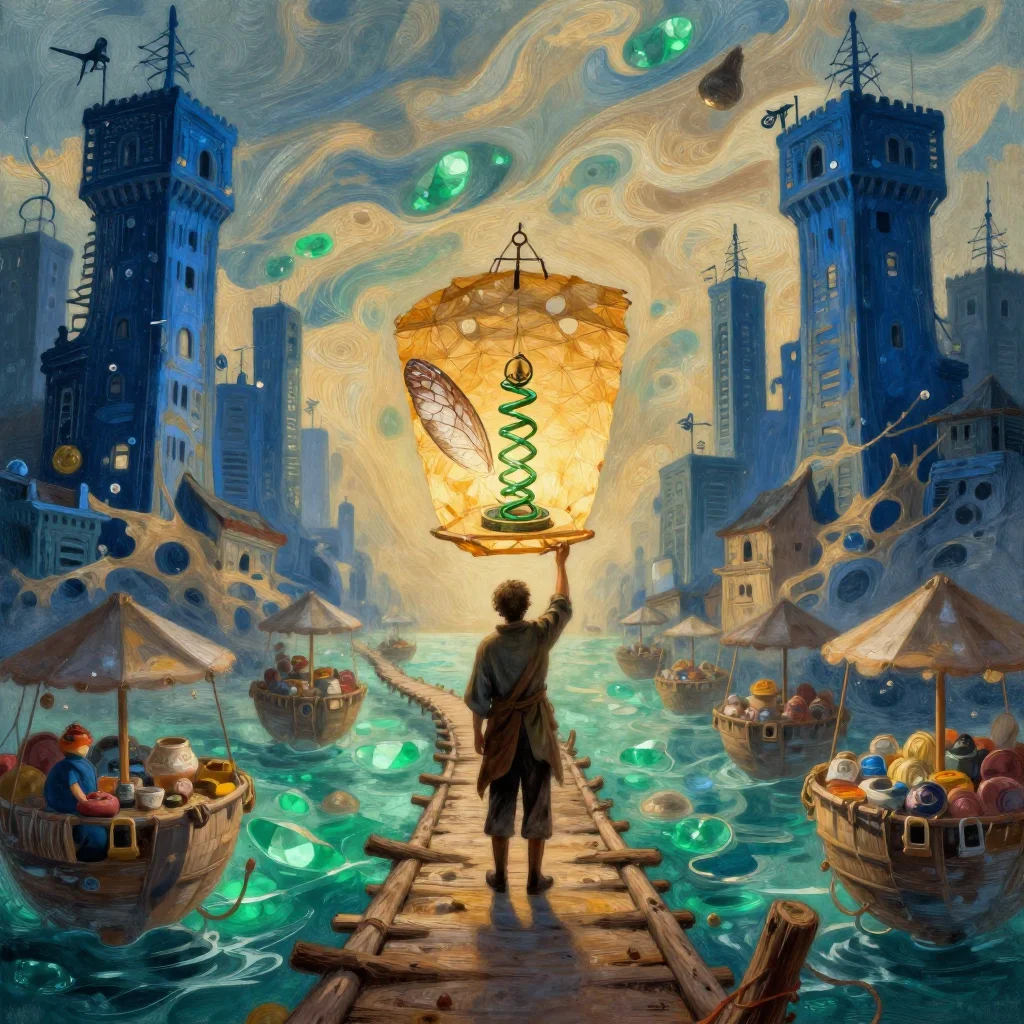
It was not a harbor. Its stalls hung from chains of pale kelp, and its walkways were boards of driftwood polished by countless vanished hands. Above the market floated the remnants of a drowned city, its towers hanging upside down beneath a cobalt cloud. Each forgotten memory drifted between the stalls in a paper lantern, warm as a coal, its glow divided into the seasons it had witnessed.
Orin made clocks there. Not clocks for hours, but clocks for the slow turning of a year: a winter dial with silver teeth, a spring movement wound in green thread, a summer face marked by a thin gold ray. He knew each mechanism by sound. The winter clocks ticked like knuckles. The spring clocks whispered. His own workshop leaned beneath a blue awning, crowded with gears shaped like leaves, shells, and small sleeping animals.
One lantern had no glow. It was a little paper thing, folded shut around a broken spring of green steel. The spring had belonged to a clock that measured the first warm night after a long winter. Orin had made it years ago for a woman named Maelis, who had promised to return when the sap rose.
She had not returned. Worse, no one remembered her.
So the clock had come loose from its maker.
The Choir of Borrowed Voices
The spring was not alone. Beneath the stalls, a choir gathered around it, singing from inside sealed jars.
“Give it to me,” sang the oldest voice, sweet and cracked. “I will remember the winter she walked through. I will give her back the courage of that night.”
“Give it to me,” said a child’s voice. “Then spring will come whenever she wants it.”
A bitter whisper answered. “Give it to me, and she will never leave again.”
Orin covered the spring with his palm. The choir’s song rose until the lanterns shook. One voice wanted a past untouched by loss. Another wanted an endless present. A third wanted the future in which Maelis had never gone away. They were all memories, but none of them agreed about the woman they claimed to remember.
“A memory is not a person,” Orin said. “It is only what a person left behind.”
The choir went silent.
He placed the spring inside a glass cylinder and began to work. The lantern unfolded around it. On one face appeared a moth wing, pale and veined with sea-glass green. He had found it beneath the winter dial that morning.
The wing belonged to no creature he knew.
The Price of Returning
At the market’s highest stall, an old woman sold directions to places that no longer existed. Orin traded her a summer clock for a single answer.
“Where is Maelis?”
The old woman looked at the moth wing in the lantern. “The maker is not where the maker was.”
She told him the market had once contained a bridge of seasons. To cross it, he had to give the borrowed spring a proper home. A clock could be returned only when its maker’s hand was remembered by the hands that followed.
So Orin climbed.
The bridge was made of winter ice, spring mud, and summer dust. Beneath it, the sea shone with the reflected blue of a storm. The choir followed him, their jars knocking against one another. With every step, the voices offered him gifts: the face of Maelis laughing, the sound of her voice calling his name, the memory of her promise.
He refused them all.
At the bridge’s end waited a small stone house with an open door. Inside, no one sat. On the workbench lay a coil of copper wire and a note made from a torn map.
Orin read the map. It led to a field beyond the market, where a clockmaker had planted the lost spring in a row of winter-dark trees. There it had grown into a tree that flowered only for one person.
Behind him, the choir began to sing again. The child wanted him to break the spring. The bitter voice wanted him to keep it forever. The oldest voice simply wept.
Orin entered the house and set the lantern on the workbench.
The Time That Belongs
He repaired the spring with a sliver of the moth wing. Its scales glittered beneath the blue light, each one holding a small reflection: a winter road, a summer window, Maelis’s hand closing around a gift.
Orin fixed the mechanism. Once.
The clock began to move again. Not according to the market’s borrowed seasons, but according to the first warm night after winter. Snow loosened from the trees. A green scent rose from the earth.
The choir crowded the doorway, afraid to cross.
Orin carried the lantern outside. Beneath the old tree, a woman stood with her back to him, her coat white with frost. She did not turn when he approached.
“I made something that could return,” he said. “I thought that meant I could keep you.”
She touched the lantern. The paper opened, and the moth wing lifted into the cobalt shadow. Its scales scattered like seeds.
“No,” she said. “It meant you could let me go.”
The spring turned once more. The choir’s voices joined it, no longer arguing. For one brief instant, every memory of Maelis agreed on the same thing: she had stood there, smiling, while the first star appeared over the market.
Then the market rose into the sky.
Orin watched the paper lantern become a small sun among the floating stalls. The moth wing carried the light westward.
He kept the empty clock.
Its hands moved, but it no longer kept anyone from leaving.





