 Netwrck
Adventure.
The Last Platform
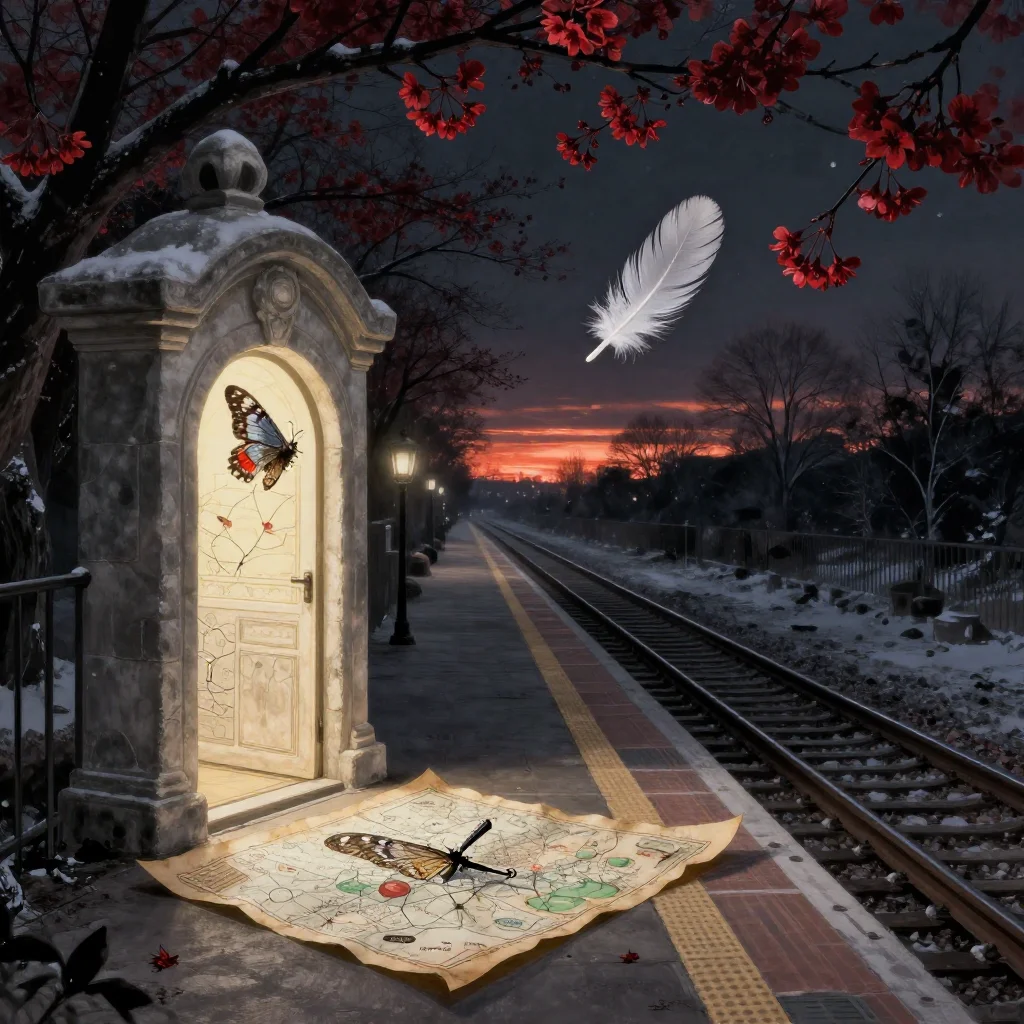
Winter had settled over Vey Station so deeply that the lamps burned blue. Snow packed the rails and sealed the doors of the ticket office, yet at midnight a train arrived with no engine and no sound, only a warm draft smelling of wet earth and oranges.
Its conductor wore a black cherry coat and carried a lantern filled with pale stone.
“Where do you wish to go?” he asked Elian Voss.
Elian had spent forty years drawing coastlines, borders, and vanished villages. Retirement had left him with stiff fingers, a pension too small for travel, and one peculiar gift: he could draw doors only on maps of places that no longer exist. The first door had appeared beneath his pencil when he mapped a drowned abbey. The last had been a nursery erased by a reservoir.
He kept them folded in his coat. None led anywhere he wished to go.
Now the conductor unfolded one of Elian’s maps. A thin red line ran from Vey Station to a place marked only by a moth wing.
“Lost Season,” the conductor said. “Change is permitted there. So are second chances.”
Elian looked at the white feather caught in the lantern’s glass. “Can lost things rest there?”
“If someone builds them a place.”
The train swallowed him.
The Market of Certain Things
Lost Season was a platform beneath a copper horizon, crowded with seasons that had failed to become weather. Autumn drifted in orange heaps. Spring stood in glass bottles, trapped mid-rain. Summer burned politely behind a curtain of heat haze.
Between them stretched a market.
Stalls displayed objects with sharp price tags: a childhood dog named Bracken, nine years old forever; a sailor’s forgotten name; a red mitten returned from a war; a marriage that had almost happened.
Elian asked the marketkeeper, a woman whose shadow was shaped like a locked gate, what the things cost.
“A memory,” she said. “The truest one you have.”
At the next stall, an old clock sold for the price of a lifetime. A grandmother’s voice cost three happy summers. A white feather lay beside a black cherry stall, though no hand offered it.
“Those are free?” Elian asked.
“They are not things.”
He reached for the feather. The marketkeeper struck his wrist with a brass ruler.
“Everything valuable must be true,” she said. “The feather belonged to a man who promised his daughter he would return. He did. He returned with another woman, and the daughter kept the feather until her death. It is the last proof that he was ever a father.”
Near the final stall lay the moth wing, black and silver, preserved beneath glass.
“This,” the marketkeeper said, “is the truth your station is hiding.”
The Door Beneath the Map
Elian bought the wing with the memory of his first map: a coastline he had drawn from his father’s descriptions, though his father had never seen the sea.
The wing unfolded in his palm. Along its veins appeared a route through Lost Season, winding past winter doors, summer orchards, and a field where October wolves waited beneath the copper sky.
At the route’s end stood a blank platform.
Elian knelt and drew.
His pencil moved without guidance. He drew a shelter with wide windows, a warm stove, low shelves, and a garden where seeds waited under snow. He drew places for abandoned names, unworn shoes, unspoken apologies, and homes erased by flood or fire.
The map tore.
A door rose from the paper, larger than the platform.
Behind it waited an empty room filled with winter.
“A place where lost things can rest,” Elian said.
The market rang like a bell.
“Then name what brought you here,” the conductor said.
Elian looked at the feather. The promise inside it remained true, though its ending had been mercy. He understood then that truth was not the same as pain, and memory was not the same as a wound.
He drew one final mark: a small black cherry tree growing beside the shelter, its branches sheltering every discarded season.
What Winter Kept
At dawn, Elian’s door stood between the winter tracks and the market’s copper horizon. Lost things entered in silence: a glove smelling of a vanished coast, a ticket torn from a timetable no one remembered, a bell from a drowned church.
The marketkeeper followed him to the threshold.
“You bought a truth,” she said. “What will you sell?”
Elian placed the moth wing on the shelf beside the white feather.
“The belief that what is lost must be recovered,” he said. “Some things only need a place to stop waiting.”
He closed the door. The train waited outside, its windows full of pale stone.
When it carried him back to Vey Station, the snow remained. The station clock began to move again. And beneath the platform, among black cherry roots and frozen rails, a soft green leaf opened.





