 Netwrck
Fairy-Tale Fiction.
The Doctor of Unfinished Homes
Dr. Elian Vale arrived at Vesper Station before the snow had learned to settle. The platform was black lacquer beneath a white sky, its lamps holding little moons of gold dust. He carried a leather case containing silver needles, bitter herbs, and three small bells prescribed for homesickness: one for the body, one for memory, one for the name a person had carried before home became home.
The station opened onto four seasons. Frost-season passengers boarded the north train, which arrived smelling of pine and iron. The east line smelled of wet earth. To the south, summer leaked through the carriage windows as heat, jasmine, and the promise of insects. Westward ran the train of late spring, its coaches bright with flowering orchards.
Elian had treated thousands of homesick travelers. Some missed a particular chair. Others missed the sound of their mother's voice, the ache of a childhood threshold, the exact weather of a room where they had once been safe. He cured them by prescribing a season—not the season they had lost, but one that carried enough resemblance to deceive longing.
That night, the station's great brass machine stood beneath the clock tower. It was beautiful: black lacquer, gold dust in its gears, a copper star revolving above its condenser. Each spoke bore an engraved season. When turned, it opened a passage through the timetable and returned travelers to a remembered world.
Elian's purpose was simple. He intended to dismantle the machine before it could become a beautiful prison.
What the Flood Found
At midnight, water rose through the station's drains.
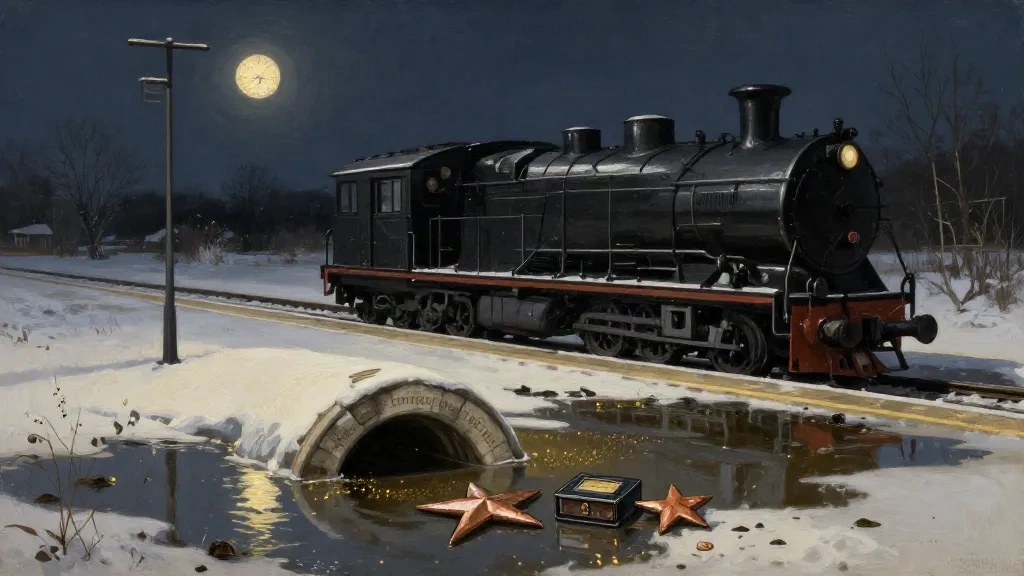
It came clear and cold, carrying a smell of wet stone. The black lacquer platform became a mirror. The copper star reflected overhead, broken into a hundred trembling pieces. Passengers shouted as the tracks filled, though the trains themselves remained safe, suspended behind invisible thresholds.
Elian saw the water pull something from beneath the waiting hall. Slabs of pale stone turned in the current. Copper wires clung to them like red roots. Letters emerged along a buried wall, each one stamped with a municipal seal: THE PUBLIC ROOM OF ARRIVAL.
Below the inscription stood a list of names.
Every name belonged to someone who had once been treated at Vesper Station. Beside each name was a destination: a kitchen in Gallowmere, a garden near Lake Orra, a hospital in the hills, a house at the end of a street where the lamps had not yet been invented.
Someone had planned this place before the station rose above it. It was not meant to send passengers into imagined seasons. It was meant to return them to a home that had been made public—a shelter where no one had to possess money, a name, or a perfect memory in order to arrive.
Then the flood reached the machine.
Water turned its gears without force, merely persuasion. The copper star spun faster. The north train opened onto a village Elian knew from a patient's story: low stone houses, a red door, snow on the sills. For one bright second, he could smell cinnamon from an imaginary kitchen.
Beside him, a young passenger stepped toward it.
“My mother lived there,” she whispered.
“Your mother may still be dead,” Elian said.
“She may be waiting.”
The Price of Arrival
He unlocked the machine. The copper star trembled in his palm. Beneath it, a final inscription appeared as the water withdrew: EVERY ARRIVAL REPEATS THE LEAVING.
The beautiful machine did not free people from homesickness. It made the relief permanent. Passengers could live inside the season that healed them, until the healing itself became a room with no door.
Elian climbed onto the machine and drove the copper star into its locked housing. Gold dust rose around him. The alternate seasons collided—frost in the orchard cars, summer snow on the platform, spring rain inside the winter waiting room. People screamed. The station trembled.
Then he pulled the star free.
Every passage collapsed at once.
The young passenger wept as her village vanished. An old man reached for a field he had not entered in fifty years. A child held out both hands toward a train carrying a summer that had never belonged to her.
Elian felt the full weight of their grief. He had mistaken relief for health. A cure that erased consequence could become captivity, even if its walls were made of sunlight.
He placed the copper star on the buried civic stone.
A Public Door
By dawn, the water had gone. The flood left the Public Room of Arrival exposed, its floor marked with silver channels that led not to distant seasons but to stations throughout the country. Elian's machine parts lay scattered across the platform: gears, copper wires, black lacquer, gold dust.
He rebuilt nothing. Instead, he installed the star at the center of the old room. The station's timetable changed. No train carried passengers to a remembered home. Each platform offered a route to a real shelter, where food, warmth, and a doctor waited without payment.
The music box on his desk began to play. Its melody was the one his mother had used to quiet him through fever. He had carried it for years, afraid that opening its lid would release more than music. Now he understood: memory was not a country to occupy. It was a lamp to carry.
At sunset, travelers waited in the exposed civic room. Their coats shone with meltwater. Their suitcases carried mud from many places. No one asked which season they preferred.
Elian stood beneath the copper star. It no longer revolved. It held the room in a steady ray of gold.
“Welcome home,” he said, and meant the next door.





