 Netwrck
Speculative Fiction.
The Brass Compass
Mara Venn was apprenticed to a cartographer who measured coastlines by their willingness to change. His maps were charcoal and rust red, salted at the edges, and corrected before the ink dried. He had given her a brass compass with a needle that trembled whenever the sea had recently touched the shore.
At dawn, the needle swung inland.
Outside, Bellwether stirred beneath pale winter light. Gulls hung motionless over the breakwater. Stores lifted their shutters. Along the tidal line, the first forgotten object of the day waited: a child's red mitten, swollen and shining.
Mara copied the mitten onto the corner of her map, then touched the compass. The needle pointed to the skin between her thumb and wrist.
When she looked down, a country had appeared there.
It was no larger than a thumbnail, with a black mountain range, a narrow coast, and a red river looping through a charcoal plain. Along its western shore, almost too small to see, stood a white tower.
Her master came behind her. He did not touch the mark.
“That is not geography,” he said.
“It is now.”
He set down a folded map, its creases worn soft as cloth. On the front was Bellwether. On the back, the ink had faded except for one phrase: The last note belongs to whoever remembers the crossing.
That afternoon, Mara played the song for him. It was the song her mother had hummed while braiding seaweed into fishing line, a melody the townchildren had carried through three generations. The tune ended on a rising note, bright enough to make the windows tremble.
But the final note was gone.
Every time Mara reached it, the brass compass spun. Her hand on the map country went numb. The song continued without her.
“The tide brings back one thing,” she said. “Why can't it bring this back?”
Her master folded the map again. “Because it is not an object.”
The Rival at the Waterline
On the third morning, Iven Marr came from the western road with a black coat and a silver boat hook. He wanted the lost note for a different reason.
His sister had crossed the water years ago, following a white light from the town's old signal tower. She never returned. Iven believed the missing note contained the name she had used to call across the sea.
“Once I know it,” he said, “she can hear me.”
He offered Mara money, then a place on his boat. When she refused, he did not argue. He cut a notch in the floating dock and kept watching the water.
The country on Mara's hand changed that night. Its red river widened. A black ship appeared offshore, though Bellwether's bay had been empty since dawn.
At the next tide, the sea returned a silver harmonica.
Mara recognized its case. Iven followed her to the beach. Together they listened as the harmonica produced a thin, wavering melody. It was her song, but the missing note had been replaced by a voice singing the first half of her sister's name.
Iven's hand closed around the harmonica.
“Give me the map.”
“You need a song, not a country.”
“The song is in the country.”
He swung the boat hook at her compass. She stepped aside, and the hook struck the folded map in her hand. The paper opened in the wind.
Every line on it began to bleed rust red.
The Crossing
The map was not a route. It was a record of what the town had forgotten, arranged in the order the sea had returned it. Mitten, harmonica, key, thimble, name.
At its center, beneath the old tower, lay a blank space.
Mara understood then. The missing note had not vanished. It had been spent becoming a door.
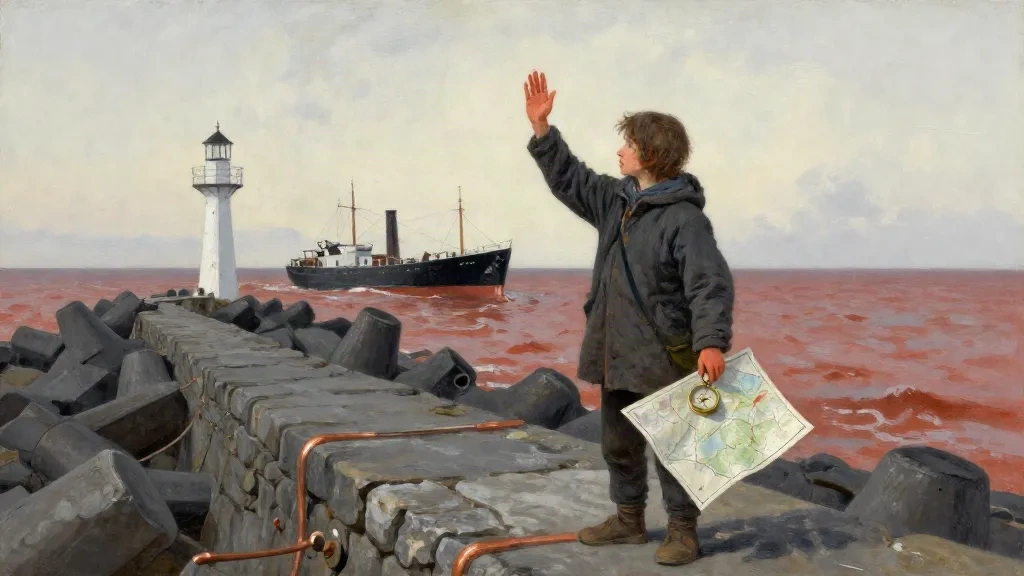
She and Iven rowed at slack tide. The black ship waited beyond the breakwater, its hull shining with frost. When Mara stepped aboard, the country on her hand lifted from her skin and spread beneath her feet.
Iven climbed after her.
The sea folded around them. Bellwether disappeared into a vertical wall of water, and the tower rose ahead, white and narrow. A woman stood at its top, looking down with her mouth open in a soundless command.
“She is waiting for the note,” Iven said.
“No.” Mara raised the brass compass. Its needle pointed toward the blank space on the map. “She is waiting for someone to finish the song.”
The final note was not a sound. It was the decision to remain.
Mara opened her mouth and sang the melody from the beginning. Iven joined her without using the harmonica. The notes climbed through the tower, through the black ship, through the water. The woman on the tower smiled.
Then Mara gave the last note to the sea.
It was not a high note. It was low, full, and certain, the sound a coast makes when it accepts a returning boat.
The Map Beneath the Salt
They woke on Bellwether's beach as the tide withdrew. Iven's sister was gone, but the harmonica lay open beside them. When Iven lifted it, the first half of her name sounded clearly, followed by a silence that no longer hurt.
Mara's hand was blank except for a rust-red line around the wrist. The folded map had become ordinary paper.
At noon, the sea returned a small wooden box. Inside was her master's charcoal compass, its needle pointing north.
He was waiting at the cartography house, old and steady. He saw the red line on her hand and nodded.
“A country can leave,” he said, “without becoming less true.”
That evening, Mara drew the bay again. She left the tower blank. She left the river unfinished. In the margin, she wrote the date and, beneath it, a single rising curve.
No one knew whether it was a note or a road. Mara knew both could carry a person home.





