 Netwrck
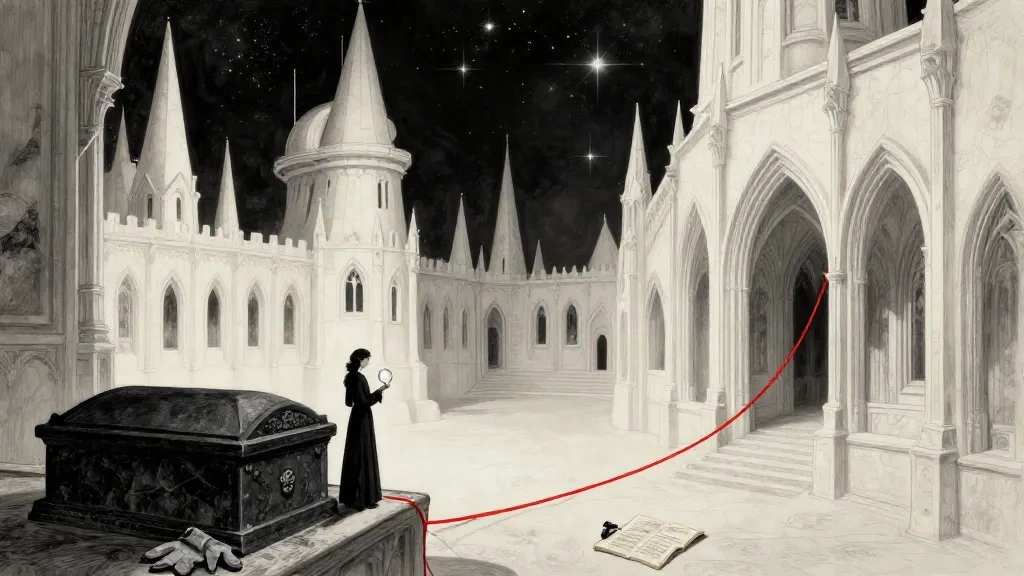
Gothic Fantasy.
The Catalogue of the Unborn
On the lowest shelf of the monastery’s future room, Sister Anja Vey found the ledger dated three hundred years hence.
The chamber had been cut into the comet’s white coral heart, its walls veined with red thread where miners had stitched fractures shut. Above, wind worried the monastery’s brass weather-vanes. Below, the buried stone breathed cold through the soles of her boots.
Every leaf in the future catalogue was blank except one. A name had been inked there in a disciplined, upright hand:
ANJA VEY, keeper of erased names, received into silence.
She recognized the handwriting as her own, though the ink had not yet dried.
Beside the ledger lay a glass seed clouded with frost. Anja had found it that morning inside the reliquary of Saint Orra, the land’s forgotten founder. The seed had cracked along its white seam when she heard the name, and from the crack came a voice repeating: Give me back what you have buried.
Anja had no wish to restore the dead. She wished to restore the land.
A Glove at the North Window
Saint Orra was said to have taught the first settlers to write. Before her monastery, the country had possessed fields and forests but no names. After her death, maps arrived in bundles from the capital, each village reduced to a number, each family erased if its line failed.
Anja spent her days repairing those omissions. She copied forgotten boundaries into the oldest register, and when a child asked where her grandmother had come from, she drew the vanished road upon the classroom slate in red.
That evening, a single wool glove hung outside the north window. It was grey, stiff with frost, and embroidered at the cuff with a name no living person used.
Anja brought it inside. The wool dissolved into a strip of red thread, which stitched itself across her ledger. The shadow in the corner lifted its head.
It had been born when the monastery struck the comet’s dark side. It wore no face, only a cloak the colour of old ink. Its hands, however, were human enough to hold a pen.
“You cannot restore a name,” it said. “You can only make another error.”
“Then I will restore the correct one.”
The shadow smiled by opening its mouth across its throat.
The Contract of White Coral
It offered to guide her to the founder’s grave. In exchange, it required only her signature beneath Orra’s original land deed.
“You possess no claim,” Anja said.
“Not yet. But you will.”
At dawn they descended through the monastery’s observatory, where dead stars floated in glass jars. The shadow walked ahead, its cloak trailing soot over the white coral steps. Anja carried the glass seed. The red thread pulled taut between them, stitched through the shadow’s sleeve.
The founder’s grave lay beneath the cloister, behind a door sealed with a lock of melted winter. The shadow signed the thaw into existence. The door opened.
Inside, the name waited.
It was carved into a slab of black comet rock, every letter filled with red wax. As Anja touched it, the wool glove reappeared around her hand. The grave spoke in the same voice as the seed.
“I was not Orra. Orra was the name given to my silence.”
Anja understood then that the catalogue had not been prophecy. It was an instrument. The future was being shaped by whoever possessed the power to record what came before.
The Name Beneath the Ink
She drew her knife and cut the red thread from the grave. It tightened around her wrist. The shadow lunged; the glass seed split open between them.
Inside was no soil, only a small white page.
Anja pressed it against the black slab. The shadow’s pen moved without its hand, signing her name, the monastery’s name, the land’s name. Each signature erased another boundary from the map.
She drove the knife through the pen.
Then, beneath the founder’s false name, she wrote the name the settlers had forbidden: Ysara Vale, woman of the first road.
The comet shuddered. Red thread tore loose from every wall. In the cloister above, bells rang in rooms that had never held bells. Outside, winter withdrew from the fields, exposing buried roads, old foundations, and the stone ribs of a city hidden beneath the grass.
The shadow became ink, spread across the floor, and tried to flee. Anja wrapped the wool glove around the glass seed and set both within the grave. The red thread followed, stitching the slab shut.
By sunrise she had copied Ysara’s name into every register in the monastery.
Years later, when the future catalogue finally bore her date, it recorded:
ANJA VEY, who returned a name to the land.
It did not say that the land remembered her. It said only that the land no longer had to.





