 Netwrck
Weird Fiction.
Twelve Stars in the Observatory
The volcano kept its observatory below the weather. A stairway of black basalt descended from the telescope room, past instruments furred with saffron dust, into a chamber where smoke-grey air moved without wind.
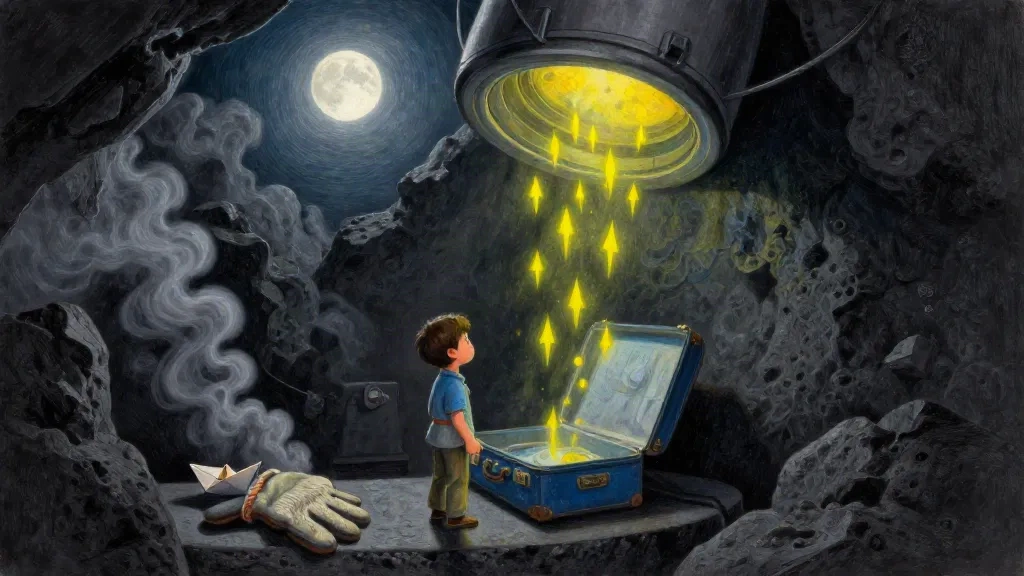
Ilo carried the archive in a blue suitcase. One wool glove, six brass catalogue cards, thirty-seven stones pressed to written names. At the bottom of the suitcase lay twelve loose stars.
They were no larger than grains of salt, yet their light pricked her palms. She felt them as heat, as tiny hinges turning beneath her skin.
The constellation had been called the Saffron Kite. Six years ago, the observatory had lifted it from the winter sky and stored it here for safekeeping. Safekeeping was the official word. The old curator had used another: abduction.
On the chamber wall, twelve empty circles surrounded a paper boat. A note in the curator’s square hand read:
Return the Kite to the sky it was taken from. If you are too late, keep one star.
Beneath it was her mother’s name.
A Deadline Borrowed from the Future
Mother had descended the stairway eleven years ago and not returned. Everyone else called her missing. The wall disagreed.
Every midnight, its basalt warmed and a sentence appeared in glowing mineral seams:
You have three nights.
On the first night, two nights remained. On the second, one.
Ilo set the wool glove beside the note. Her mother had worn it during the night the Kite disappeared. She had sewn a paper boat into its cuff, though she claimed never to have learned paper folding.
Ilo lifted the boat. Inside it, an address.
Not a place. A date: fourteen winters from now.
Along the chamber wall, a narrow cable descended through a seam in the rock. When Ilo raised the paper boat, the cable tightened. From far below came three knocks.
Three knocks. A pause. Three more.
Then her mother’s voice, thin as a thread pulled through glass, said, “You brought the stars.”
“You told me where.”
“I told the person who brings them.”
With her gloved hand, Ilo touched the seam. It opened onto a blue room suspended inside the volcano’s throat. Her mother floated there in a harness of copper wire, eyes closed, one bare hand extended. Above her, the twelve missing stars cast their glow through the water. She was alive and keeping the constellation aloft.
The Hour Before the Mountain Spoke
“The Kite cannot leave the sky without a witness,” Mother whispered. “The witness becomes its place. If I open this room, the stars return to me. They will burn the time out of me.”
“And the deadline?”
“Borrowed from a person who has not died.”
“You.”
“A year from tonight. By then, if you return the Kite to the year it was taken from, I will wake.”
The calendar in the archive had never included years before its construction. The blue suitcase did. Under its lining, stamped in fading thread, Ilo found a year: the winter of the theft.
Returning to that sky meant opening the observatory’s roof at the correct angle while the stars still believed they belonged there. The machinery had been removed. So had the roof.
She tied the wool glove to the paper boat and pulled the observatory’s cable through the throat. One tug opened the dome years above them. The other connected her to her mother.
At midnight, Ilo climbed.
Smoke-grey ash filled the stairwell. The suitcase dragged behind her, its wheels ticking like a mechanical heart. The wool glove snapped free on the hundredth step. She left it lying in the dark.
The Shape the Sky Remembered
At the summit, the telescope pointed where the Saffron Kite should have burned. Ilo opened the suitcase.
The stars rose.
They crossed the dome in the old order, though not the old shape. Six years had tightened some distances and loosened others. One passed through Leo. One trembled near the horizon. Together they formed a crooked bird with an open, saffron heart.
The observatory recorded the unfamiliar constellation. Its plate clicked: SKY RESTORED, POSITION ALTERED BY ELAPSED TIME.
Above the volcano, something enormous exhaled.
Inside the blue room, copper wires burned through. Ilo held the paper boat against the telescope eyepiece, feeling the cable tighten around her wrist. Her mother’s borrowed years flowed upward, one by one, into the stars.
Then the twelve lights went out.
For a moment, only ash moved across the open roof.
One star returned.
It stood above the summit in a saffron point brighter than the instrument glass. Then another. Then all twelve, arranged not as they had been stolen, but as they were set down: a paper constellation, a boat navigating the dark.
Days later, the harness rose empty from the throat of the volcano. In the archive, a single wool glove waited beside the catalogue cards.
Ilo never entered the date into the records. Some deadlines are not measurements. They are ropes lowered by someone still holding the other end.
That winter, travellers reported hearing paper crackle above the observatory, though no wind crossed the summit. They looked up and found twelve lights where the map showed blankness.
One was moving.





