 Netwrck
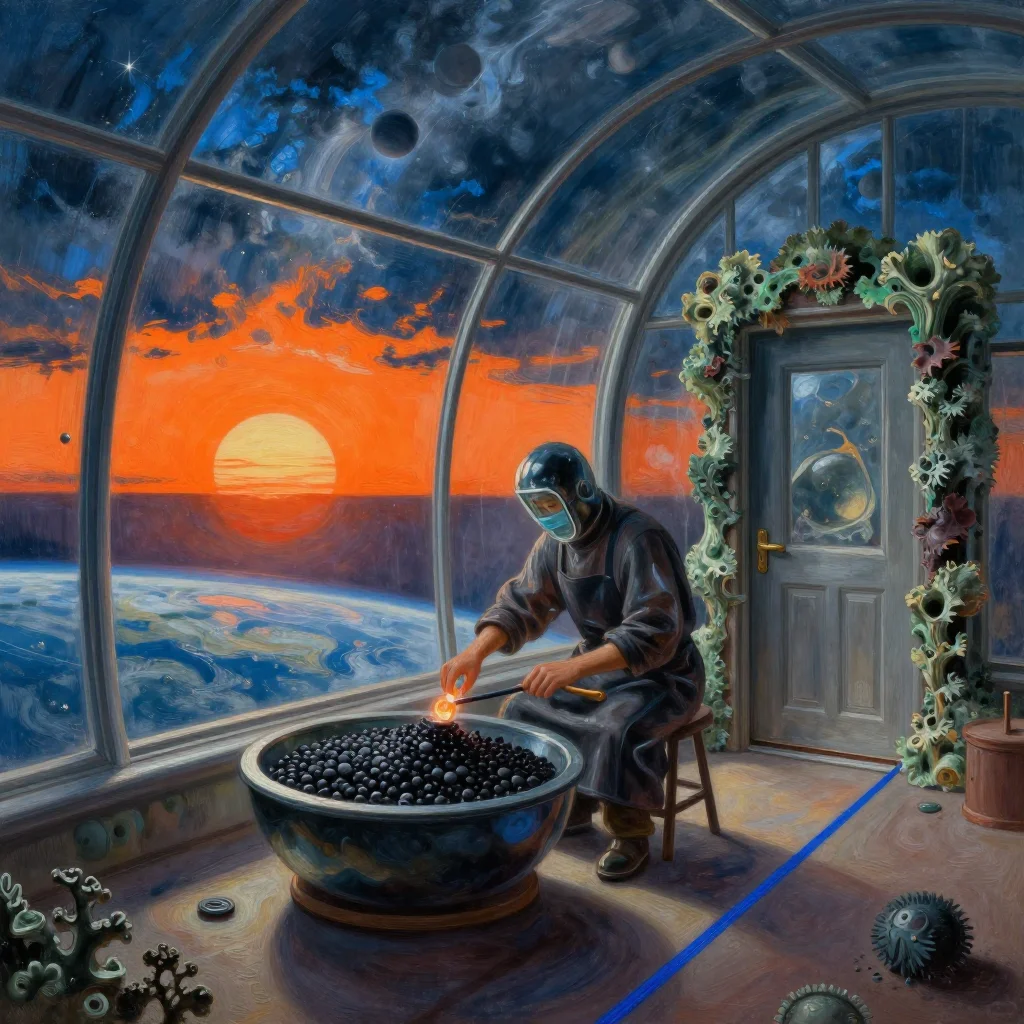
Surrealism.
The seed beneath the leaves
At dawn, the orbital greenhouse was the color of a coal that had remembered fire.
Burnt orange sunlight pressed through the curved roof. Lichen silvered the irrigation pipes. Beyond them, blue storm-light gathered along Earth’s rim, flickering without rain. The seed slept in a black basin at the greenhouse’s center, holding the genetic memory of extinct forests: cedar, ash, hornbeam, and one unnamed tree whose leaves had burned blue.
Mira Venn stood beside the seed with a blowpipe in one hand and a pane of window glass balanced on the other. She shaped windows for rooms in other worlds—small panes for a weather station on Europa, long ones for a schoolhouse on Ceres, and a circular pane for a widow who lived beneath a permanent artificial dusk.
Her own room had no view. Its wall was painted the color of an unripe pear, and each morning began with the same three sounds: the seed’s compressor, the greenhouse’s ventilation fan, and Mira’s father knocking twice.
“Leave the window open,” he called.
He said this every morning. He said it as if the window were a mouth.
Mira did not open it. She polished the glass instead, watching her breath fade across the pane.
The trail that softened
The trail appeared after the third lunar repair, beginning at the seed and ending at an unmarked door in the eastern wall.
No one remembered installing the door. It had no handle, hinges, number, or weather seal. Burnt orange lichen surrounded its frame. A blue thread lay across the floor, tied in a knot so small it looked like a stitch holding the world shut.
At first the trail was dangerous. It bent the greenhouse’s gravity by fractions. It made the seed cough up seeds that grew into trees with roots pointing upward. Anyone who followed it heard an answer to a question they had not asked.
Then the trail began to change.
Whenever everyone told the truth, it sharpened. Floor plates cracked. The blue thread tightened. The unmarked door opened onto a forest of black trunks and orange leaves.
Whenever everyone lied, the trail became safer. The floor stayed level. The trees folded themselves into shadows. The door disappeared until the next falsehood.
So the greenhouse began lying.
“The reserve tanks are full,” said the horticultist, though the gauges showed red.
“The moon is shrinking,” said the pilot, though the charts showed nothing.
“I never wanted to leave home,” said Mira’s father, standing before the unmarked door.
Mira held the blue thread beneath her thumbnail. It was warm. It pulled gently toward the door, like a leash held by an impatient animal.
Morning without a witness
At 06:12, the seed announced a storm.
Blue storm-light entered the greenhouse in a sheet. It erased the burned orange sun, drowned the lichen, and left the plants standing in silhouettes. The unmarked door opened by itself.
Behind it was no forest. Beyond it was Mira’s room: pear-colored wall, narrow bed, two cups on the table, and a window open to a sky full of stars.
Her father sat at the table. Beside him waited an unblown vessel, clear as a held breath.
“You can have the morning back,” he said.
“Which morning?”
“The one you spent making windows for people who will never know your name.”
The blue thread leapt from her hand and stitched itself through the doorframe.
Mira understood then that the trail had not been protecting the greenhouse. It had been protecting the version of events in which no one spoke aloud what they wanted. Every truth opened the way to loss. Every lie made the loss gentler until it became indistinguishable from peace.
She stepped toward the door. Her father remained seated, his face softened by the blue weather.
“I want one ordinary morning,” Mira said.
The words changed the greenhouse. The seed stopped coughing. The lichen turned pale gold. The doorframe widened, and Mira saw herself entering a room where the cups were already warm.
There, no one had lied. No one had left. The glass on the table had no scratches, and the window was open.
The work of the hands
Mira raised the blowpipe.
She had spent her life making windows for rooms in other worlds, but she had forgotten that glass is made by heat, pressure, and breath—not by truth.
She fed the blue flame into the dark seed basin. The seed warmed. The unmarked door began to close. Her father looked up.
“Don’t lie now,” Mira said.
He flinched.
She drew a single blue thread from the flame and laid it across the threshold. It did not tighten. It did not loosen. It became a seam between the ordinary room and the impossible one.
Mira blew. The air moved through the thread and made a low, human note. The pear-colored wall split into warm panels. The second cup filled. Morning entered through the open window, carrying the smell of wet soil.
Her father stood. He looked older, but less careful.
“I wanted to keep you here,” he said.
“I know.”
“I wanted the morning back.”
“Then help me make it.”
Together they opened the greenhouse door. Not the unmarked door. The real one, which led to the service ring and the stations where people waited for windows made by a stranger.
On the floor, the blue thread had become an ordinary thread. It led toward the seed.
Mira picked it up and began tying a new pane.
Behind her, the empty room faded. Ahead, the storm-light softened. And in the reflection of the unfinished glass, one ordinary morning waited for no one to steal it.





